

One. Queen Elizabeth II 1977 Silver Jubilee Medal (Canadian issue). Loose on clean length of ribbon. Unnamed as issued.
Good VF Condition $225
| One. Queen Elizabeth II 1977 Silver Jubilee Medal (Canadian issue). Loose on clean length of ribbon. Unnamed as issued. Good VF Condition $225 |
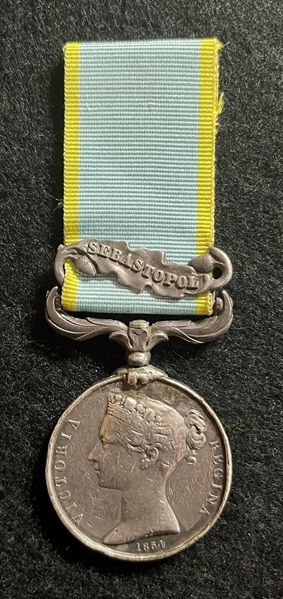 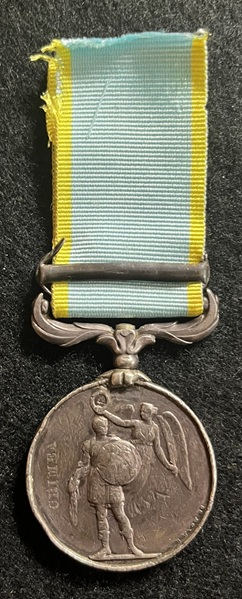 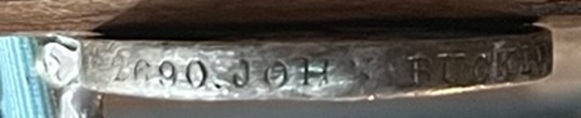 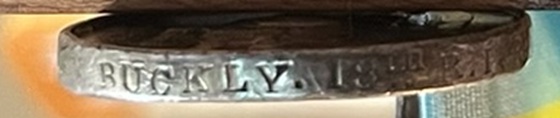   One. Crimea Medal 1854-56 with clasp SEBASTOPOL. Named in engraved capitals to 2690 JOHN BUCKLY. 18TH R.I. REGT. Well-worn with edge knocks and contacting; one ear missing from clasp. Unresearched. Loose on modern replacement ribbon. One. Crimea Medal 1854-56 with clasp SEBASTOPOL. Named in engraved capitals to 2690 JOHN BUCKLY. 18TH R.I. REGT. Well-worn with edge knocks and contacting; one ear missing from clasp. Unresearched. Loose on modern replacement ribbon. VF Condition $275 |
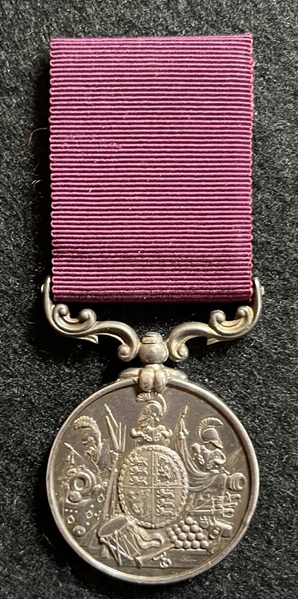 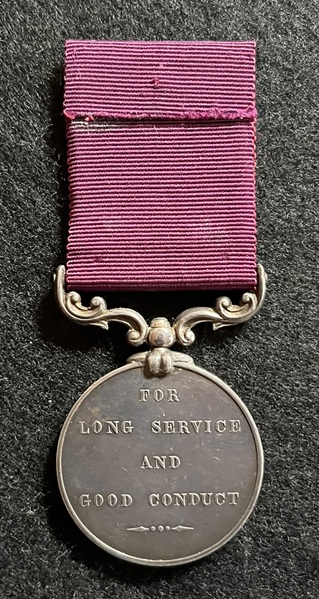 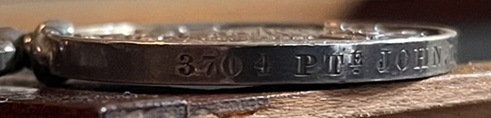 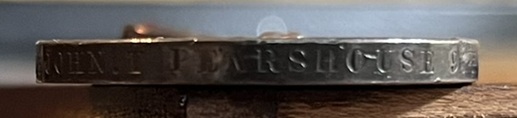 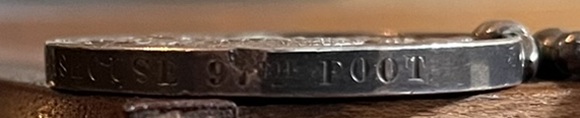 One. Army Long Service and Good Conduct Medal (VR). Named to 3704 PTE JOHN. T. PEARSHOUSE 97TH FOOT. John Thomas Pearshouse served in the 97th Regiment from 16 September 1854 to 12 October 1875. His service included 4 months in Malta, 5 months in the Crimea, and just over 7 years in the East Indies. After his release, he worked as a labourer at the Mint, according to information contained in the 1881 Census. Electronic copy of service papers and other research accompany medal. Medal is loose on piece of older ribbon. One edge knock above 97, but otherwise... One. Army Long Service and Good Conduct Medal (VR). Named to 3704 PTE JOHN. T. PEARSHOUSE 97TH FOOT. John Thomas Pearshouse served in the 97th Regiment from 16 September 1854 to 12 October 1875. His service included 4 months in Malta, 5 months in the Crimea, and just over 7 years in the East Indies. After his release, he worked as a labourer at the Mint, according to information contained in the 1881 Census. Electronic copy of service papers and other research accompany medal. Medal is loose on piece of older ribbon. One edge knock above 97, but otherwise... VF Condition $200 |
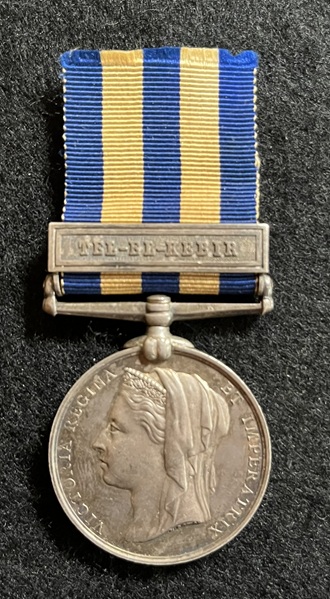 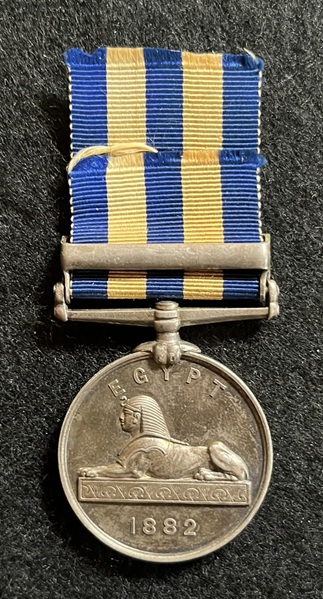  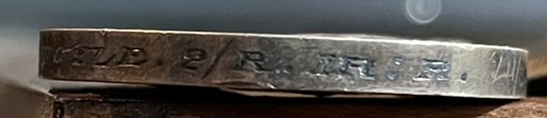 One. Egypt Medal 1882-89 with dated reverse and clasp TEL-EL-KEBIR. Named to 882 PTE. W. DOYLE. 2nd R. IR: R. Un-researched. Very faint pawnbroker's number scratched on edge afer unit name near suspender. Medal is loose on a length of faded original ribbon. One. Egypt Medal 1882-89 with dated reverse and clasp TEL-EL-KEBIR. Named to 882 PTE. W. DOYLE. 2nd R. IR: R. Un-researched. Very faint pawnbroker's number scratched on edge afer unit name near suspender. Medal is loose on a length of faded original ribbon. VF Condition $375 |
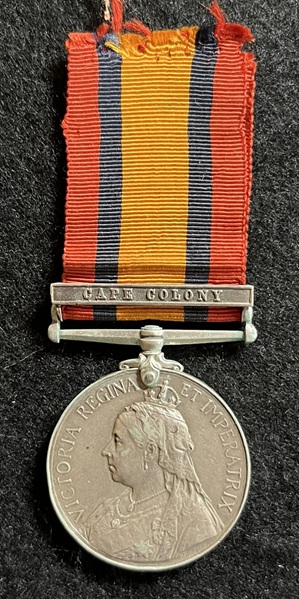 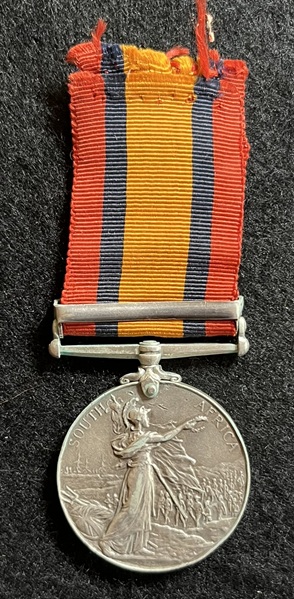  One. Queen's South Africa Medal 1899-1902 with clasp CAPE COLONY. Named to 808 PTE. J. YOUNG 1ST CITY VOLS. With copy of medal roll confirming clasp, which indicates that Young served with the First City of Grahamstown Volunteers (later re-named as Marshall's Horse), a locally raised unit in South Africa. Medal is loose on short length of slightly tattered original ribbon. One. Queen's South Africa Medal 1899-1902 with clasp CAPE COLONY. Named to 808 PTE. J. YOUNG 1ST CITY VOLS. With copy of medal roll confirming clasp, which indicates that Young served with the First City of Grahamstown Volunteers (later re-named as Marshall's Horse), a locally raised unit in South Africa. Medal is loose on short length of slightly tattered original ribbon. VF Condition $200 |
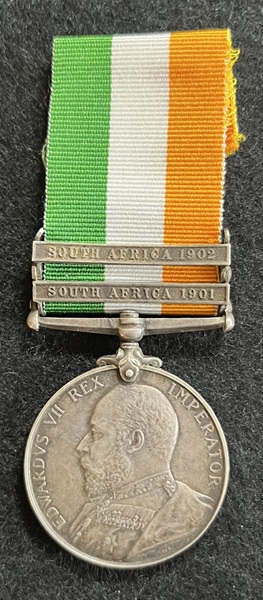 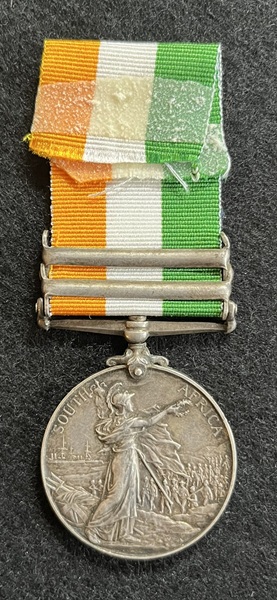 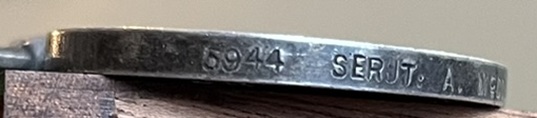 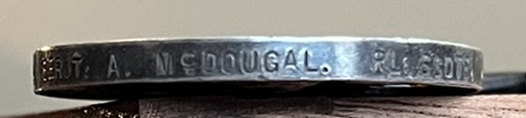 One. King's South Africa Medal 1899-1902 with clasps SOUTH AFRICA 1901, SOUTH AFRICA 1902. Named to 5944 SERJT. A. MCDOUGAL RL: SCOTS. Un-researched. Medal is loose on length of clean newer ribbon, with some tape residue on reverse. VF Condition $175 |
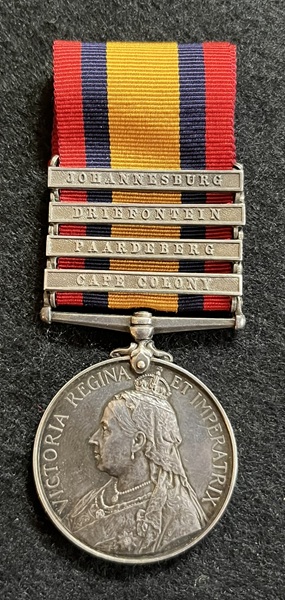 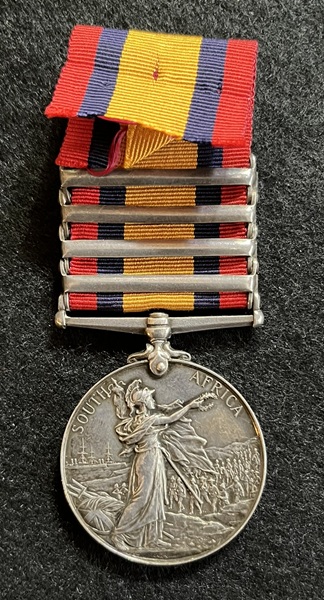 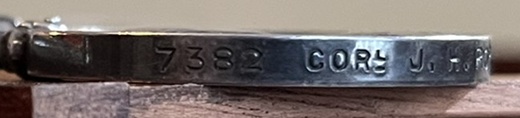 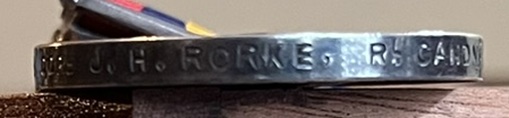  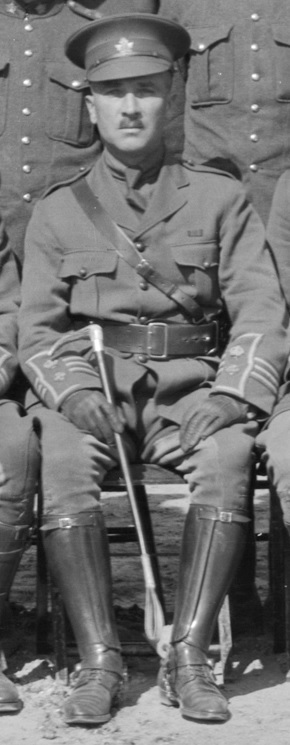 One. Queen's South Africa Medal 1899-1902 with clasps CAPE COLONY, PAARDEBERG, DRIEFONTEIN and JOHANNESBURG. Named to 7382 CORL J.H. RORKE RL CANDN: REGT. Joseph Hilliard Rorke was born on 30 November 1876 in Thornbury, Ontario. A journalist in civilian life, he was serving as a Lieutenant in the 31st (Grey) Battalion, Canadian Militia when he resigned his commission in order to enlist on 20 October 1899 as a Private in C Company, 2nd (S.S.) Bn, Royal Canadian Regiment for service in South Africa. He participated in all of the regiment's engagements overseas, being promoted to Corporal in June 1900, and he was discharged on the unit's return to Canada in early November 1900. During the First World War, Rorke was the Commanding Officer of the 248th Bn, Canadian Expeditionary Force, which he raised in Grey County between 23 September 1916 and early 1917. He deployed to England with his unit, which was understrength and ultimately broken up to provide reinforcements, before returning to Canada as a result of medical issues (gastritis) in August 1917. Medal is loose on length of clean newer ribbon. VF Condition $1500 |
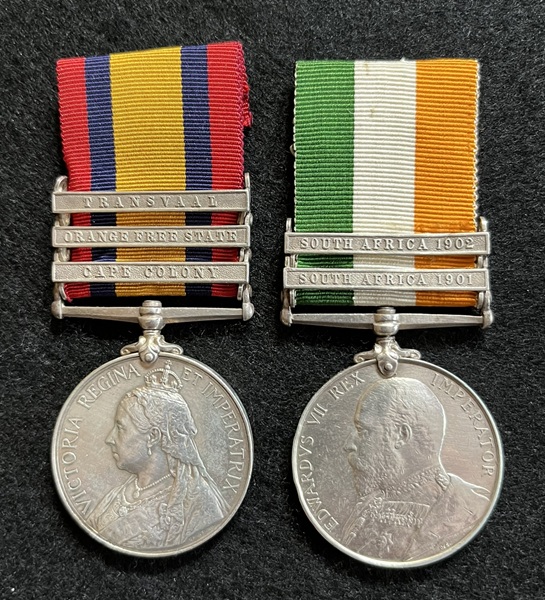 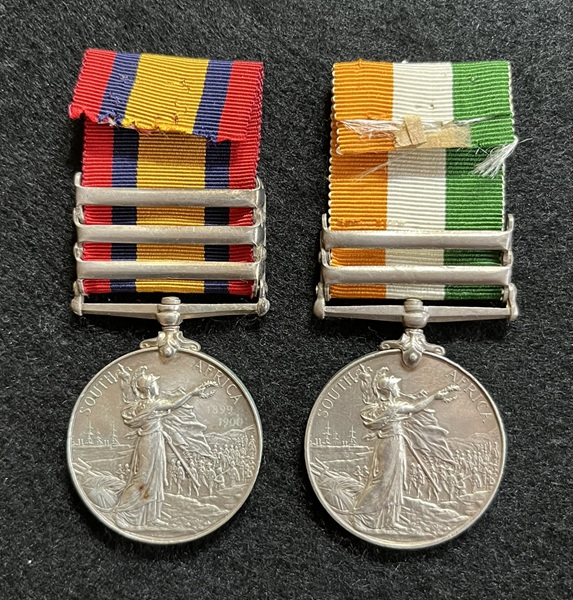 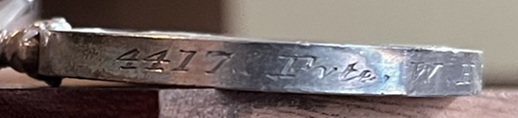 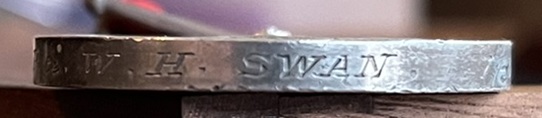 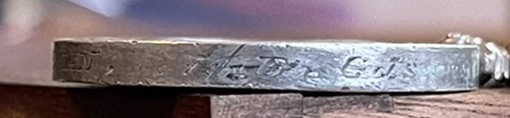 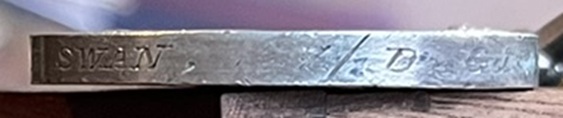 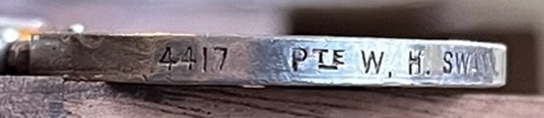  Two. Queen's South Africa Medal 1899-1902 with clasps CAPE COLONY, ORANGE FREE STATE, TRANSVAAL, and King's South Africa Medal 1901-1902 with clasps SOUTH AFRICA 1901, SOUTH AFRICA 1902. QSA named in slanted engraved capitals to 4417 Pvte. W.H. SWAN 7/Dn Gds, and KSA named in impressed capitals to 4417 PTE. W.H.SWANN. 7TH DRGN: GDS: William Henry Swann was born in St. Andrews, London, Middlesex in October 1870. He joined the 7th Dragoon Guards on a short service engagement on 9 September 1893. He was a shop assistant at the time of his enlistment, according to his two page engagement form, which confirms his surname was spelled SWANN, vice SWAN, suggesting an error in the naming of his QSA. Both medals and associated clasps are confirmed on the medal rolls. Otherwise unresearched. Good VF Condition $400 |
  Two. Family group. Father. Silver 1st Place Marksman Medal. Reverse engraved HANTS COUNTY WON BY I. J. BARNHILL 30th OCTr 1867. Isaac Logan Barnhill ( father of Jacob Lynds Barnhill ) was born 23 May 1836 in Belmont, Colchester County, Nova Scotia and moved as a young man to Shubenacadie, Hants County, Nova Scotia. He was a long serving militia man in the Hants County area. He served as a Sergeant in 1866 with the Shubenacadie Volunteer Company and was awarded the Canada General Service Medal with clasp Fenian Raid 1866 for his service. The 1885 Militia List shows him as a Captain with the 78th Colchester /Hants /Pictou Battalion. Barnhill passed away on 10 January 1911 and his obituary (copy included with medal) documents his skill as a marksman. He travelled to England with the Canadian team to international shooting events at Wimbledon and Bisley on three occasions, and was twice a member of the Canadian team that won the Kolapore Cup. It appears that this medal was won at the yearly match of the Nova Scotia Rifle Association, which traces its origins back to 1861. Son. Colonial Auxiliary Force Officers' Decoration (VRI). Named to CAPTAIN J. L. BARNHILL 78th REGIMENT. Jacob Lynds Barnhill was born in Shubenacadie, Nova Scotia in 1859. He started his career as a teacher and joined the 78th Regiment (Colchester - Hants - Pictou Battalion of Infantry) in 1885. Period Militia lists show him as a 2nd Lieutenant with the unit in 1885, and indicate he was still serving as a Major in 1909. His name does not appear in the 1911 list; of note, the 78th was split into the 76th Colchester and Hants Rifles and 78th Pictou Highlanders in 1910, and it appears that Barnhill retired from militia service around this time. He was awarded his decoration on 11 June 1904, in General Order 83, page 247. In civilian life Barnhill became a lawyer, being admitted to the Bar in May 1884. He became very prominent in the legal profession in Halifax, Nova Scotia, as evidenced by his lengthy obituary, a copy of which accompanies the decoration. Barnhill passed away in November 1941. He is interred in Camphill Cemetery, Halifax, Nova Scotia. Good VF Condition $1750 |
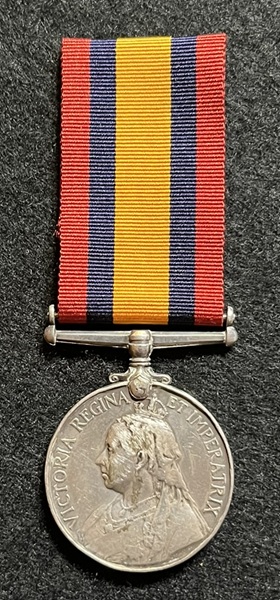 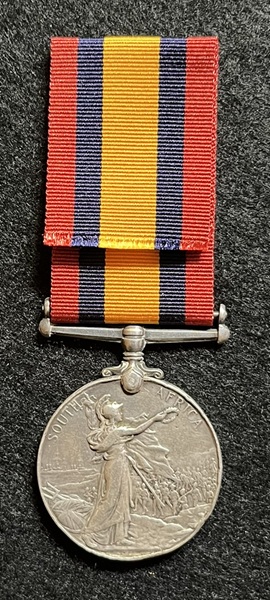 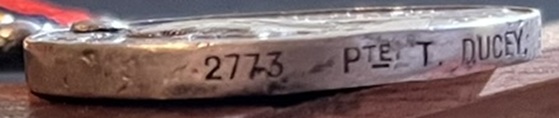  One. Queen's South Africa Medal 1899-1902. Named to 2773 PTE. T. DUCEY. K.R.R.C. With copy of medal roll indicating entitlement to clasps for Cape Colony and Orange Free State, which are not with the medal. Ducey died of disease on 3 April 1900 at Naauw Poort while serving with the 9th KRRC. Medal has had the suspension re-pinned, and it is badly edge-knocked, thus... Fair Condition $150 |
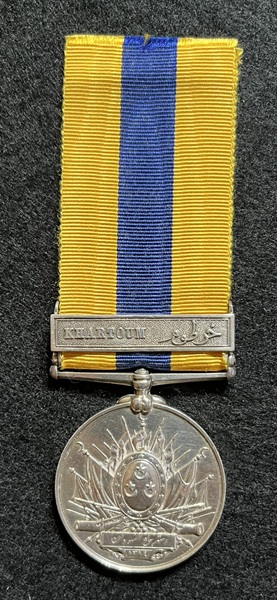  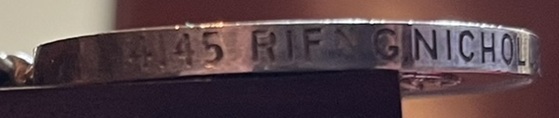 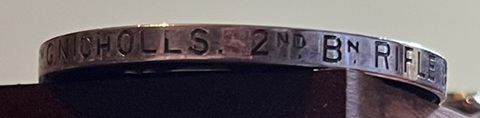 One. Khedive's Sudan Medal with clasp KHARTOUM. Named to 4145 RIFN G. NICHOLLS. 2ND BN RIFLE BDE in engraved capital letters. Unresearched. Loose on clean modern ribbon. VF Condition $500 |
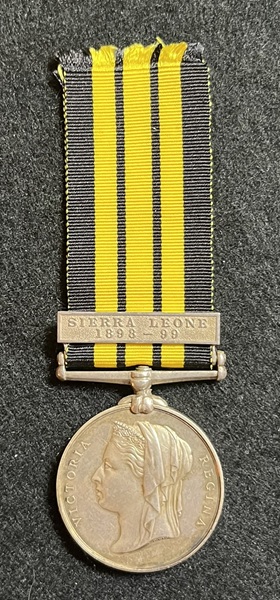 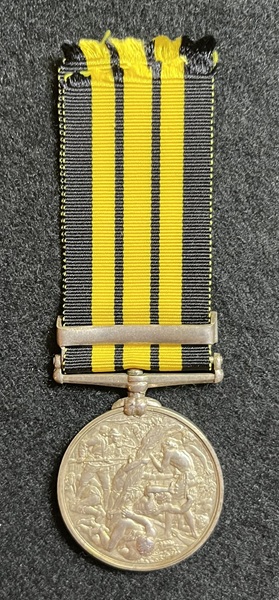 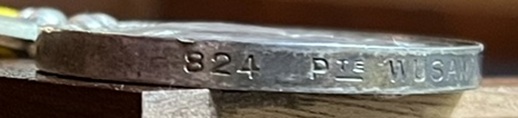 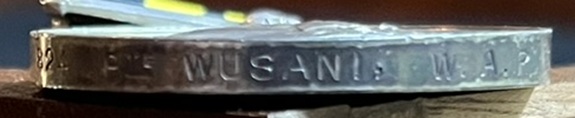 One. East & West Africa 1887-1900 with clasp Sierra Leone 1898-99. Named to 824 PTE WUSANI, W.A.R. VF Condition $475 |
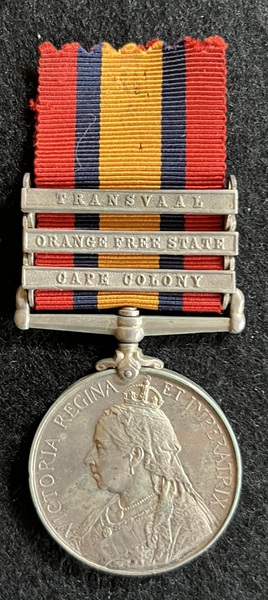 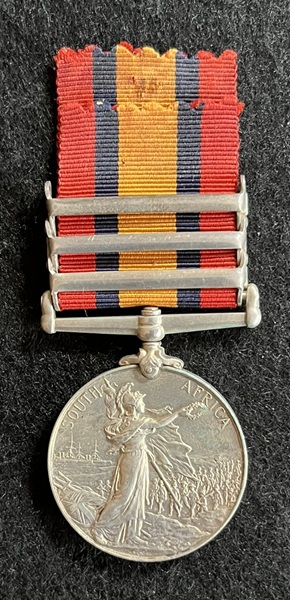 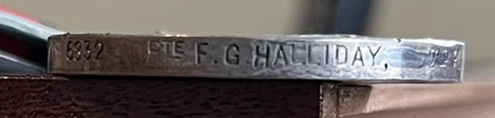 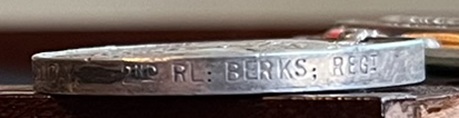 One. Queen's South Africa Medal 1899-1902 with clasps CAPE COLONY, ORANGE FREE STATE, TRANSVAAL. Named to 6832 PTE. F.G. HALLIDAY. 2ND RL: BERKS: REGT. Un-researched. Medal is loose and unmounted on short length of older ribbon. Good VF Condition $250 |
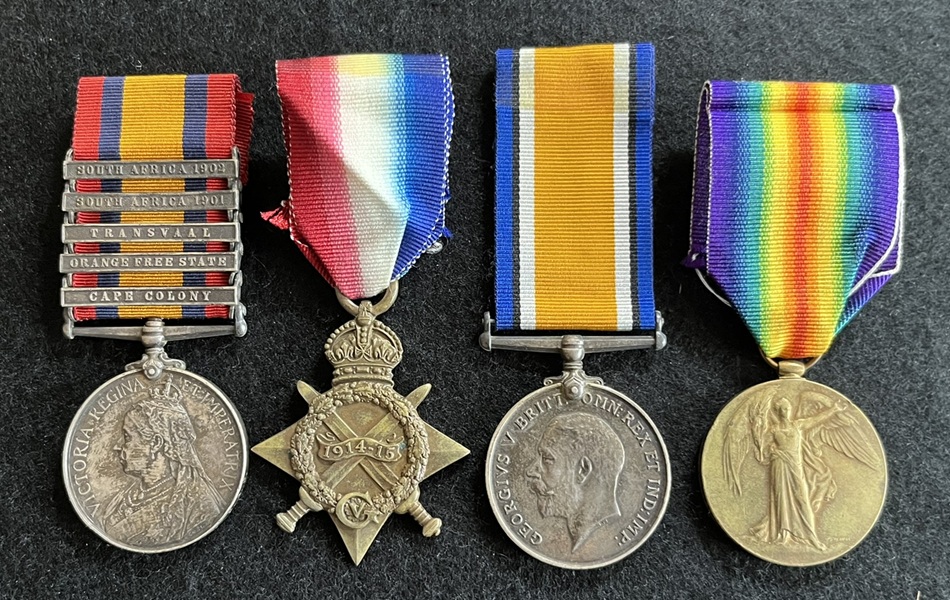 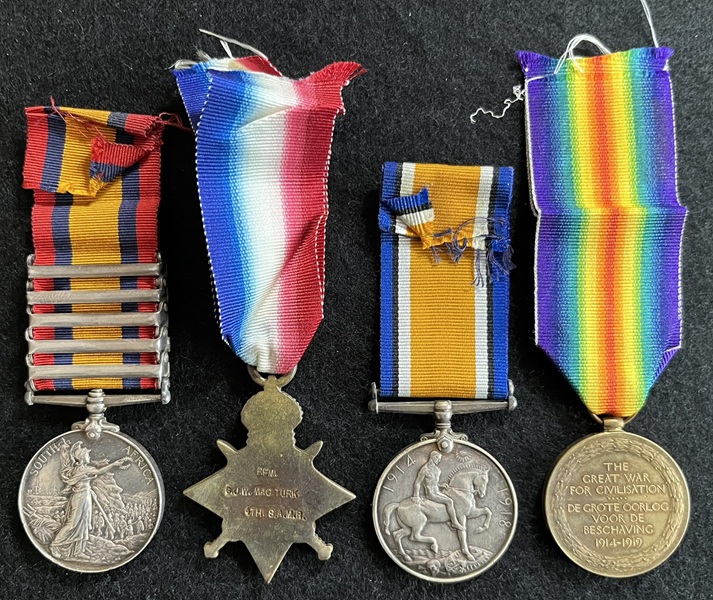 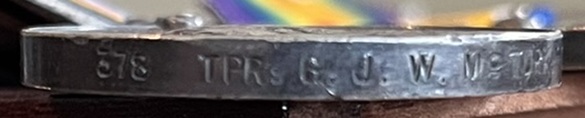   Four. Queen's South Africa Medal 1899-1902 with clasps CAPE COLONY, ORANGE FREE STATE, TRANSVAAL, SOUTH AFRICA 1901, SOUTH AFRICA 1902, 1914-15 Star, British War Medal 1914-20, and Victory Medal. QSA named 378 TPR. G.J.W. MCTURK. S.A.C., and trio named RFM. G.J.W. MCTURK 4TH S.A.M.R. With electronic copy of medal roll entries for QSA and clasps, but otherwise un-researched. Previously sold in Jeffrey Hoare Sale #58, 21 Februsry 1998, as lot# 2187. Medals are loose on modern ribbons. Good VF Condition $550 |
    One. King's South Africa Medal 1899-1902 with clasps SOUTH AFRICA 1901, SOUTH AFRICA 1902. Named to 10967 DVR. G. STUART. A.S.C.. Un-researched. Medal is unmounted with older original quality ribbon. Some edge knocks but otherwise... VF Condition $140 |
    One. Queen's South Africa Medal 1899-1902 with clasps CAPE COLONY, ORANGE FREE STATE, TRANSVAAL. Named to 71913 GNR: C. MACKIE. 14:S.D, R.G.A. Un-researched. Loose on clean older ribbon. EF Condition $225 |
    One. Queen's South Africa Medal 1899-1902 with clasp ORANGE FREE STATE. Named to 5380 PTE. J. WHITE. RL: LANC: REGT. Copy medal roll with the medal indicates that White served with the 3rd Bn Rl Lanc Regt and was also entitled to the clasp 'CAPE COLONY'. Otherwise un-researched. Loose on modern ribbon with tape residue on reverse, one large EK near name of unit. VF Condition $200 |
  One. India General Service Medal 1854-95 with clasp PEGU. Un-named. Loose on older faded original ribbon. Un-researched. Good VF Condition $250 |
    One. Royal Navy Long Service and Good Conduct Medal(VR). Named to E.T.J. TURNER H.M.S. COAST GUARD. Turner was also entitled to a British War Medal for his Coast Guard service during the Great War, and he was promoted to the rank of Chief Petty Officer in 1915. On short length of worn original ribbon. Good VF Condition $240 |
   One. Queen's South Africa Medal 1899-1902 with clasp CAPE COLONY. Named to 3327 PTE. J. DAVIS. DERBY: REGT. Un-researched. Loose on short piece of modern ribbon. Good VF Condition $200 |
   One. Royal Canadian Humane Association Medal. Engraved on reverse "Awarded to Gilbert Gilmour for conspicuous courage in saving a man from drowning in the River St Lawrence in September 1903". Accompanied by copies of some period newspaper clippings from the Montreal Gazette of 3 September and 24 December 1903, which describe the circumstances of Gilmour's act of bravery. The rescue for which he received this award took place on 2 September 1903 near Longue Pointe in Montreal's East End. Gilmour was in a rowing skiff at the time of the incident, and spent about 15 minutes rescuing the man, who had suffered from cramps while bathing nearer to shore and had been swept downstream. The drowning man resisted Gilmour's attempts to save him, striking the latter in the face at one point with his elbow and almost knocking him unconscious. Gilmour apparently saved another man from drowning sometime in the previous month, and the rescue for which this medal was awarded was his fifth. Medal suspender is loose and moves freely around the circumference of the medal, and could benefit from being crimped. The medal is missing its ribbon, and has some verdegris on the obverse, but is otherwise in ... F Condition $875 |
    One. King's South Africa Medal 1899-1902 with clasps SOUTH AFRICA 1901 and SOUTH AFRICA 1902. Named in impressed capitals to 3635 PTE. J. KAY. SCOT: RIFLES. Un-researched. Court-mounted on card on clean newer ribbon. Good VF Condition $150 |
    One. India General Service Medal 1854-1895 with clasp BURMA 1885-87. Named to 770 Pte. J. Davies 1st Bn R.W. Fus. in engraved running script. Un-researched. Loose on older silk ribbon. Good VF Condition $250 |
    One. Queen's South Africa Medal 1899-1902 with clasps CAPE COLONY, ORANGE FREE STATE, TRANSVAAL. Named to 79616 GNR. A.H. WOOD. 6TH E.D., R.G.A. in impressed capitals. Service number officially corrected. Unresearched. Medal is loose on clean new ribbon. Good VF Condition $175 |
   Two. Queen's South Africa Medal 1899-1902 with clasps CAPE COLONY, ORANGE FREE STATE, TRANSVAAL, SOUTH AFRICA 1901 and SOUTH AFRICA 1902 and British War Medal 1914-20. Named to 4799 PTE. W. NIGHTINGALE. 7TH HUSSARS on QSA, and to 228862 A. SJT. W. NIGHTINGALE 92-CAN. INF. on BWM. William Nightingale was born 1 March 1881 in Middlesex, England. He was married and working as a coachman in Montreal when he joined the 1st Reinforcing Company, 5th Royal Highlanders of Canada at Montreal on 21 August 1916. He noted on enrollment that he had served 8 years with the 7th Hussars, and an additional 4 years in the Reserves. Nightingale served in the 92nd Battalion CEF in England only, and the BWM represents his full medal entitlement for his First World War service. His service with the 7th Hussars is unresearched. Medals are loose and unmounted on older ribbons. Good VF Condition $475 |
    Two. Queen's South Africa Medal 1899-1902 with clasps TRANSVAAL, SOUTH AFRICA 1902, and British War Medal 1914-20. Named to 171 PTE. A. BERRY. CANADIAN M.R. on QSA, and to 190174 PTE. A.E. BERRY 91-CAN. INF. on BWM. Albert Edward Berry as born in St. Thomas, Ontario on 31 October 1880. He stated on attestation to the Canadian Expeditionary Force that he had previously served in the 3rd Battalion of the Royal Canadian Regiment for a year, and the 2nd Canadian Mounted Rifles, serving in South Africa for one year. He earned the Queen's South Africa Medal for the latter service. On his enrollment in the Canadian Expeditionary Force, Berry gave his civilian trade as 'woodturner', and also noted that he had served in the 25th Elgin Regiment for 10 years, holding the rank of Sergeant. He was married, and his wife, Mrs. Eulia Berta Berry, was living at 53 West Avenue in St. Thomas, with their three children, when he attested in the 91st Battalion on 24 March 1916. Berry arrived in England in July 1916, but medical issues (rheumatoid arthritis in his right hip and knee) led to him being medically discharged and returned to Canada in October 1916, with the BWM his full medal entitlement for his service. Medals are loose and unmounted on relatively clean older ribbons; the QSA has been plated, and the BWM silvered. Good VF Condition $1050 |
   Three. Military Medal (GV), British War Medal and Victory Medal. Named to 871283 PTE - A.SJT. E.B. SHEILDS 43/MAN. R. on MM, and to same number, rank, initials and but last name spelled SHIELDS and unit shown as 43-CAN.INF. on pair. Ernest Battell Shields was born in Moose Jaw, Saskatchewan on 22 August 1887. He was a carpenter/builder in civilian life, and enlisted in Winnipeg, Manitoba in the 183rd Battalion CEF on 25 February 1916, indicating previous membership in the Legion of Frontiersmen. After a period of time spent with reserve formations in England, with his passage to the front delayed by medical issues (concussion deafness), he reached the 43rd Battalion in France on 21 July 1918. While with the 43rd, Shields would have participated in the battle of Amiens, which began on 8 August 1918, and saw the battalion penetrate two miles into enemy territory. The battalion also participated in the battle of Arras (27 August), the breaking of the Drocourt-Queant Line (2 September), and the crossing of the Canal Du Nord between 27 September and 1 October, when the 43rd captured the village of Tilloy and the high ground overlooking Cambrai from the north. Shields was awarded the Military Medal in Canadian Corps Order 1899 on 11 September 1918, later being recorded in London Gazette 31173 of 11 February 1919. There is no recorded citation documenting the circumstances surrounding his MM award. Shields was killed in action on 1 October 1918 during the fighting at Tilloy, and he is buried in Millswitch British Cemetery, Tilloy-les-Cambrai, France. Group includes a Statement of Service document from Library and Archives Canada, produced on 20 March 1986, as well as the original card which accompanied the Memorial Cross sent to his next of kin (the cross is regrettably not with the group). Group is court mounted on newer ribbons, and lacquered. Good VF Condition $1150 |
   One. Distinguished Conduct Medal (GV). Named to 13149 LCPL. J. SHARPLES. 2/COY CAN: M.G.C. John Sharples was born in Blackburn, England on 26 April 1896. He indicated his profession on enlistment as 'locomotive fireman'. After enlisting in Saskatoon, Saskatchewan, he attested into the 5th Battalion CEF on 21 September 1914 at Valcartier. His service record indicates that he had previously served in the 29th Light Horse, which was based in Saskatchewan; he had also served for 2 years in the British Army, as a member of the 2nd Volunteer Battalion of the East Lancashire Regiment. Sharples joined the 5th Bn in France on 14 May 1915, and served with the latter unit until he was transferred to the 2nd Canadian Infantry Brigade Machine Gun Company on 20 June 1916. Accidentally wounded on 11 September 1916, when he tripped in a trench near Pozieres after cleaning his machine gun, and impaled himself with a cleaning rod that went through the side of his face, he rejoined his unit on 18 November. Sharples was promoted to Lance Corporal on 11 May 1917. Wounded by a gas shell in mid-August 1917 (likely at the battle of Hill 70), Sharples was hospitalized with shrapnel wounds to his hand and the effects of gassing. He rejoined his unit again by 3 October 1917, and was back in action during the battle of Passchendaele, where his gallantry resulted in the award of the Distinguished Conduct Medal, which was published in London Gazette on 28 March 1918. His citation states: For conspicuous gallantry and devotion to duty in action. Early in the day he was left alone with his gun, the remainder of his crew becoming casualties. He mounted it in a commanding position, and kept it in action throughout two whole days, and until he himself became a casualty, and was removed suffering from a concussion. Sharples service file indicates that he received his concussion wound, as well as a wound to his right thigh, in action on 11 November 1917, which suggests that his DCM was earned during the battle of Passchendaele between 9-11 November 1917. Sharples indicated his intent after discharge was to settle in Sutherland, Saskatchewan. He was discharged from the CEF on 8 May 1919 in Toronto. Medal is on clean original ribbon, and is unmounted. An excellent gallantry award for the Battle of Passchendaele to a twice-wounded soldier from Saskatchewan, one of only 1984 awards of the DCM to the CEF during the First World War. Good VF Condition $2000 |
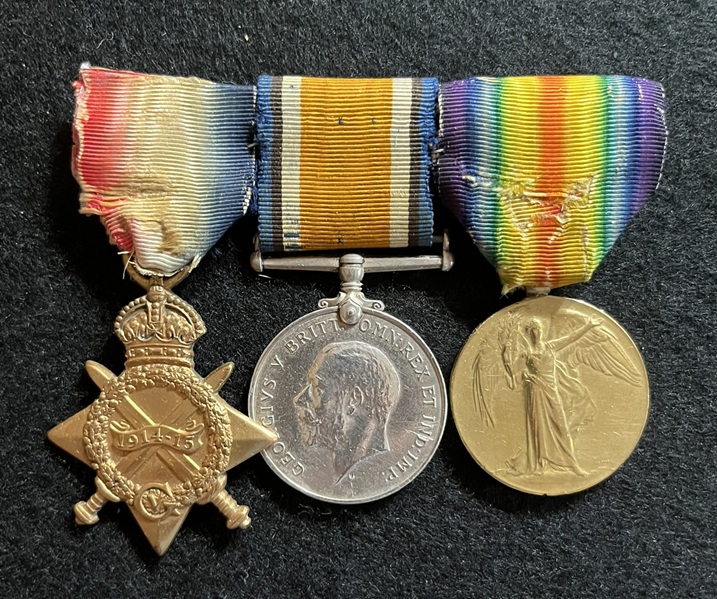 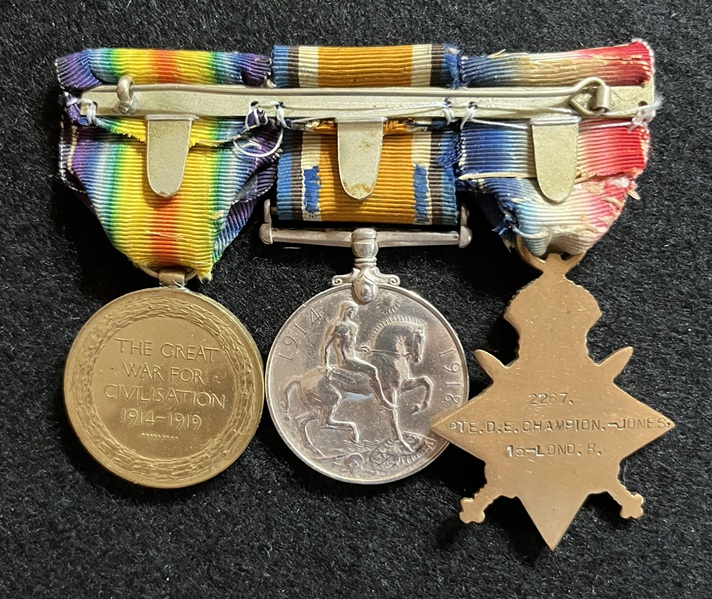  Three. 1914-15 Star, British War Medal 1914-20 and Victory Medal. Star named 2267 PTE. D.E. CHAMPION-JONES. 15-LOND.R. and pair named CAPT. D.E. CHAMPION-JONES. Swing mounted as worn on older frayed ribbons. Medal index card indicates that Douglas Ernest Champion-Jones served in France from 17 March 1915; he was commissioned into the 22nd London Regiment. Medals swing mounted as worn on frayed original ribbons. Three. 1914-15 Star, British War Medal 1914-20 and Victory Medal. Star named 2267 PTE. D.E. CHAMPION-JONES. 15-LOND.R. and pair named CAPT. D.E. CHAMPION-JONES. Swing mounted as worn on older frayed ribbons. Medal index card indicates that Douglas Ernest Champion-Jones served in France from 17 March 1915; he was commissioned into the 22nd London Regiment. Medals swing mounted as worn on frayed original ribbons. Good VF Condition $450 |
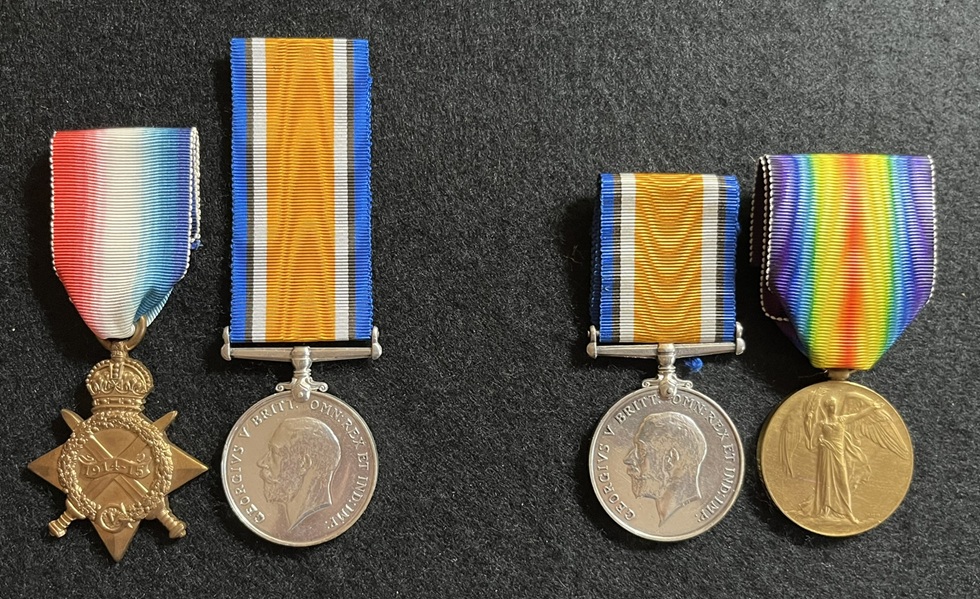 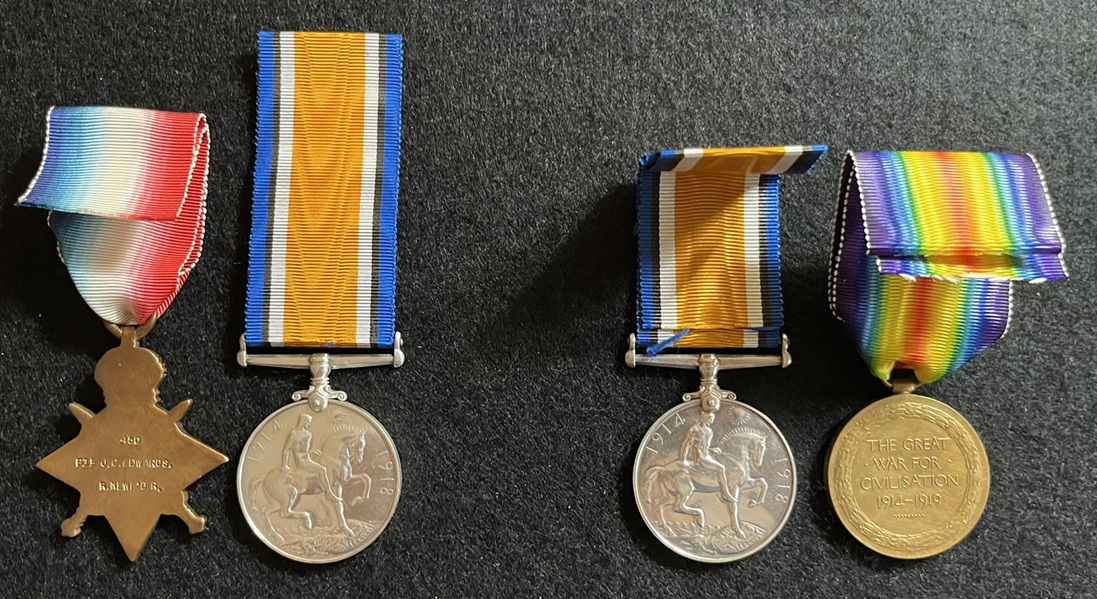  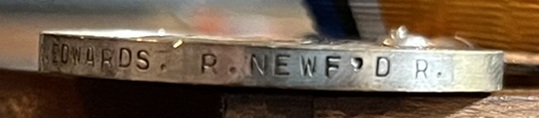   Family group. First brother. Two. 1914-15 Star and British War Medal 1914-20. Named 450 PTE. J.C. EDWARDS. R. NEWF'D. R. John Charles Edwards was a 20 year old painter living in St. Johns, Newfoundland when he joined the 1st Newfoundland Regiment on 8 September 1914.He was a member of the first group of men who answered the call to service, colloquially known as the "First 500 " and the "Blue Putties", a nod to their distinctive dress. Although the Newfoundland Government originally intended to provide only 500 men for the Regiment, by war's end over 6,000 men had served in its ranks. The 1st Newfoundland Regiment sailed for England on 3 October 1914. It trained in England and Scotland before deploying to join the British Mediterranean Expeditionary Force in Alexandria, Egypt on 1 September 1915. Less than two weeks later, on 13 September 1915, Edwards landed with his regiment at Gallipoli. Given the appalling conditions there, many men became ill as their time on the peninsula wore on, including Edwards, who was evacuated with jaundice around the time that the unit left, on 26 November 1915. He rejoined the unit on 1 March 1916 at Suez. The Newfoundland Regiment joined the British Expeditionary Force in France on 14 March 1916. Edwards was severely wounded (gunshot to head) in action on the Somme at Beaumont Hamel, France on 1 July 1916, and invalided back to England by hospital ship. He was admitted to the Royal Victoria Hospital, Netley, England on 5 July 1916 where he died of his wounds on 21 July 1916. He was buried at Wandsworth Cemetery, London, England. Medals are accompanied by hard copies of service records and a picture of Edwards from the CVWM. Second brother. Two. British War Medal 1914-20 and Victory Medal. Named to 2287 PTE. A.J. EDWARDS R. NEWF'D. R. Alphonsus J. Edwards (brother to John Charles) was a 19 year old painter living in St. Johns, Newfoundland when he joined the 1st Newfoundland Regiment on 23 March 1916. He sailed for England on 28 August 1916, joining the Regiment on 12 December 1916. Edwards contacted dysentry in France on 7 February 1917 and was invalided to England, rejoining the unit after recuperating on 18 August 1917. During the Battle of the Lys in April 1918, Edwards received a shell wound to the head on 19 April 1918 and died of his wounds on 5 May 1918 at the 2nd Australian General Hospital in Boulogne. He is buried at the Commonwealth War Graves Commission's Boulogne Eastern cemetery, Pas de Calais, France. Medals are accompanied by hard copy excerpts of service records. A poignant group to two brothers from Newfoundland who each fell in service. Family group. First brother. Two. 1914-15 Star and British War Medal 1914-20. Named 450 PTE. J.C. EDWARDS. R. NEWF'D. R. John Charles Edwards was a 20 year old painter living in St. Johns, Newfoundland when he joined the 1st Newfoundland Regiment on 8 September 1914.He was a member of the first group of men who answered the call to service, colloquially known as the "First 500 " and the "Blue Putties", a nod to their distinctive dress. Although the Newfoundland Government originally intended to provide only 500 men for the Regiment, by war's end over 6,000 men had served in its ranks. The 1st Newfoundland Regiment sailed for England on 3 October 1914. It trained in England and Scotland before deploying to join the British Mediterranean Expeditionary Force in Alexandria, Egypt on 1 September 1915. Less than two weeks later, on 13 September 1915, Edwards landed with his regiment at Gallipoli. Given the appalling conditions there, many men became ill as their time on the peninsula wore on, including Edwards, who was evacuated with jaundice around the time that the unit left, on 26 November 1915. He rejoined the unit on 1 March 1916 at Suez. The Newfoundland Regiment joined the British Expeditionary Force in France on 14 March 1916. Edwards was severely wounded (gunshot to head) in action on the Somme at Beaumont Hamel, France on 1 July 1916, and invalided back to England by hospital ship. He was admitted to the Royal Victoria Hospital, Netley, England on 5 July 1916 where he died of his wounds on 21 July 1916. He was buried at Wandsworth Cemetery, London, England. Medals are accompanied by hard copies of service records and a picture of Edwards from the CVWM. Second brother. Two. British War Medal 1914-20 and Victory Medal. Named to 2287 PTE. A.J. EDWARDS R. NEWF'D. R. Alphonsus J. Edwards (brother to John Charles) was a 19 year old painter living in St. Johns, Newfoundland when he joined the 1st Newfoundland Regiment on 23 March 1916. He sailed for England on 28 August 1916, joining the Regiment on 12 December 1916. Edwards contacted dysentry in France on 7 February 1917 and was invalided to England, rejoining the unit after recuperating on 18 August 1917. During the Battle of the Lys in April 1918, Edwards received a shell wound to the head on 19 April 1918 and died of his wounds on 5 May 1918 at the 2nd Australian General Hospital in Boulogne. He is buried at the Commonwealth War Graves Commission's Boulogne Eastern cemetery, Pas de Calais, France. Medals are accompanied by hard copy excerpts of service records. A poignant group to two brothers from Newfoundland who each fell in service. VF Condition $2200 |
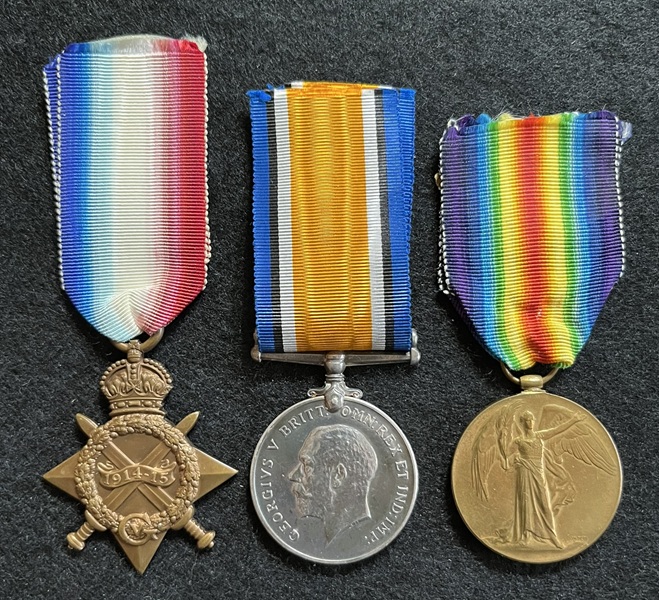 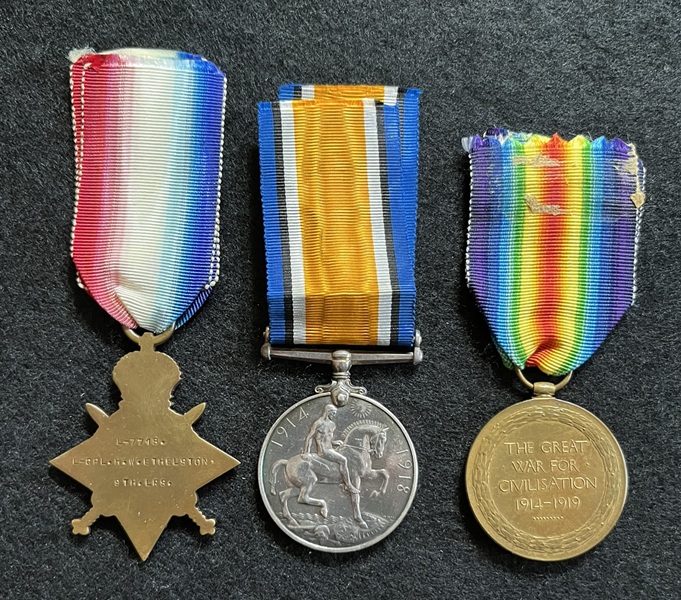  Three. 1914-15 Star, British War Medal 1914-20 and Victory Medal. Star named to L-7718. L-CPL. H.W. ETHELSTON. 9TH. LRS.; BWM/Victory same number, name but rank CPL, unit 9-LRS. Medal index card confirms awards, and indicates Harold W. Ethelston served in France from 1 June 1915. Medals are loose on clean modern ribbons. Good VF Condition $300 |
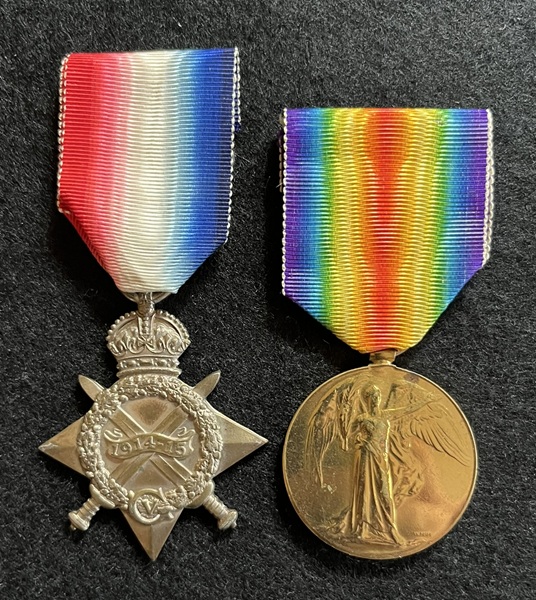 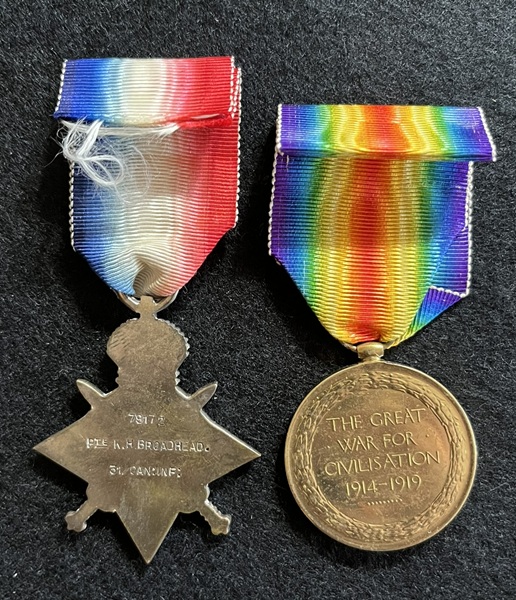 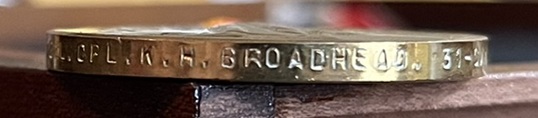 Two. 1914-15 Star and Victory Medal. Named to 79172 PTE. K.H. BROADHEAD, 31/CAN: INF: on Star, and to same number, named but rank L. CPL., unit 31-CAN.INF. Keith Harris Broadhead was killed in action at Hooge, Belgium on 6 June 1916, at the age of 25. He is commemorated on the Commonwealth War Grave Commission's Menin Gate Memorial, Ypres, Belgium. Broadhead's 1914-15 has been gilded, and this is slightly worn on the high points; each medal is on a piece of clean original ribbon. Good VF Condition $275 |
    Five. Family group. Son - Three. 1914-15 Star, British War Medal 1914-20 and Victory Medal. Named to 9820 PTE. F. PEARCE 3/CAN: INF: on Star, and to same number, name but rank A. SJT., unit 3-CAN. INF. on pair. Father - Two. British War Medal 1914-20 and Victory Medal. Named to 833 PTE. F. PEARCE C.M.G. BDE. Notes with group indicate father (Frank Pearce Sr) was wounded and briefly recorded as missing while serving with Eaton's Motor Machine Gun Battery on 3 June 1916 at Ypres, when he was buried by a shell, which resulted in him being sent home and medically released the next month. Son (Frank Pearce Jr) was wounded on 18 September 1915 by dust fron a shell explosion which injured both eyes, resulting in treatment in England. Both groups plated and court mounted on clean older ribbons. Good VF Condition $450 |
    Four. 1914-15 Star, British War Medal 1914-20, Victory Medal and Meritorious Service Medal (GV). Star named to T-689 DVR. W. DRUMMOND, A.S.C., pair named with service number 689, and same rank, name, unit, and MSM named T4-237254 DVR. W. DRUMMOND. 51/HIGH: D.T. A.S.C. William Drummond was from Lochearnhead, Scotland. His MSM naming indicates service in the 51st Highland Division, which was made up of Terrritorial Force (mainly Highland) units including the Seaforth Highlanders, Cameron Highlanders, Argyll & Sutherland Highlanders, and the Gordon Highlanders. Drummond was awarded the MSM " in recognition of valuable services rendered with the Forces in France during the present war ", and it was recorded in the London Gazette of 17 June 1918. Drummond emigrated to Canada after the war, his obituary noting that he passed away in Kentville, Nova Scotia in September 1974, aged 81. Group is accompanied by a hard copy research file that includes Drummond's Medal Index Card, the London Gazette entry announcing his award of the MSM, and an obituary. More research possible; medals are loose and unmounted on clean modern ribbons. Good VF Condition $525 |
    Three. 1914-15 Star, British War Medal 1914-20, and Victory Medal. Named to 106004 PTE A. BARRETT. 1/CAN.MTD.RIF. on Star, and to same number, name, but rank A.L.CPL. and unit 1-C.M.R. on pair. Alexander Barrett was born in Belfast, Ireland on 30 November 1880. A plumber in civilian life, he claimed 18 months previous service in the Imperial Yeomanry when he enrolled in the 1st Canadian Mounted Rifles at Winnipeg, Manitoba on 13 Janaury 1915. Barrett arrived in England 15 June 1915, proceeding to France on 22 September 1915 with the 1st CMR. He was transferred to the 2nd CMR on 10 January 1916, and then to the Military Mounted Police, 3rd Canadian Division HQ, in February 1916. He appears to have not been a good fit in this role, as his record notes he was transferred back to 2nd CMR from the MMP on 31 August 1916, the request for this being signed by Barrett who appended his signature with the words 'under protest'. Barrett received a gunshot wound to the right arm on 11 October 1916, and was returned to England to convalesce; he spent time at the Canadian Reserve Cavalry Regiment before being returned overseas to France for duty, joining the Fort Garry Horse in France on 7 December 1917. Barrett was wounded again on 30 January 1918, a bomb wound to the face which affected his forehead and nose, and this ended his service at the front. Medals loose on clean original ribbons. Group is accompanied by an original set of 4 CEF cloth service stripes, two wound stripes in brass with backing plates, two CEF general service buttons, and a CEF Class A War Service Badge numbered 168271 on reverse. Good VF Condition $550 |
   Four. 1914-15 Star, British War Medal 1914-20, Victory Medal and Royal Fleet Reserve Long Service Medal (GV). Star named 208388 F.L. EVANS, A.B. R.N., pair same number, name but rating L.S., and Long Service named 208388 (P.O. A. 7299) F.L. EVANS P.O. R.F.R. With copy service record indicating Evans served on HMS Fearless at Jutland. Good VF Condition $250 |
   Two. 1914-15 Star and British War Medal. Star named to LT. A.T. HILL CAN: A.S.C., and BWM named to MAJOR A.T. HILL. Arthur Torrens Hill was from Quebec City, Quebec, and had pre-war service in the 8th Royal Rifles, the Army Medical Corps and the Army Service Corps when he joined the 2nd Divisional Train, CEF as a Lieutenant on 25 February 1915. He proceded overseas in September 1915, and transferred to the Canadian Forestry Corps (CFC) in December 1916, serving in France as a Captain and Acting Major while in command of 24th Company CFC. Medals are loose with clean ribbons, the Victory Medal ribbon of modern manufacture. Good VF Condition $175 |
     Three. 1914-15 Star, British War Medal 1914-20, and Victory Medal. 1914-15 Star named 112159 TPR. R. WICK. 2/CAN: DIV: CAV:, and pair named with same number, name, but rank PTE., unit CAN.CAV. BDE. Reginald Wick was born 25 October 1895 in Hull, England. He was a farmer and a member of the 19th Regiment of the Canadian Militia in St. Catherines, Ontario when he enlisted in the 7th Regiment Canadian Mounted Rifles in London, Ontario on 9 February 1915. He arrived in the United Kingdom on 22 June 1915, and embarked for France with his unit, which became the 1st Hussars Special Service Squadron, and acted as the 2nd Canadian Division's Cavalry Squadron, on 15 September the same year. Wick was attached to the 2nd Canadian Division Signal Company for duty on 2 October 1915, returning to his unit on 13 March 1916. He was detached again, to the 5th Canadian Infantry Brigade, to act as a trench guide from 2-9 May 1916. Wick was ill with dysentry during this duty and spent some time in 5th Canadian Field Ambulance, his release from medical care coinciding with his return to his unit. The 2nd Canadian Division Cavalry Squadron, along with those of the other divisions, became part of the Canadian Corps Cavalry Regiment on 31 May 1916, and was later renamed The Canadian Light Horse on 9 March 1917. Wick was detached to the 3rd Cavalry Division School between 30 January and 5 March 1917, and then returned to his unit, serving with the CLH until war's end. On 1 April 1919, Wick transferred to the Canadian Army Pay Corps in England, and later decided to take his discharge in the UK, being released on 24 June 1919. Group is loose on long lengths of original ribbon which have some adhesive residue on them in spots, and is accompanied by a period set of miniature medals and a buttonhole badge with miniature ribbon bar for trio, as well as original transmittal paperwork and discharge papers. A very scarce group to an original member of the Canadian Light Horse. Good VF Condition $650 |
   Three. 1914-15 Star, British War Medal 1914-20, and Victory Medal. Named to 112120 TPR. H.H. RIDDELL. CAN: CAV: on Star, and to CAPT. H.H. RIDDELL on pair. Hugh Hamilton Riddell was born in Petrolia, Ontario on 21 December 1894 and was working as a clerk when he joined the 7th Canadian Mounted Rifles on 13 January 1915. He embarked for England with his unit in June 1915, and landed in France at Havre on 17 September the same year. Riddell served as a Trooper with the 2nd Canadian Division Cavalry Squadron, which eventually became part of the Canadian Corps Cavalry Regiment before being renamed in February 1917 and becoming the Canadian Light Horse. He left the unit on receiving a temporary commission as a Lieutenant on 13 April 1917, and was transferred to the 1st Battalion, CEF, where he served for the remainder of the war. Medals are loose on older ribbons, which have some adhesive residue and paper from a previous display mounting. A scarce group to a Canadian Light Horse soldier. Good VF Condition $500 |
   Three. 1914-15 Star, British War Medal 1914-20, and Victory Medal.. Star named to CAPT: E.W. HONSINGER. CAN: A.D.C. and pair named MAJOR E.W. HONSINGER. Eliphalet Wilbur Honsinger was born in St.Thomas, Ontario on 2 November 1880, according to his CEF attestation papers, although some sources indicate he was likely born earlier, in 1873 or 1874. Honsinger was apparently from one of the oldest families in St. Thomas. His mother was Margaret Drake, daughter of Benjamin Drake, whose father donated the land that eventually became the St. Thomas Cemetery. He was a dental surgeon, but indicated 3 years of past military service as QM Sergt of the 25th Regiment, Canadian Militia in Elgin County. He enrolled in the Canadian Army Dental Corps on 5 June 1915 in Ottawa. He embarked in Canada for overseas on 24 June 1915, and was assigned to No. 2 Can CC Station at Shorncliffe in August 1915. He served in France from September 1915 - September 1916, before being repatriated ill to the UK, and the remainder of his service was completed there. Honsinger was well-known in St. Thomas, serving as a member of the Board of Education, and he was also a mason. He passed away at the age of 73, on 26 August 1947. There are several references to Honsinger and his family online, and much more research is possible. Medals are mounted for display on card, on period ribbons, using double-sided tape; 1914-15 Star has been gold-plated. A rare group to the Canadian Army Dental Corps. Good VF Condn $700 |
   Three. 1914-15 Star, British War Medal 1914-20 and Victory Medal. Named to 24349 Pte E. DICKERSON. 13/CAN:INF: on Star, and to 24349 CPL. E. DICKERSON. 13-CAN.INF. on pair. Ernest Dickerson was an original member of the 13th Battalion, Canadian Expeditionary Force, 1st Canadian Division, who attested into C Company at Valcartier, Quebec on 25 August 1914, and arrived in St. Nazaire, France on 15 February 1915. Electronic service record and research file accompanies group; it indicates that Dickerson received a gunshot wound to his left foot on April 15th, 1916 at Ypres while taking a platoon into a new part of the trenches, and he was also gassed. He was transferred to England on the St-George, and admitted to the 2nd Canadian Stationary Hospital on April 22nd. His foot had completely healed by May 8th. Dickerson appears to have remained in England for the remainder of the war, finishing his service with the 5th Reserve Battalion in Sandling, and promoted to Company Sergeant Major on November 16th, 1918. Dickerson was discharged on November 30th, 1919. Medals are individually court-mounted on clean modern ribbons. Good VF Condition $325 |
 Three. 1914-15 Star, British War Medal 1914-20, and Victory Medal with modern replacement Mention in Dispatches oakleaf. Named to 1747 Pte W. SIRETT CAN.A.M.C. on 1914-15 Star, and to 1747 A. W.O. CL. 2 W. SIRETT C.A.M.C. on pair. Walter Sirett was born on June 4th, 1883 in Bicester, Oxon, England. An auto engineer and mechanic by trade, he married Eva Mary Pinkard in 1903, and immigrated to Canada in 1910. On January 13th, 1915, Sirett enlisted at Toronto, Ontario in the 5th Canadian Field Ambulance. The doctor who passed his medical exam noticed a hammer toe on his right foot, but 17 years of experience as an auto engineer made him a valuable man. He sailed from Halifax on the SS Northland on April 18th, 1915, and arrived in Avonmouth, England on the 29th. Sirett was promoted Acting Sergeant on June 28th, 1915, and appointed instructor of driving at the 5th Canadian Field Ambulance. There was 11 drivers and 7 vehicles per Field Ambulance. The drivers were provided by Divisional Mechanical Transport Company. His unit was inspected by the King on September 2nd, 1915. On September 6th, Sirett was confirmed in the rank of Sergeant, with effect from July 1st, and attached to ASC transport. His unit embarked for France in early September, arriving in Havre, France on the 16th. On March 5th, 1916, a note in the War diary of the 5th Canadian Field Ambulance states that "Commanding officer recommend no 1747 Sergt Walter Sirett and no 1688 Pte William Ewart Morgan for devotion to duty" According to the war diary, they were the first of their unit to receive a decoration or citation. This notice led, on April 30th, to a Mention in Despatch, which was recorded in London Gazette 29623 of June 15th, 1916. On June 14th, an excerpt from Daily Orders notebook for 5th Canadian Field Ambulance notes that Sirett was transferred to the 2nd Division Supply Column C.A.S.C. and attached to the 5th Canadian Field Ambulance to complete personnel of Mechanical Transport Section. He was commanding 13 men at this time. Sirett was promoted Warrant Officer Class 2 on April 30th, 1919, returning from England to Canada on the SS Scotian, with his wife, on June 15th, 1920. Sirett died on October 21st, 1963 in Vancouver, British Columbia at the age of 80. Group comes with electronic research file. Medals are clean and court mounted on modern ribbons. A nice early Mention in Despatches award to a senior non-commissioned officer of the CAMC. EF Condition $475 |
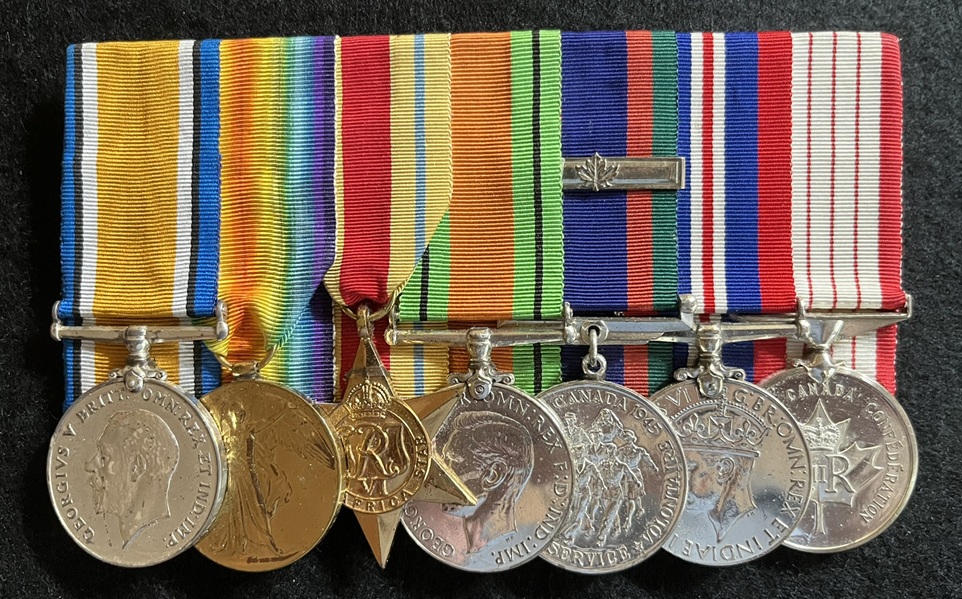 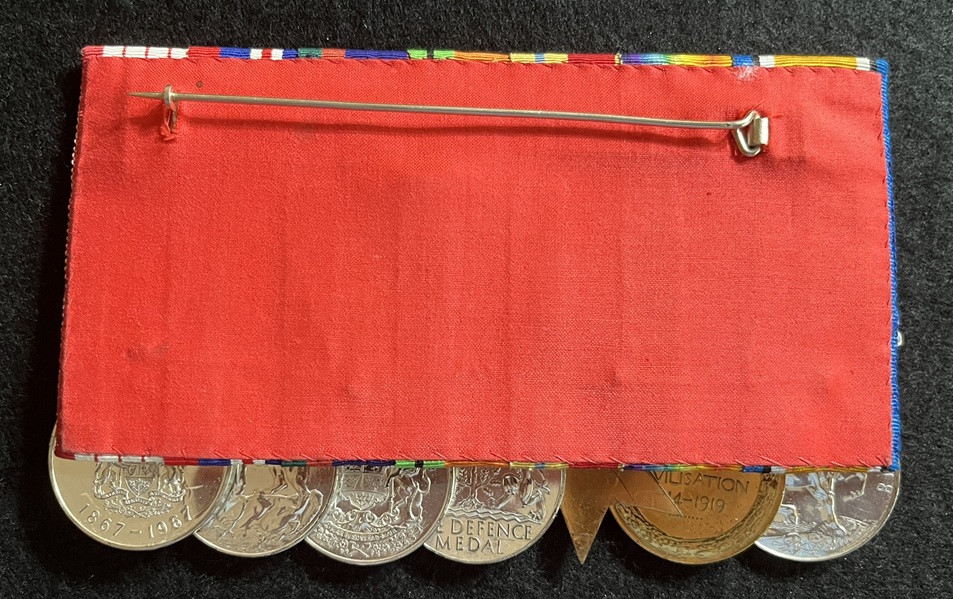  Seven. British War Medal 1914-20, Victory Medal, Africa Star, Defence Medal (Canadian issue), Canadian Volunteer Service Medal with Overseas clasp, War Medal 1939-45, and Canadian Centennial Medal. BWM and Victory are named 404406 PTE. B. MINSKIP 14th BN CAN INF. Bert Minskip was born on 7 August 1896 in Doncaster, Yorkshire, England. He joined the 35th Bn Canadian Expeditionary Force on 12 April 1915 in Toronto, Ontario, at the age of 18, his civilian trade given as cabinet maker. Minskip embarked for the United Kingdom on 17 August 1915, being assigned to the 23rd Reserve Battalion until April 1916, when he was deployed to France as a reinforcement for the 14th Battalion, Canadian Expeditionary Force. While in England, Minskip was fined for being absent without leave, and also awarded 42 days of detention after being courtmartialed for the charge of disobeying an officer. He received a gunshot wound to the head on 1 September 1918, receiving a slight fracture to his skull, and spent the remainder of the war receiving treatment in England before being discharged from the CEF in March 1919, remaining in the UK. Minskip appears to have returned to Canada sometime in the next few years, as he rejoined the Non-Permanent Active Militia in Ottawa, Ontario in September 1925, serving as a Provisional Lieutenant in No. 16 Company, Royal Canadian Corps of Signals until June 1926, when he resigned his commission due to the pressures of his civil employment. Minskip served as an audit clerk and accountant working for the Department of National Defence, Department of Labour, and Department of Finance between 1933 and 1939. His service in the Second World War is unresearched. Minskip's BWM and Victory are official replacements that were issued on 6 September 1966. Medals are lacquered and court-mounted for wear. Seven. British War Medal 1914-20, Victory Medal, Africa Star, Defence Medal (Canadian issue), Canadian Volunteer Service Medal with Overseas clasp, War Medal 1939-45, and Canadian Centennial Medal. BWM and Victory are named 404406 PTE. B. MINSKIP 14th BN CAN INF. Bert Minskip was born on 7 August 1896 in Doncaster, Yorkshire, England. He joined the 35th Bn Canadian Expeditionary Force on 12 April 1915 in Toronto, Ontario, at the age of 18, his civilian trade given as cabinet maker. Minskip embarked for the United Kingdom on 17 August 1915, being assigned to the 23rd Reserve Battalion until April 1916, when he was deployed to France as a reinforcement for the 14th Battalion, Canadian Expeditionary Force. While in England, Minskip was fined for being absent without leave, and also awarded 42 days of detention after being courtmartialed for the charge of disobeying an officer. He received a gunshot wound to the head on 1 September 1918, receiving a slight fracture to his skull, and spent the remainder of the war receiving treatment in England before being discharged from the CEF in March 1919, remaining in the UK. Minskip appears to have returned to Canada sometime in the next few years, as he rejoined the Non-Permanent Active Militia in Ottawa, Ontario in September 1925, serving as a Provisional Lieutenant in No. 16 Company, Royal Canadian Corps of Signals until June 1926, when he resigned his commission due to the pressures of his civil employment. Minskip served as an audit clerk and accountant working for the Department of National Defence, Department of Labour, and Department of Finance between 1933 and 1939. His service in the Second World War is unresearched. Minskip's BWM and Victory are official replacements that were issued on 6 September 1966. Medals are lacquered and court-mounted for wear. Good VF Condition $600 |
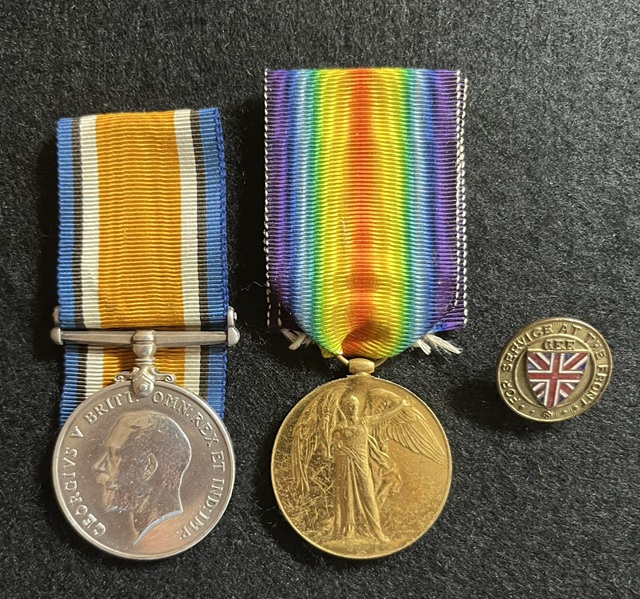 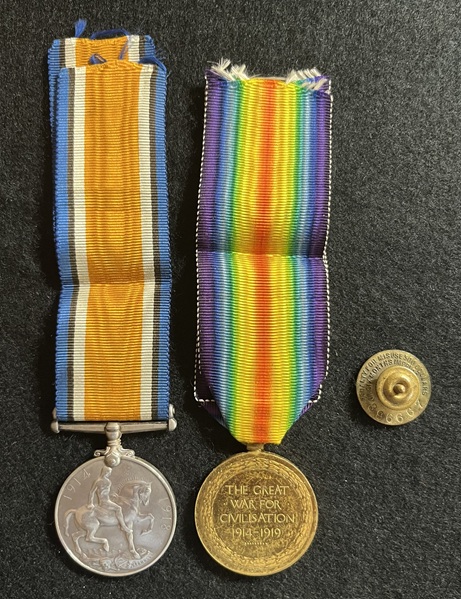  Two. British War Medal 1914-20 and Victory Medal. Named to 6325 A/SJT. J. DUNBAR 1-CAN.INF. James Dunbar was born on 4 July 1886 in Glasgow, Lanarkshire, Scotland. Son of James (1845-1920) and Robina (nee Addison) Dunbar (1846-1930) James emigrated to Windsor, Ontario, arriving in 1913. Employed as a plumber, Dunbar enlisted in the 1st Battalion, Canadian Expeditionary Force at Windsor, Ontario on 22 September 1914, his service record indicating he was enrolled with service number 6325 as a Private in C Company. He sailed from Canada on 14 October 1914 from Halifax, Nova Scotia aboard S. S. Laurentic, arriving in England on 22 October. Dunbar married (with permission from his chain of command) on 4 Januuary 1915. He embarked for France on 11 February 1915. Dunbar received an accidental bayonet wound (Slight) on 24 April 1915 while his unit was engaged in the Second Battle of Ypres. On 13 June 1916, Dunbar was blown up in a shell explosion in the area of Ypres. His medical record indicated that he had "No wound-can walk", but that he experienced pain when standing very erect, and he was prescribed massage and evacuated to 2nd Western General Hospital, Manchester. Dunbar was discharged from C. C. H. Uxbridge after 65 days recovery. On 18 July 1916, Dunbar was promoted Armourer Corporal. This promotion was cancelled 4 months later as a punishment due to him being 48 hours absent without leave. Dunbar remained in England, being assigned to 2 CCD drawing clerk's pay from 1 May 1917. He finished the war in England, before being sent to CCD Buxton on 22 May 1919 for return to Canada aboard S. S. Adriatic, which sailed 28 July 1919 and arrived in Halifax, NS on 5 August. Dunbar was discharged at Halifax on 13 August 1919. His medals were sent to him in Stettler, Alberta on 6 July 1921. Medals are loose on lengths of clean original ribbon, and accompanied by his Class A War Service Badge numbered 396667. Two. British War Medal 1914-20 and Victory Medal. Named to 6325 A/SJT. J. DUNBAR 1-CAN.INF. James Dunbar was born on 4 July 1886 in Glasgow, Lanarkshire, Scotland. Son of James (1845-1920) and Robina (nee Addison) Dunbar (1846-1930) James emigrated to Windsor, Ontario, arriving in 1913. Employed as a plumber, Dunbar enlisted in the 1st Battalion, Canadian Expeditionary Force at Windsor, Ontario on 22 September 1914, his service record indicating he was enrolled with service number 6325 as a Private in C Company. He sailed from Canada on 14 October 1914 from Halifax, Nova Scotia aboard S. S. Laurentic, arriving in England on 22 October. Dunbar married (with permission from his chain of command) on 4 Januuary 1915. He embarked for France on 11 February 1915. Dunbar received an accidental bayonet wound (Slight) on 24 April 1915 while his unit was engaged in the Second Battle of Ypres. On 13 June 1916, Dunbar was blown up in a shell explosion in the area of Ypres. His medical record indicated that he had "No wound-can walk", but that he experienced pain when standing very erect, and he was prescribed massage and evacuated to 2nd Western General Hospital, Manchester. Dunbar was discharged from C. C. H. Uxbridge after 65 days recovery. On 18 July 1916, Dunbar was promoted Armourer Corporal. This promotion was cancelled 4 months later as a punishment due to him being 48 hours absent without leave. Dunbar remained in England, being assigned to 2 CCD drawing clerk's pay from 1 May 1917. He finished the war in England, before being sent to CCD Buxton on 22 May 1919 for return to Canada aboard S. S. Adriatic, which sailed 28 July 1919 and arrived in Halifax, NS on 5 August. Dunbar was discharged at Halifax on 13 August 1919. His medals were sent to him in Stettler, Alberta on 6 July 1921. Medals are loose on lengths of clean original ribbon, and accompanied by his Class A War Service Badge numbered 396667. Good VF Condition $200 |
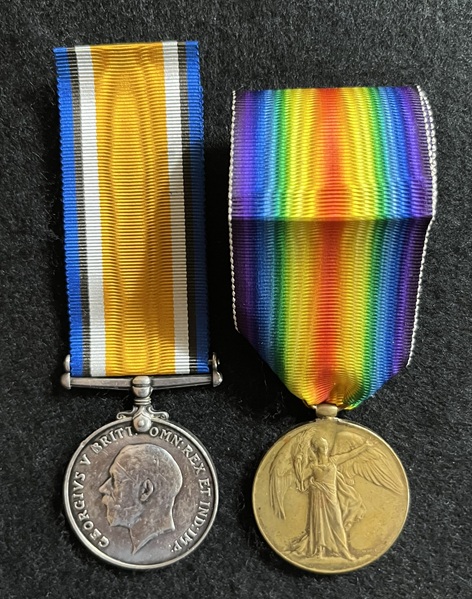 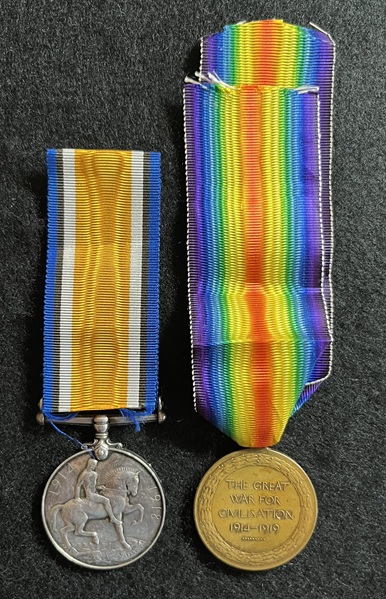  Two. British War Medal 1914-20 and Victory Medal. Named to LIEUT. R. L. HUGHES. Raymond Lees Hughes was born on 16 July 1892 in Dundas, Ontario. The son of William Alfred (1858-1919) and Susanna (nee McKee 1860-1929), Raymond Lees Hughes was a University of Toronto Law Student C.O.T.C Cadet Captain and Colour Sergeant on attestation to the 26th Battery, 7th Brigade Canadian Field Artillery as a Gunner with service number 89673 on 24 March 1915. Hughes was sent to England for training to secure a commission in the Royal Field Artillery, being struck off strength from the CEF on commissioning in the British Army on 29 November 1915. He returned to U of T at war's end to complete his studies. Hughes married Mildred Bernice Youmans (1904-1994) on 16 September 1926 in Dufferin, Ontario. He died on 1 September 1966 at the age of 74, and he is buried in Toronto, Ontario. Group includes hard copies of U of T Graduation photo and Ancestry research. Of note, Hughes' older brother Elwood Alexander Hughes OBE (1884-1956) was an early Olympic athlete and manager of the Canadian National Exposition for many years. Group is loose on clean lengths of original ribbon. An interesting pair with further reseacrh potential to a member of a prominent Toronto family. Two. British War Medal 1914-20 and Victory Medal. Named to LIEUT. R. L. HUGHES. Raymond Lees Hughes was born on 16 July 1892 in Dundas, Ontario. The son of William Alfred (1858-1919) and Susanna (nee McKee 1860-1929), Raymond Lees Hughes was a University of Toronto Law Student C.O.T.C Cadet Captain and Colour Sergeant on attestation to the 26th Battery, 7th Brigade Canadian Field Artillery as a Gunner with service number 89673 on 24 March 1915. Hughes was sent to England for training to secure a commission in the Royal Field Artillery, being struck off strength from the CEF on commissioning in the British Army on 29 November 1915. He returned to U of T at war's end to complete his studies. Hughes married Mildred Bernice Youmans (1904-1994) on 16 September 1926 in Dufferin, Ontario. He died on 1 September 1966 at the age of 74, and he is buried in Toronto, Ontario. Group includes hard copies of U of T Graduation photo and Ancestry research. Of note, Hughes' older brother Elwood Alexander Hughes OBE (1884-1956) was an early Olympic athlete and manager of the Canadian National Exposition for many years. Group is loose on clean lengths of original ribbon. An interesting pair with further reseacrh potential to a member of a prominent Toronto family. Good VF Condition $250 |
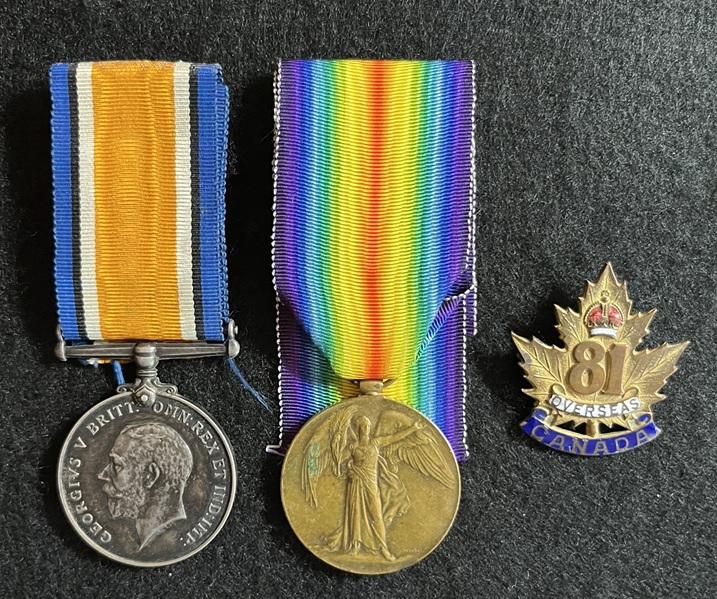 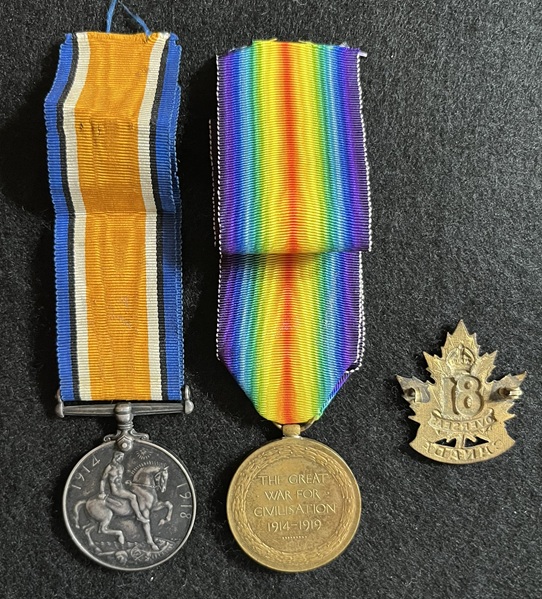  Two. British War Medal 1914-20 and Victory Medal. Named to 159061 PTE W. DRUMMOND 4-C.M.R. William Drummond was born in Glasgow, Scotland on 24 May 1885. He enlisted in the 81st Battalion, Canadian Expeditionary Force on 17 September 1915 at Toronto, Ontario, giving his trade as 'ice cream maker' and listing his wife Kate Drummond as next of kin. Drummond embarked for the United Kingdom from Halifax, Nova Scotia on 1 May 1916, disembarking at Liverpool on 6 May. He was transferred to the 4th Canadian Mounted Rifles on 4 June 1916, and embarked for France shortly afterwards, joining the unit in the field on 7 June in the aftermath of their decimation at Mount Sorrel on 2 June, where 626 out of 702 officers and men in the unit were killed, wounded, or captured. Drummond fell ill with trench fever in October 1916, and was “on command P of W Coy.” for 6 days between 18 and 22 April 1917, likely dealing with prisoners taken at the recent Canadian assault on Vimy Ridge. Drummond was subsequently wounded (Gas Poisoning) on 7 September 1917, and invalided back to England. He returned to his unit in the field after recovering, arriving on 18 August 1918, and serving at the front until war's end. Drummond was discharged from the CEF on 30 March 1919 in Toronto, and his medals were later sent to him at 18 Amherst Avenue in Toronto. William Drummond died on 29 September 1962 at Sunnybrook Hospital, Toronto, aged 77. He was predeceased by his wife Kate, who passed in 1945. Drummond was interred at Prospect Cemetery, Toronto. His medals are loose on original ribbons, and are accompanied by a polished brass enameled ’81 Overseas Canada’ sweetheart pin, with a pin back clasp that has been broken off. Two. British War Medal 1914-20 and Victory Medal. Named to 159061 PTE W. DRUMMOND 4-C.M.R. William Drummond was born in Glasgow, Scotland on 24 May 1885. He enlisted in the 81st Battalion, Canadian Expeditionary Force on 17 September 1915 at Toronto, Ontario, giving his trade as 'ice cream maker' and listing his wife Kate Drummond as next of kin. Drummond embarked for the United Kingdom from Halifax, Nova Scotia on 1 May 1916, disembarking at Liverpool on 6 May. He was transferred to the 4th Canadian Mounted Rifles on 4 June 1916, and embarked for France shortly afterwards, joining the unit in the field on 7 June in the aftermath of their decimation at Mount Sorrel on 2 June, where 626 out of 702 officers and men in the unit were killed, wounded, or captured. Drummond fell ill with trench fever in October 1916, and was “on command P of W Coy.” for 6 days between 18 and 22 April 1917, likely dealing with prisoners taken at the recent Canadian assault on Vimy Ridge. Drummond was subsequently wounded (Gas Poisoning) on 7 September 1917, and invalided back to England. He returned to his unit in the field after recovering, arriving on 18 August 1918, and serving at the front until war's end. Drummond was discharged from the CEF on 30 March 1919 in Toronto, and his medals were later sent to him at 18 Amherst Avenue in Toronto. William Drummond died on 29 September 1962 at Sunnybrook Hospital, Toronto, aged 77. He was predeceased by his wife Kate, who passed in 1945. Drummond was interred at Prospect Cemetery, Toronto. His medals are loose on original ribbons, and are accompanied by a polished brass enameled ’81 Overseas Canada’ sweetheart pin, with a pin back clasp that has been broken off. VF Condition $175 |
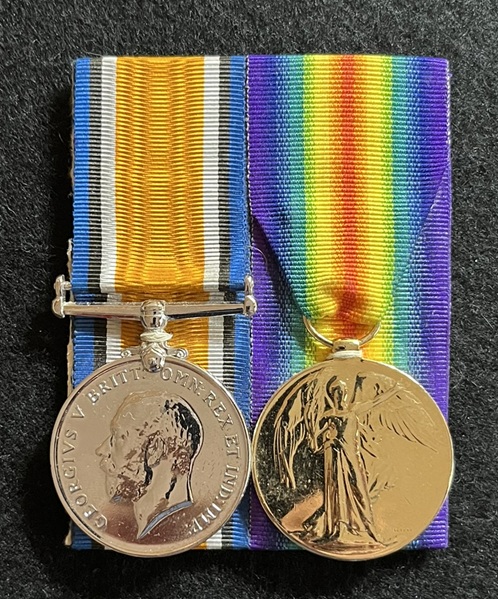 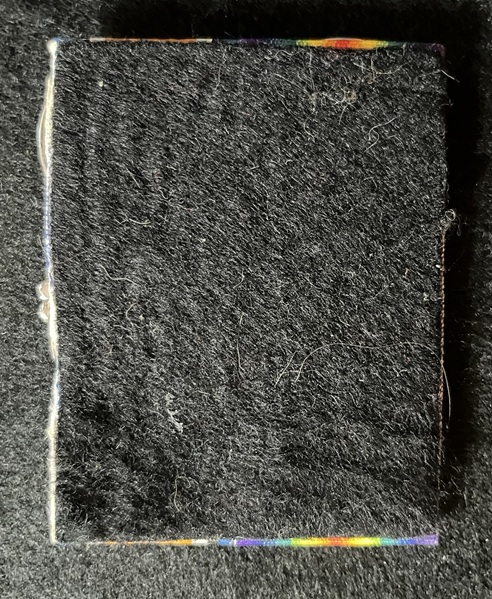  Two. British War Medal 1914-20 and Victory Medal. Named to 42805 SGT.A. DAVISON. C.F.A. Alexander Davison was born in Kilrosshire, Scotland on 16 November 1895. He was working as a teamster, and living in Port Dover, Ontario, when he enlisted in the 3rd Brigade, Canadian Field Artillery at Valcartier, Quebec on 24 September 1914. Davison indicated that he had one year of service in the 77th Regiment of the Canadian Militia. Davison was deployed to England with the 1st Canadian Division in the fall of 1914, but he was retained there after arrival, serving with a series of units before being deployed to France on 19 January 1916, where he served with the 5th Battery, CFA. Group is plated and court mounted on newer ribbons. Two. British War Medal 1914-20 and Victory Medal. Named to 42805 SGT.A. DAVISON. C.F.A. Alexander Davison was born in Kilrosshire, Scotland on 16 November 1895. He was working as a teamster, and living in Port Dover, Ontario, when he enlisted in the 3rd Brigade, Canadian Field Artillery at Valcartier, Quebec on 24 September 1914. Davison indicated that he had one year of service in the 77th Regiment of the Canadian Militia. Davison was deployed to England with the 1st Canadian Division in the fall of 1914, but he was retained there after arrival, serving with a series of units before being deployed to France on 19 January 1916, where he served with the 5th Battery, CFA. Group is plated and court mounted on newer ribbons. VF Condition $140 |
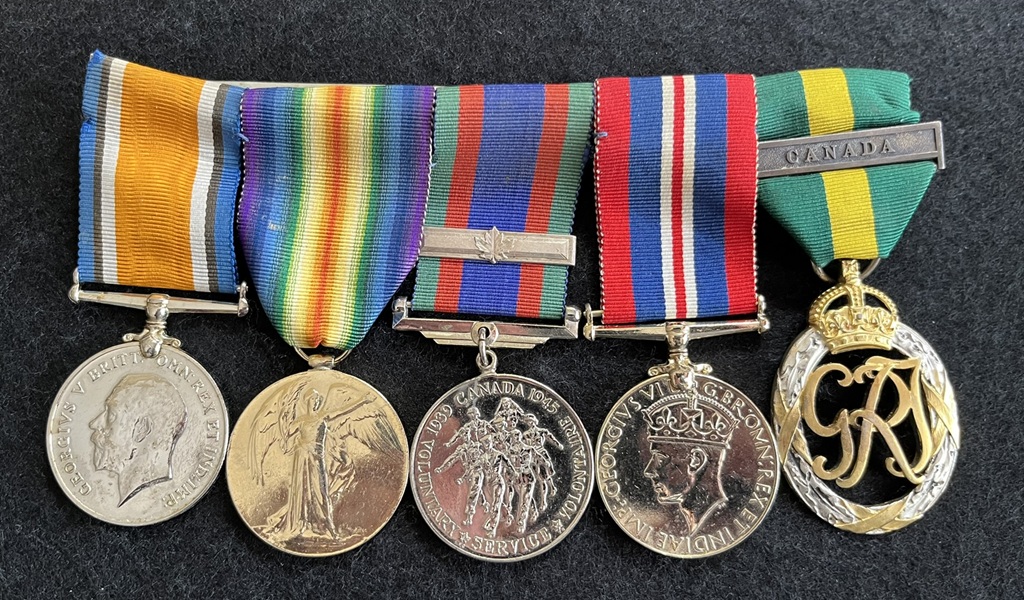 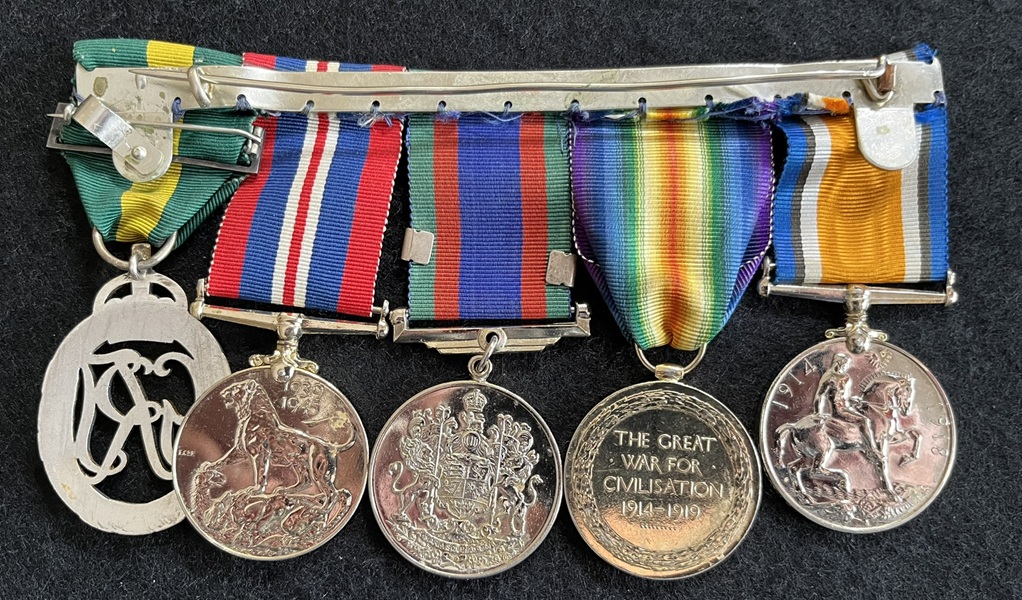  Five. British War Medal 1914-20, Victory Medal, Canadian Volunteer Service Medal with Overseas clasp, War Medal 1939-45 (Canadian issue), and Efficiency Decoration (GVI) with CANADA bar. BWM and Victory named to LIEUT. D.D. THOMSON. Donald Duncan Thomson was born on 5 February 1894 at St. Thomas, Ontario. An accountant in civilian life, he attested into No. 2 Overseas Canadian Army Service Corps Training Depot, Canadian Expeditionary Force on 29 September 1916 at Toronto, Ontario. He had 18 months previous service in the 25th Regiment, Canadian Militia. Thomson embarked for England on 28 December the same year, eventually deploying to France as a reinforcement to the 1st Divisional Train in May 1917. Quickly identified as apt for service as a commissioned officer, he returned to England in September 1917 for officer training, and was commissioned as a Temporary Lieutenant in January 1918. Posted to the 15th Battalion, CEF in April 1918, he was wounded during the battle of Amiens on 9 August 1918 (shrapnel wound to his right arm). Returning to his unit at the end of October 1918, he was repatriated to England with his unit in March 1919, returning to Canada and being discharged from the CEF in late April. Thomson volunteered for service at the outbreak of the Second World War in September 1939, writing directly to the Director of Supply and Transport to solicit employment of a specialist nature involving transportation of personnel or materiel, and citing his extensive background working for 16 years with two railways, as well as 7 years with the Ontario Civil Service. He was appointed as a Lieutenant in No. 2 District Depot, C.A.S.F. as a member of the Permanent Establishment on 24 August 1940. He served for most of the war with No. 9 Detachment, RCASC based in Ottawa, but travelling around the country on military duty, as well as to the United States. Promoted to Major by war's end, he continued his service until late 1946. Thomson's service during the Second World War in Canada and the United States resulted in the award of the Canadian Volunteer Service Medal and the War Medal 1939-45, which is noted on his discharge certifcate dated 4 November 1946. Thomson was apparently eager to continue his active service after release, with a letter to this effect in his service file dated November 1950, but his efforts were rejected due to his age. He appears to have received his Efficiciency Decoration as a late claim initiated on his behalf by the 48th Highlanders of Canada Old Comrades Association in 1974, which likely explains why it is not named. Medals are swing mounted as worn, on clean period ribbons, and are possibly lacquered or lightly plated, with the exception of the ED. Good VF Condition $600 |
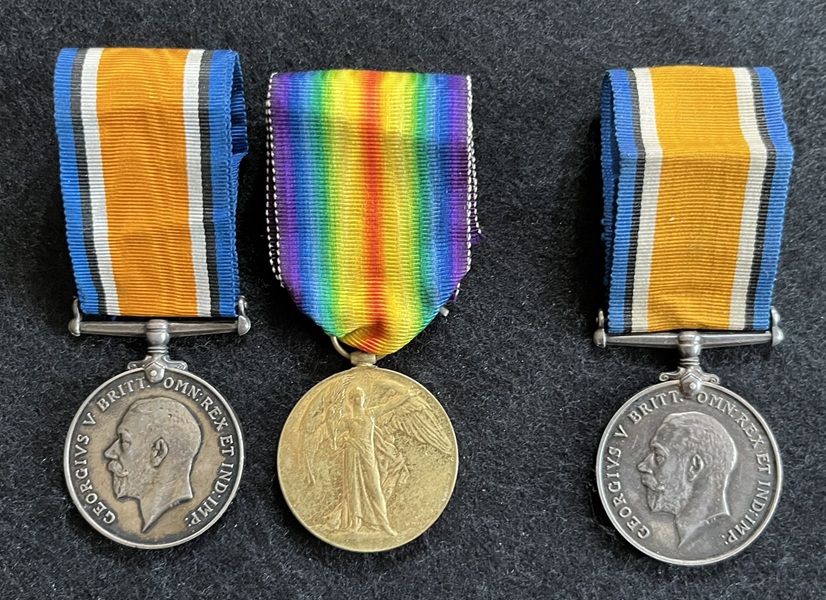 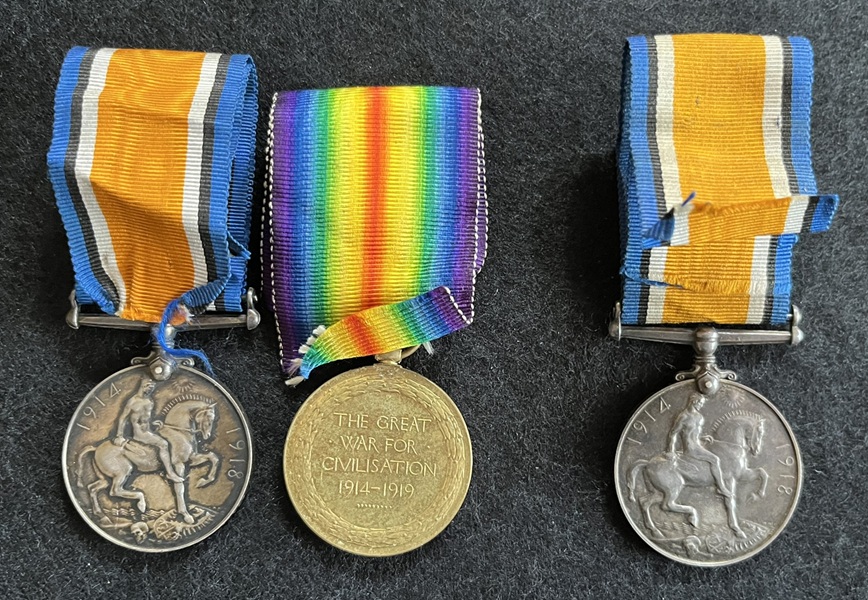 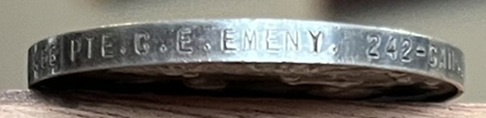  Family group. Son - One. British War Medal 1914-20. Named to 1048466 PTE. C.E. EMENY. 242-CAN. INF. Father - Two. British War Medal 1914-20 and Victory Medal. Named to 1048163 PTE. T. EMENY. C.F.C. Thomas Emeny was born on 5 August 1866 in Didsbury, Lancashire, England. He was living in Edmonton where he was working as a fireman, axeman and cook when he enlisted in the 242nd Battalion, Canadian Expeditionary Force at Edmonton, Alberta on 21 August 1916. He indicated that he had previous military service in the 19th Alberta Dragoons. He embarked for the United Kingdom with his unit from Halifax, Nova Scotia in November 1916, and was transferred to the Canadian Forestry Corps in France at the end of January 1917, landing at Havre on 4 February 1917. He served in France with the 22nd Company, CFC until war's end. His son, Clarence Edward Emeny, was born on 2 June 1901 in Guelph, Ontario. He was working as a bicycle repairman when he joined the 242nd Battalion, CEF on 11 September 1916, at the age of 16. He did not lie about his age, and a note on his attestation paper indicates that 'this boy is normally developed for his age and would be suitable for drummer, bugler or other similar duties'. While he was retained on the unit's strength in Canada, and travelled with the 242nd Battalion to England in November 1916, the fact that he was underage led to his being returned to Canada for discharge in January 1917, with the British War Medal, named to him as a member of the 242nd Battalion, his only entitlement. An interesting father/son group with underage service. VF Condition $300 |
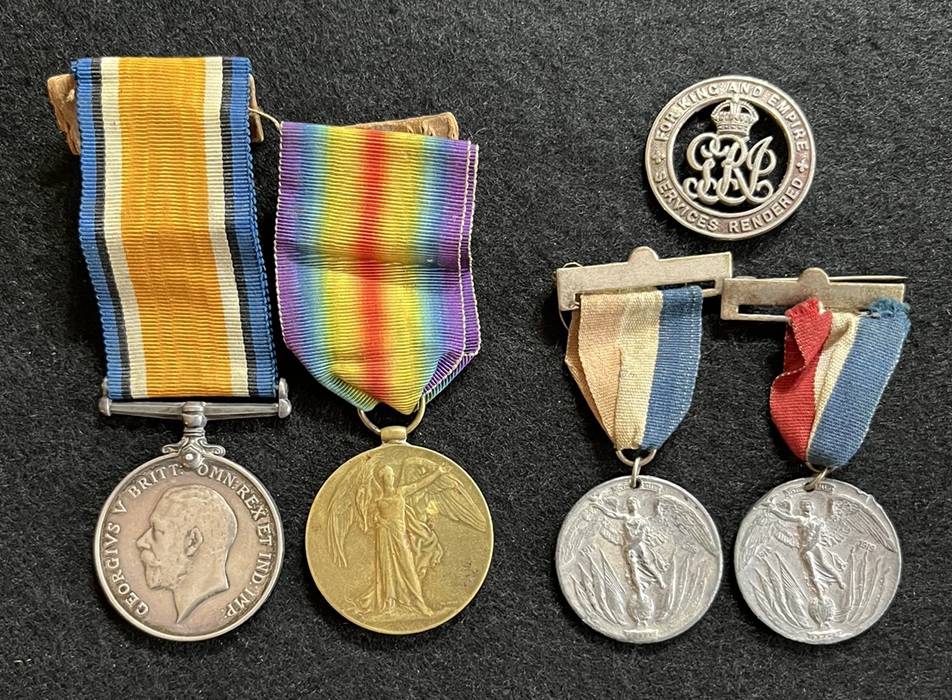 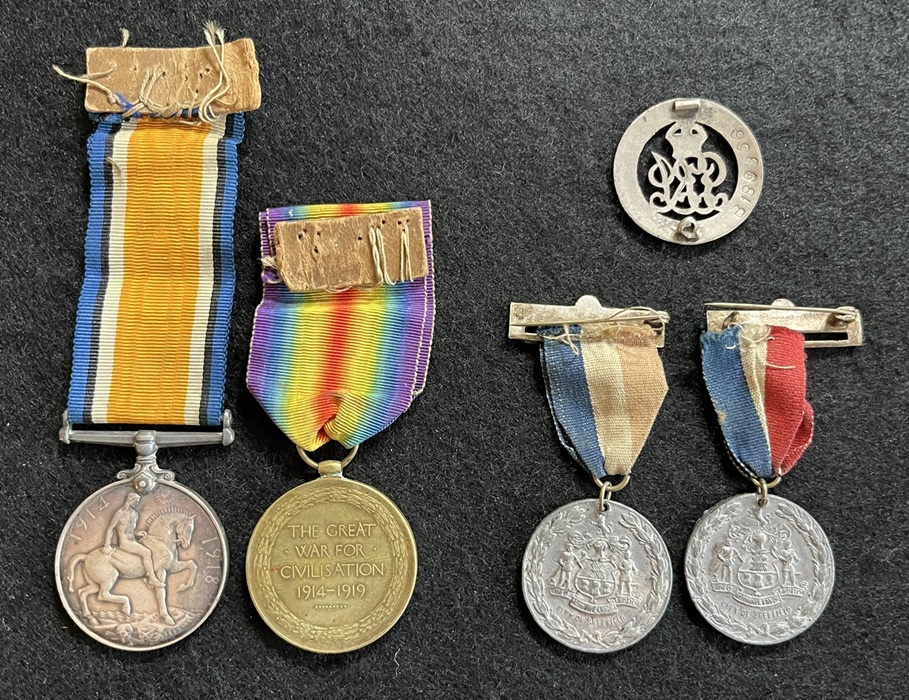  Three. British War Medal 1914-20, Victory Medal, and Silver War Service Badge. Named to 26535 PTE. W. KAY DURH. L.I. on pair, and War Service Badge numbered B189856. Accompanied by two City of Sheffield Municipal Medals in white metal on red/white/blue ribbon with suspenders. Catch on War Service Badge is missing. Medals are loose on older original ribbon. Unresearched. VF Condition $150 |
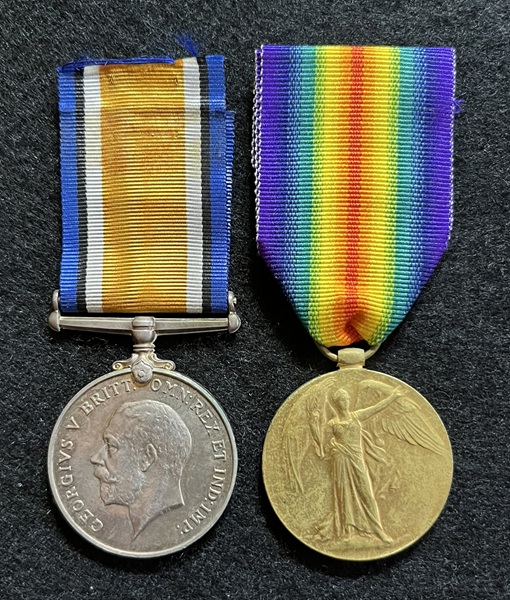 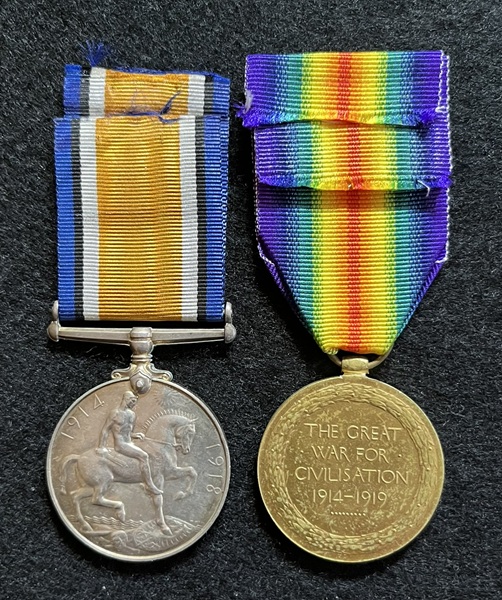   Two. British War Medal 1914-20 and Victory Medal. Named to 339364 BMBR. W.S.P. THORMAN. C.G.A. William Spencer Pelham Thorman was born on 17 January 1886 in Sussex, England. He was working as a teacher in Prince Rupert, British Columbia when he joined the 68th Overseas Depot Field Battery, Canadian Expeditionary Force, at Prince Rupert, British Columbia on 13 October 1916. Deployed overseas to England in March 1917, he was sent to France to join the 1st Canadian Siege Battery in October 1917. He served with the latter unit, which was renamed 1st Brigade Canadian Garrison Artillery (Heavy) in March 1918, until the end of the war. Medals are loose on newer ribbon. A scarcer Canadian Artillery unit. Good VF Condition $150 |
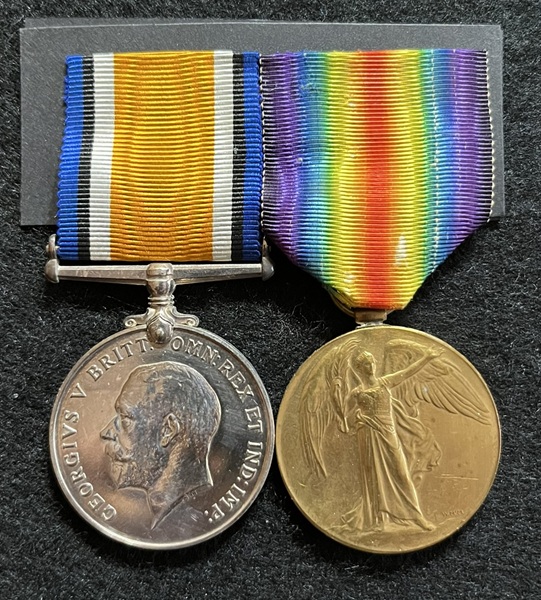 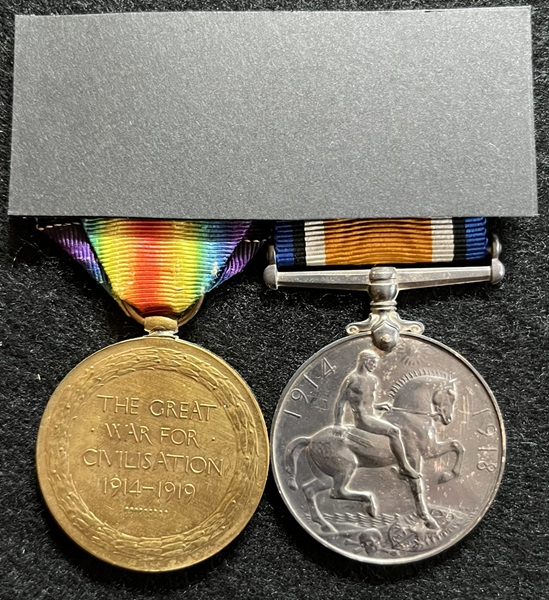   Two. British War Medal 1914-20 and Victory Medal. Named to 1010064 PTE. G.H. ANDERSON 102-CAN.INF. George Henry Anderson was born on 16 December 1891 in Prestonkirk, Scotland. He was working as a farmer in Manor, Saskatchewan when he joined the 195th Battalion, Canadian Expeditionary Force on 26 April 1916. Deploying to England in November 1916, he was taken on strength of the 32nd Battalion there before being sent to France as a reinforcement for the 102nd Battalion CEF, joining the unit on 4 December 1916. Anderson was killed in action on the morning of 11 May 1917 near Lens, France, at about 10:00AM, when a shell exploded close to him, killing him outright. George Henry Anderson is buried in the Commonwealth War Graves Commission's La Chaudiere Military Cemetery, France. Medals are loose on clean older ribbons glued to a small piece of black card backing as seen in the images accompanying this listing. Good VF Condition $275 |
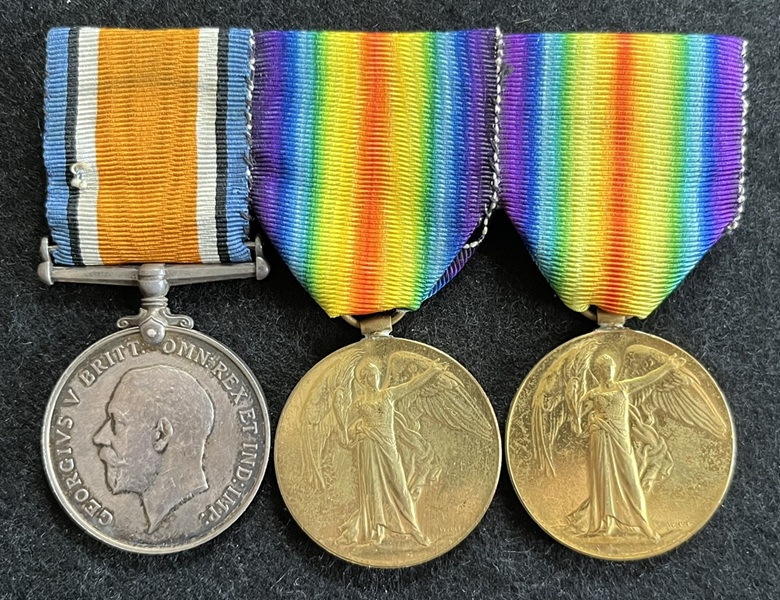 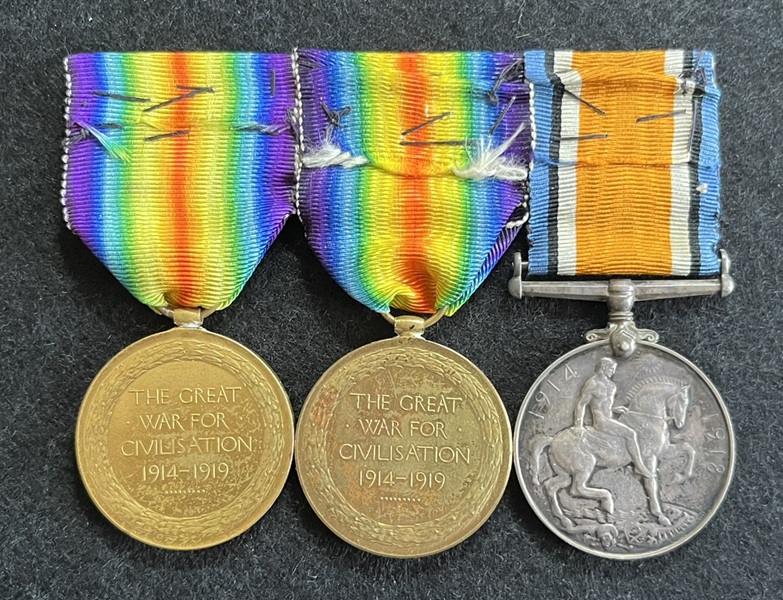    Three. British War Medal 1914-20, Victory Medal and second Victory Medal. Named to 59416 PTE. S. HAMILTON. 21-CAN. INF. Sidney Hamilton was born on 8 July 1894 in Birmingham, England. Employed as a metal polisher in civilian life, he joined the 21st Battalion, Canadian Expeditionary Force at Kingston, Ontario on 6 November 1914. He deployed with his unit to France in November 1915, and was killed in action on 14 June 1916 in trenches near Ypres at a feature known as the Bluff. His service record gives no explanation for the apparent duplicate issue of his Victory Medal. He was also entitled to the 1914-15 Star, and a Memorial Plaque and Memorial Cross was issued to his wife, Ruby, with another Memorial Cross issued to his mother. Hamilton is buried in the Commonwealth War Graves Commission's Bedford House Cemetery, Ypres, Belgium. Medals are swing mounted on clean original ribbons. A very unusual double issue of correctly named Victory Medals to a CEF soldier. VF Condition $300 |
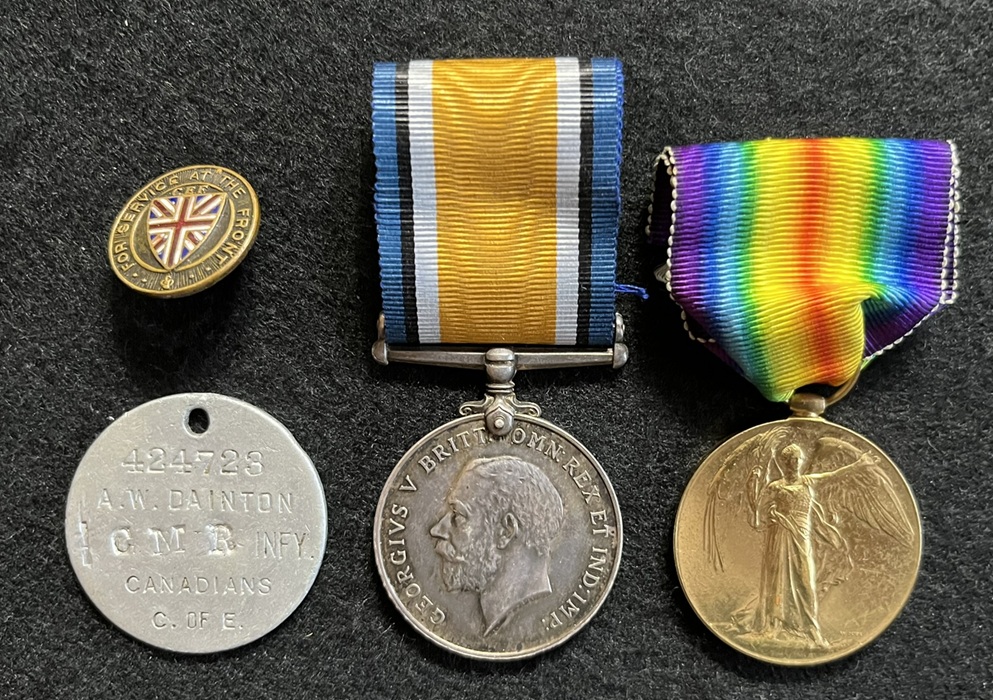 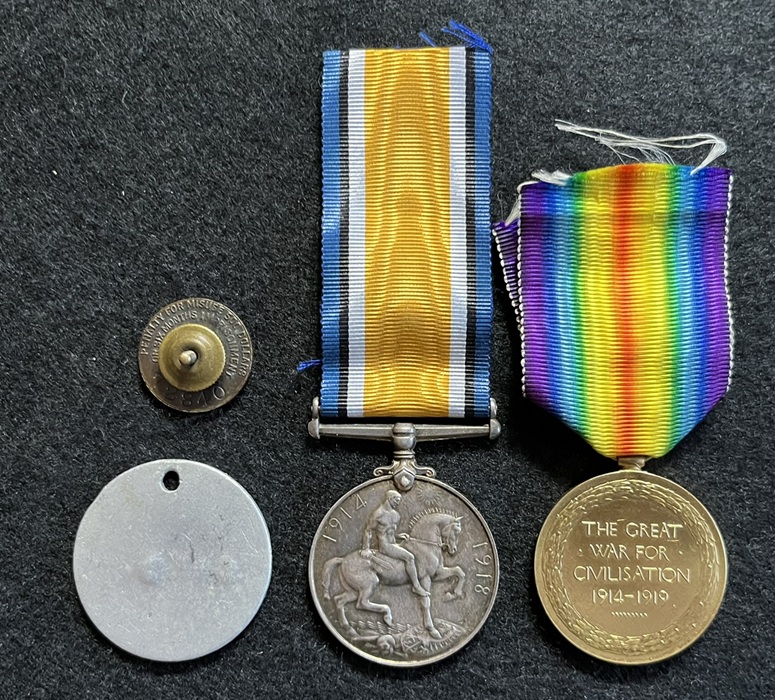  Two. British War Medal 1914-20 and Victory Medal. Named to 424723 SJT. A.W. DAINTON. 1-C.M.R. Accompanied by Dainton's aluminum identity disk and his Class A War Service Badge numbered 72840. Alfred William Dainton was born on 29 December 1893 in Southborough, Kent, England. He was working as a gardener when he joined the 45th Battalion, Canadian Expeditionary Force at Melville, Saskatchewan on 6 January 1915. He embarked for England in late March 1916, and joined the 1st Canadian Mounted Ridles as a reinforcement in France on 26 May 1916. He was wounded in action (gun shot wound to the face) between 28 September - 2 October 1916, while fighting with his battalion on the Somme. Promoted to Corporal in mid-April 1917 after the battle of Vimy Ridge, and appointed Lance Sergeant in June the following year, Dainton was made a substantive Sergeant on 11 August 1918, while his unit was fighting in the battle of Amiens. Medals are loose on lengths of clean older ribbon. VF Condition $300 |
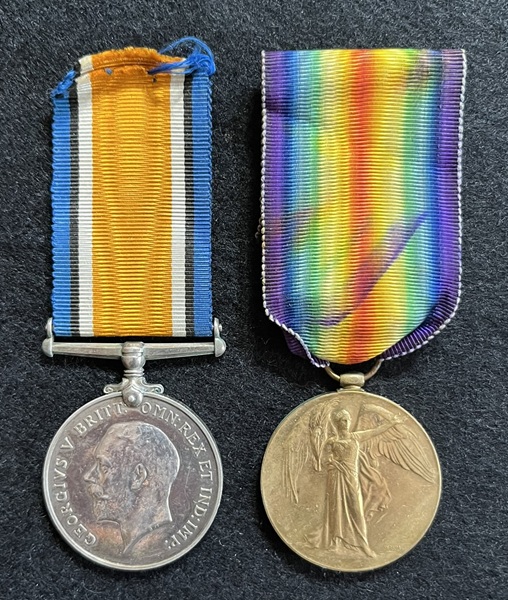 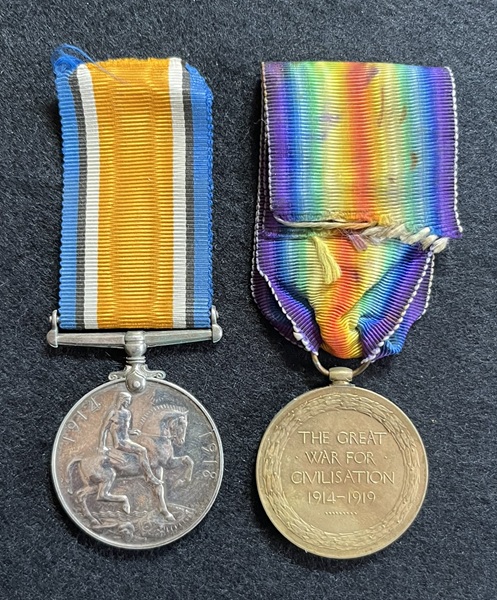  Two. British War Medal 1914-20 and Victory Medal. Named to 276590 PTE. A. JONES 46-CAN.INF. Abraham Jones was wounded on 29 September 1918. Medals are loose on faded original ribbons. VF Condition $160 |
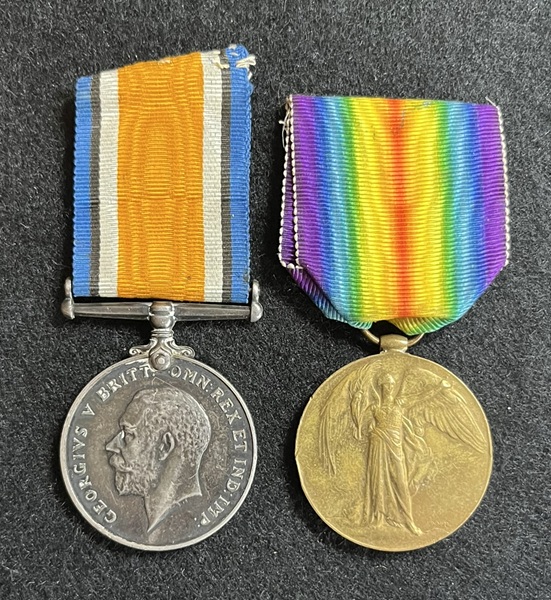 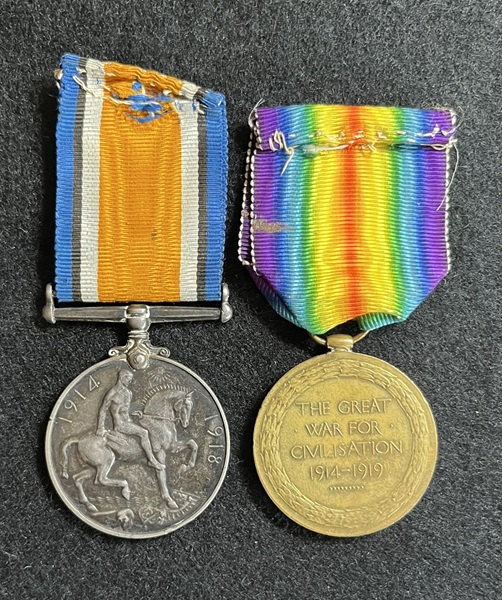  Two. British War Medal 1914-20 and Victory Medal. Named to 246806 PTE. F. OUELLETTE 38-CAN. INF. Frank Ouellette was born in Moose Creek, Ontario, and was working as a laboujrer when he joined the 207th Bn, CEF on 3 January 1917 in Ottawa, Ontario. Ouellette claimed he had 6 months previous service with the 59th Bn CEF when he enrolled in the 207th; he had apparently deserted from the latter unit in February 1916. He served in France with the 38th Battalion CEF from 18 January 1918, and was wounded in action on 26 April 1918, receiving a gun shot wound to his left arm and multiple shrapnel wounds. Medals have some edge knocks and are loose on clean original ribbons. VF Condition $175 |
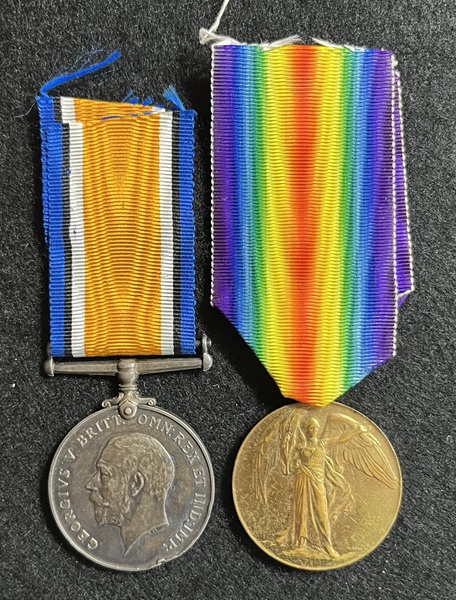 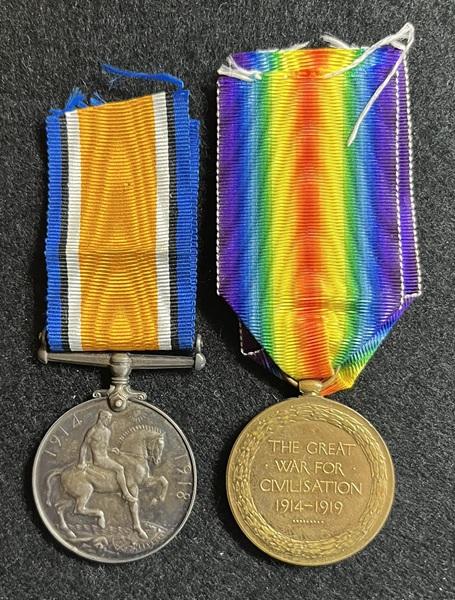  Two. British War Medal 1914-20 and Victory Medal. Named to 523215 PTE. H.E. JONES C.A.M.C. Henry Edward Jones was born on 22 January 1886 in New York, New York. He was working as a saddler in Calgary, Alberta when he joined the Canadian Army Medical Corps in Calgary, Alberta on 31 March 1916. He noted that his previous military service included time spent in the 8th Ohio Volunteer Infantry, the 1st U.S. Engineers, and the 7th Regiment, Canadian Militia in London, Ontario. Jones served at No. 2 Canadian Stationary Hospital in France from October 1916 to the end of the war. Medals are loose on older original ribbons, with a large EK on BWM above surname, but otherwise... VF Condition $175 |
   Three. British War Medal 1914-20, Victory Medal, and Royal Canadian Legion Branch Past President's Medal. BWM and Victory named 690402 PTE. H. HARVEY. CAN. INF. WKS. COY., and RCL medal named Comrade H. Harvey Mount Hamilton Bch. 163 1939-40. Harry Harvey was born on 25 July 1896 in London, England. He joined the 173rd (Highlanders) Battalion, Canadian Expeditionary Force at Hamilton, Ontario on 28 February 1916. He travelled to the UK in November 1916, and was posted to the 1st Canadian Labour Battalion while still in England in December 1916. He proceeded to France in January 1917, serving there until war's end. He received a gunshot wound to a finger on 7 July 1917. In mid-August 1917, Harvey was transferred to the 15th Battalion, CEF to serve as an infantryman. He received another gunshot wound in this role, to the left forearm, on 27 September 1918. Medals swing mounted for display on stiff card backing using original ribbons. Good VF Condition $175 |
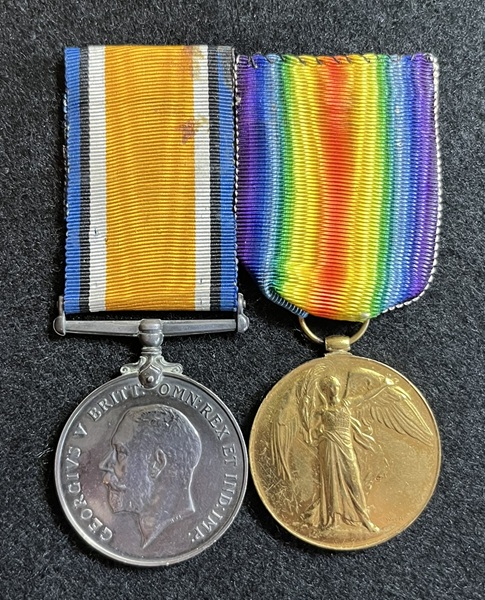 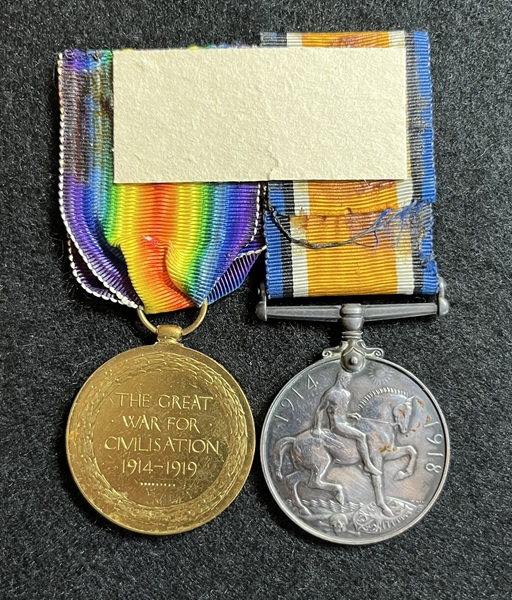  Two. British War Medal 1914-20 and Victory Medal. Named to 458056 PTE. H.M. BENNETT. 60-CAN.INF. Henry Mark Bennett was born on 2 July 1875 in Reading, England. He was working as a steam fitter when he joined the 60th Battalon, Canadian Expeditionary Force on 17 July 1915 in Montreal, Quebec. He arrived in England with the unit in November 1915, and served with the 60th Battalion in France from late February 1916 until it was disbanded due to difficulties in reinforcing it after the battle of Vimy Ridge. Bennett continued his service in France with the 5th Canadian Mounted Rifles, joining the latter unit on 24 April 1917, and later transferring to the 3rd Canadian Division Employment Company on 12 August 1917, serving with the latter element until war's end. Swing mounted on card-stiffened original ribbons for display. Good VF Condition $160 |
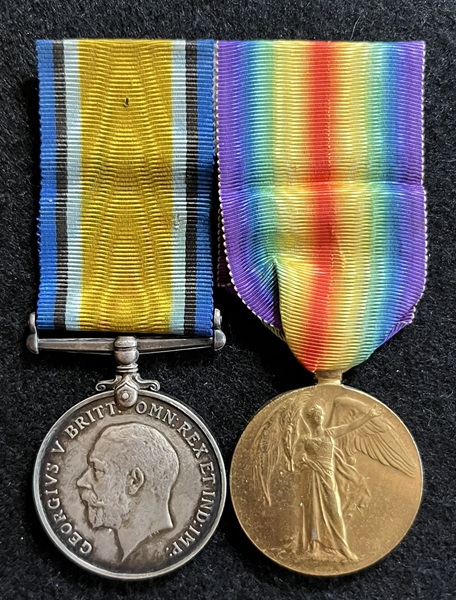 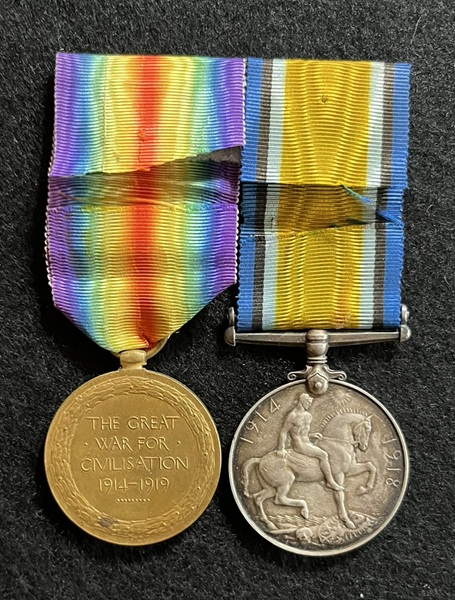  Two. British War Medal 1914-20 and Victory Medal. Named to 175036 PTE. F. ROACH. C.M.G. BDE. Frank Roach was born on 23 August 1883 in Guelph, Ontario. He was working as a labourer when he joined the 86th Battalion, Canadian Expeditionary Force at Hamilton, Ontario on 27 September 1915. He had previously joined the CFA in June 1915, only to be rejected as medically unfit shortly after enslisting, but his persistence apparently paid off. Roach sailed in May 1916 with his unit to England, where it was re-designated as the Canadian Machine Gun Corps Depot. He arrived in France on 13 March 1917, being assigned to the 9th Machine Gun Company in the 3rd Battalion, Canadian Machine Gun Corps, and joining the latter unit on 14 April 1917, at the conclusion of the battle of Vimy Ridge. Roach served with the latter unit until the end of hostilities, returning to Canada and being discharged from the CEF at Toronto, Ontario in March 1919. Medals are swing mounted for display on faded original ribbon. VF Condition $150 |
 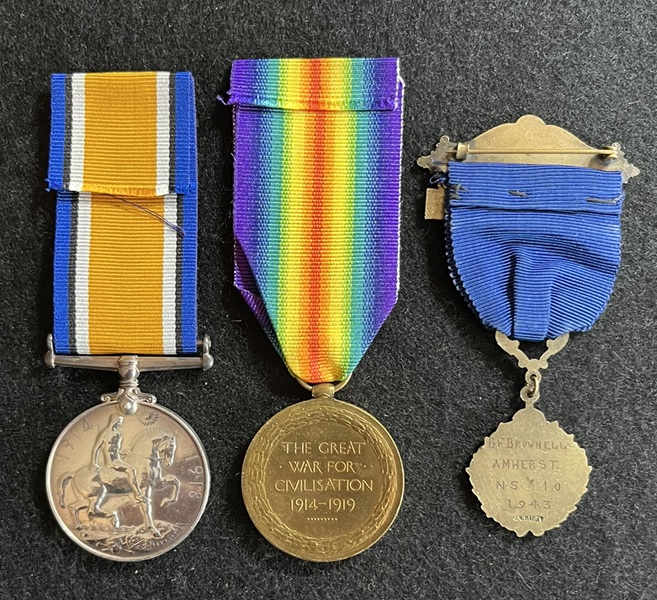   Three. British War Medal 1914-20, Victory Medal, and British Empire Service League Canadian Legion Service Medal with Past-President - Branch suspension. Named to 488184 PTE. G.F. BROWNELL. CAN. PNR. BN. on pair, and to G.F. BROWNELL AMHERST. N.S. # 10 1943 on RCL medal. Gordon Frederick Brownell enlisted in the Composite Battalion in Halifax, Nova Scotia on 8 November 1915. At the time of enlistment, he gave his civilian trade as 'clerk', and claimed previous service in the 93rd Cumberland Regiment of the Canadian Militia. The Composite Battalion was raised from militia units in the Maritime provinces in order to take over the garrison duties of the Royal Canadian Regiment, who transferred to Bermuda shortly after the outbreak of hostilities. Drafts were also sent overseas, and Brownell was deployed overseas with one of these, arriving in England on 31 January 1916 and joining the 17th Reserve Battalion there. He was later posted to the 2nd Pioneer Battalion in the field on 2 March 1916. On 9 April 1916, Brownell received a gun shot wound to his right hand and was taken to No. 22 General Hospital, before being repatriated to England for further treatment. He eventually lost two fingers and the thumb on his right hand to amputation. Brownell's injury resulted in him being declared unfit for further military service. His war over, he returned to Canada in August 1916 and was subsequently discharged from the CEF. Brownell returned to his hometown of Amherst, Nova Scotia, where his obituary states he worked for 39 years as a gatekeeper for the Canadian National Railway. He passed away in Amherst in August 1964. Medal includes hard copy research file with obituary. VF Condition $275 |
    Five. British War Medal 1914-20, Victory Medal, Canadian Volunteer Service Medal, War Medal 1939-45 (Canadian Issue) and Army Long Service and Good Conduct Medal (GV) with 'CANADA' bar. Pair named to 510991 A.S.SJT. H. HENDEN. C.O.C., and LSGC named A.SJT. H. HENDEN. R.C.O.C. Harry Hendon was born on 1 February 1887 in Wimbledon, Surrey, England. He was working as a fitter, and had previously served for four years in No. 6 London Field Artillery, when he enlisted in the Canadian Ordnance Corps at Halifax, Nova Scotia on 12 May 1914. He was assigned service number 500, and when he enrolled in the Canadian Expeditionary Force just 17 months later, on 7 October 1915, he was given a new service number, 510991. Henden was taken on strength of the Canadian Ordnance Corps overseas at Ashford, England on 15 October 1915, and proceeded to France on 29 February 1916. Henden served in a variety of artificer roles with the Canadian Corps ordnance staff, 11th Bde CFA, and 8th Bde CFA, with the work as an armament artificer evidently taking a toll on him, as despite several promotions which saw him rise to the rank of Artificer Staff Sergeant, he was eventually diagnosed with exhaustion and neuresthania in late 1917, only returning to light duty with 26 Ordnance Mobile Workshop in May 1918. He was discharged from the CEF at war's end, demobilizing in Halifax, Nova Scotia on 31 July 1919, but re-enrolled in the Permanent Force No 6 Detachment Royal Canadian Ordnance Corps on 5 November 1923, and serving for an additional 20 years and 253 days. This period included service at home during the Second World War, before retiring on 14 July 1944. Henden received his Canadian Medal for Long Service and Good Conduct April 1937, his award being published in General Order 42 of 3 April 1937. Harry Henden died on 11 January 1981, aged 94. His group is accompanied by hard copies of his service records, confirming all awards. His group is swing mounted on stiffened cardboard strip on modern slightly stained ribbons. An interesting long service group to an artificer whose work kept the Canadian Corps guns in action during the First World War. EF Condition $575 |
     Two. British War Medal 1914-20 and Victory Medal. Named to 522007 SJT. J. RICHARDSON. C.A.M.C. Accompanied by a white metal plaque (with stand) engraved with a hymn written in 1891 by Maxwell N. Cornellus; the top engraved 'SOUVENIR OF THE WORLD WAR', and the bottom engraved 'J. RICHARDSON FRANCE 1917'. Also with the group is a silver Religious Medallion, approximately the size of a silver dollar, engraved to the reverse 'IN EVENT OF DEATH PLEASE RETURN MY PERSONAL PROPERTY TO MY WIFE HELEN M. RICHARDSON HALIFAX CANADA - SGT RICHARDSON NO 7 CAN. STA. HOSPL FRANCE'. There is a neck chain on the medallion which would suggest he wore it throughout his service. Joseph Richardson was born in Wales on 18 September 1872. He enlisted in the Canadian Army Medical Corps' Number 7 Stationary Hospital (Dalhousie University) on 17 October 1915. Richardson was 42 years old on enlistment, and indicated he had 6 years previous service in the 8th (Kings) Regiment before emigrating to Canada. Number 7 Stationary Hospital was essentially a General Hospital in miniature. Its strength incuded approximately 12 medical officers, 27 nurses and a support staff of 120. At the time the unit was formed, barrack space in Halifax was limited, so it was housed at the " Old Medical Building " at Dalhousie. On 31 December 1915, the unit departed for overseas, leaving by train for Saint John, New Brunswick, and sailing on 1 January 1916 on the Troopship Metagama, arriving at Plymouth, England on 10 January 1916. Richardson was promoted to Corporal while in England, on 1 February 1916. The unit deployed to France on 18 June 1916, landing at Havre, and Richardson was promoted to Sergeant on 18 October 1916. No 7 Canadian Stationary Hospital initially served in a support role to front line services until 13 May 1917, when the hospital took over a chateau near the Village of Arques (close to the Belgium border) with tents for the overflow. Their wounded (both Allied and German) came from the nearby battlefields of Ypes and the Messines Ridge. Richardson served continuously with the unit until 11 February 1918, when he was posted to the CAMC Depot at Shorncliffe, England, before proceeding back to Canada on 27 February 1918. Richardson was declared medically unfit and discharged in Halifax on 15 June 1918, returning to his prewar job as a shipper with Hollis & Sons, who sold stoves and furnaces. Joseph Richardson passed away on 23 March 1955 at Camphill Hospital in Halifax, at the age of 83. Group includes hard copy research file with newspaper articles containing a unit photo and separate pictures of the Nursing Sisters who served with the unit. Good VF Condition $600 |
   Two. British War Medal 1914-20 and Victory Medal. Named to 6781 PTE. J. KAY. L.N. LANC. R. Loose on tattered soiled ribbons. Note with group indicates Kay also held service number 242974. Good VF Condition $125 |
   Three. British War Medal 1914-20, Victory Medal and Colonial Auxiliary Force Long Service Medal (GV). Named to 639606 A.CPL. A. TRIPP 38-CAN. INF. on pair, and to PTE. A. TRIPP GREN. REGT. on CAFLSM. Archie Tripp was born in Prescott, Ontario on 2 April 1887. He was a painter in civilian life when he joined the 156th Battalion, Canadian Expeditionary Force on 14 February 1916. On enrollment, he listed his wife, Nettie, as his next of kin, and indicated he had 10 years of previous military service as a member of the 56th Regiment of the Canadian Militia. Tripp served with the 38th Battalion in France, joining the unit on 24 May 1917. He received a gunshot wound to the head on 30 June 1917, with his wound being serious enough that he was invalided to Canada on 16 November 1917, remaining under medical treatment at the military hospital in Kingston, Ontario until he was discharged from the CEF on 8 March 1918. His Colonial Auxiliary Force Long Service Medal, earned as a member of the Grenville Regiment, was announced in General Order 33 of 1933. Archie Tripp died on 18 June 1962. Medals are loose on original ribbons, each with glue residue from being previously mounted. There are two large EKs on Tripp's CAFLSM near his rank, as can be seen in the accompanying images, but medals are otherwise in good VF condition. A scarce long service group to a Grenville Regiment soldier. Good VF Condition $400 |
   Three. British War Medal 1914-20, Victory Medal, and Memorial Cross (GV). Pair named to 2/LIEUT. P.H. JENNER. R.A.F., and cross named to LIEUT. P.H. JENNER. Percy Herbert Jenner served with 66 Squadron, Royal Air Force, and died of accidental causes on 14 December 1918 in Italy. He is buried at Montecchio Precalcino Communal Cemetery Extension, Italy. He was a locomotive engineer for the Canadian Pacific Railway before the war, and was a Sopwith Camel pilot at the time of his death. His CEF service record indicates previous service for 12 months as a Trooper in the Royal Canadian Dragoons prior to re-enlistment in the Canadian Railway Troops (with service # 2124962) in January 1917. Jenner transferred to the Royal Air Force on 19 September 1918. He was flying Sopwith Camel E7213 when he died; details of his RAF casualty card are found here. Accompanied by extensive hard and soft copy research file. An image of Jenner standing in front of a fighter aircraft can be found on Veterans' Affairs Canada's Canadian Virtual War Memorial website here. Cross has had suspension replaced with a pinback which obscures beginning of rank. Good VF Condition $800 |
   Five. British War Medal 1914-20, Defence Medal (Canadian issue), Canadian Volunteer Service Medal with Overseas clasp, War Medal 1939-45, and Memorial Cross (GVI). BWM named to 722137 PTE. H.R. ALLAN. 108-CAN. INF., Second World War medals un-named as issued, and Memorial Cross (GVI) named to M. 26927 Tpr. H.R. ALLAN. Allan was underaged when he joined the CEF during the First World War, and only served in England, receiving the British War Medal with rare naming to the 108th Battalion, which was broken up to provide reinforcements to other battalions at the front. Allan later re-enlisted at the outset of the Second World War, serving in the Calgary Regiment as a Trooper. He was killed on active service in England during training on 7 January 1942, dying of injuries sustained during the roll over of a bren gun carrier. He is buried in the CWGC's Brockwood Military Cemetery in Surrey, England. Details of his death, as well as some photos of him, can be found on VAC's Canadian Virtual War Memorial website. Medals are loose on original ribbons. A tragic group to a soldier of the Calgary Regiment with service in two conflicts. Good VF Condition $800 |
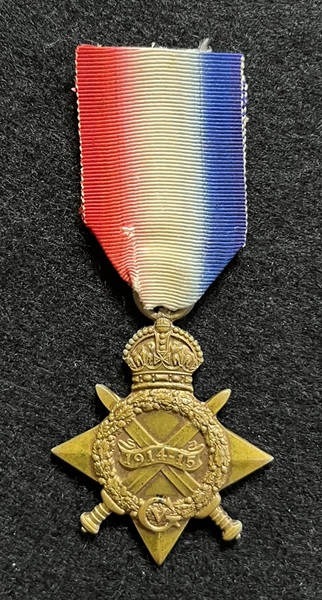 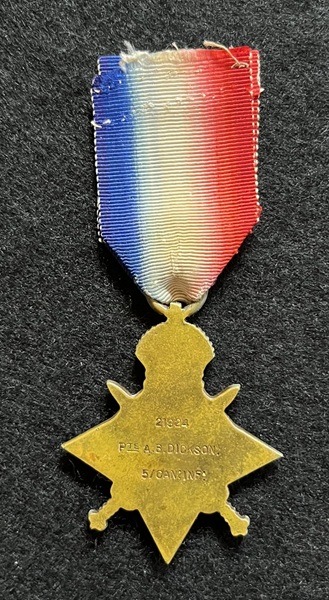 One. 1914-15 Star. Named to 21824 PTE. A.B. DICKSON. 5/CAN:INF: Alexander Bruce Dickson was born on 1 June 1885 in Dumfries, Scotland. He attested into the 11th Battalion, Canadian Expeditionary Force at Valcartier, Quebec on 23 September 1914. Travelling to the UK with the 1st Canadian Division that fall. he spent the winter training on Salisbury Plain. Transferred to the 5th Battalion, CEF on 7 February 1915, he deployed to France the following week. Dickson was wounded in action on 16 May 1915, receiving a gunshot wound to his ankle. He was commissioned into the British Army in early March 1917, serving with the 5th Battalion King's Own Scottish Borderers and being awarded the Military Cross, according to his Medal Index Card, which notes that his British War Medal 1914-20 and Victory Medal were issued in the UK. His pension ledger index card notes that he also received a gun shot wound to the chest while serving with the British Army, and indicates his place of residence after his release was Armbrae, Kilsyth, Stirlingshire. His citation for the Military Cross, which was gazetted in London Gazette 30466 of 9 January 1918, states: For conspicuous gallantry and devotion to duty when battalion intelligence officer. During the night before the attack he personally patrolled No Man's Land while the leading companies were getting into poistion, and afterwards went forward with the attack and did most valuable work in reporting the positions of enemy guns from an exposed position, where he was under continuous heavy shell and machine gun fire. Whilst engaged in this gallant work he was wounded, first by machine-gun fire and later severely by a shell. Medal is loose on short length of clean older ribbon. Good VF Condition $250 |
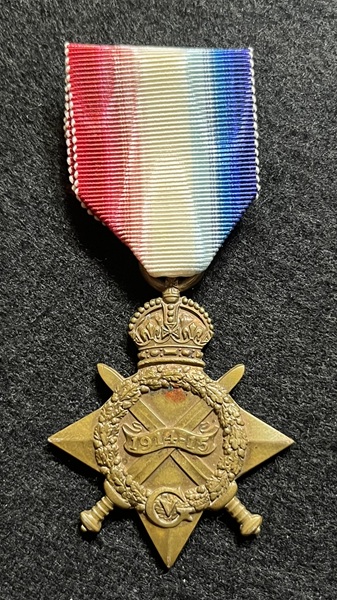 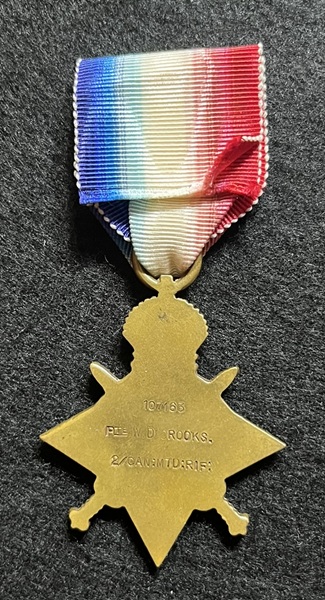 One. 1914-15 Star. Named to 107163 PTE W.D. CROOKS 2/CAN: MTD: RIF: William Crooks was killed in action on 2 October 1916, during the unit's operations on the Somme. His entry on the Canadian Virtual War Memorial website includes a newspaper clipping which mentions that he came as part of the draft from the Yukon. That said, I have not been able to find any confirmation of this, and period photos and nominal rolls of Joe Boyle's Yukon Machine Gun Battery, which was attached to the 2nd CMR for a short period before deploying to England, do not include Crooks. Medal is loose on a length of clean older ribbon, and otherwise unresearched. Good VF Condition $200 |
  One. 1914-15 Star. Named to 53597 PTE. S.B. MUSSELMAN. 18/CAN: INF: Stanley Bowman Musselman was born on 11 July 1891 in Berlin, Ontario. A locomotive fireman, he enrolled in the 18th Battalion of the Canadian Expeditionary Force in Sarnia, Ontario on 2 November 1914. He sailed overseas with his unit on 18 April 1915, arriving in France on 14 September 1915, and eventually transferring to the 2nd Canadian Division Machine Gun Company, Canadian Machine Gun Corps in December 1915, and serving with the latter corps for the remainder of the war. Medal has been gilded, and it is on a length of clean older ribbon. VF Condition $90 |
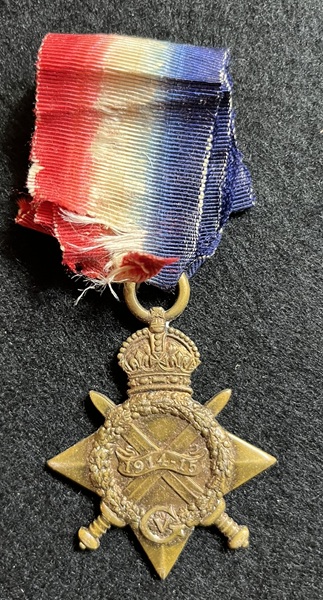 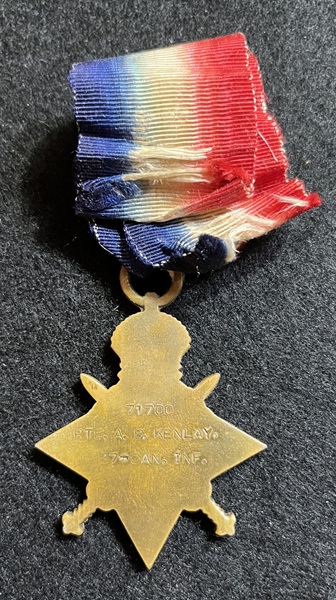 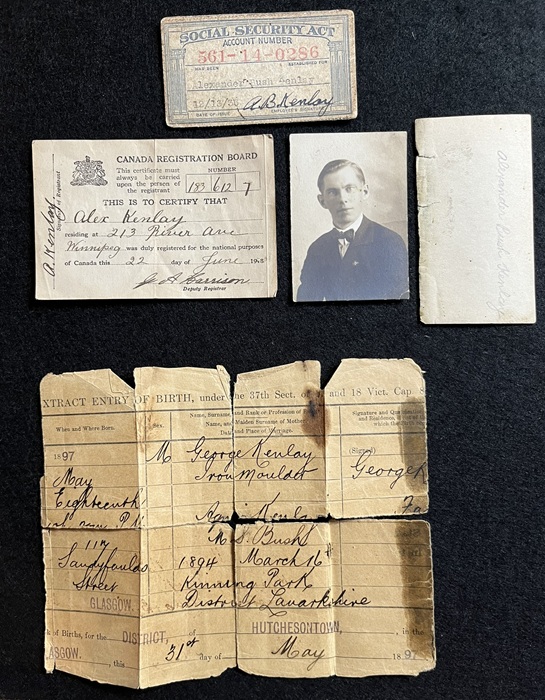 One. 1914-15 Star. Named to 71700 PTE. A.B. KENLAY. 27-CAN.INF. With original portrait image in civilian clothing, Canada Registration Board certificate dated 22 June 1918, US Social Security Account card, and birth certificate (this in pieces). Alexander Bush Kenlay was born on 18 May 1896 in Glasgow, Scotland. He was working as a packer in civilian life when he enlisted in the 11th Battalion, Canadian Expeditionary Force in Winnipeg, Manitoba on 28 October 1914. He claimed 18 months previous service in the 79th Camerons, and his attestation paper notes he was a bugler. Kenlay joined the 27h Battalion, CEF as a reinforcement in November 1915. He was wounded in action on 10 February 1916, receiving a gunshot wound to his right arm, and was shell shocked on 14 August 1916, which resulted in a diagnosis of disordered action of the heart, and led to his eventual medical release and discharge in Canada in October 1917. The Registration Board Certificate with the group is a scarce item; it appears that Kenlay later emigrated to the United States, and much further research is possible. Good VF Condition $125 |
  One. 1914-15 Star. Named to 21081 PTE. A. MANN 5/CAN: INF: Alexander Mann was born on 6 April 1886 in Arbroath, Scotland. A teamster in civilian life, with previous service in the 52nd Regiment Prince Albert Volunteers, he joined the 11th Battalion, Canadian Expeditionary Force at Valcartier, Quebec on 23 September 1914. Embarking for overseas from Quebec with the 1st Canadian Division on 4 October 1914, he landed in England and was transferred to the 5th Bn CEF on 1 February 1915. He was wounded in action (gun shot wound to chest) and taken prisoner on 24 April 1915 during the Second Battle of Ypres. He was later released from German custody and turned to England via Rotterdam, Holland on 9 January 1918, diagnosed with insanity, and repatriated to Canada for further medical treatment, before being discharged in Kingston, Ontario in January 1919. A scarce award to a Canadian prisoner of war, one of only 3842 men taken prisoner while serving with the CEF during the First World War. Good VF Condition $250 |
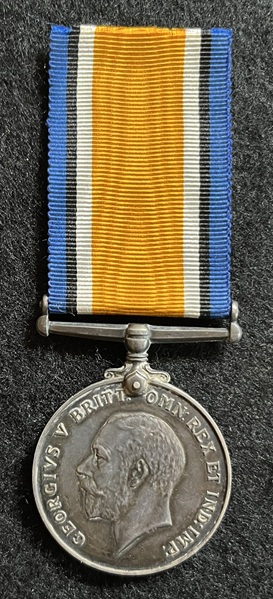 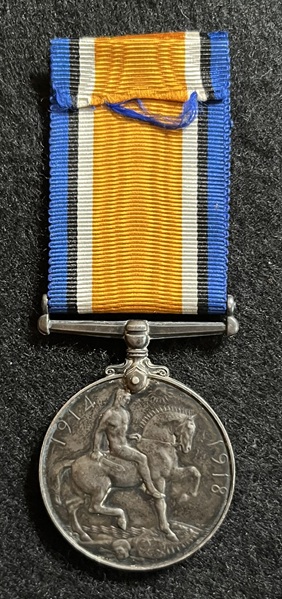 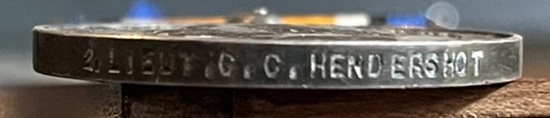 One. British War Medal 1914-20. Named to 2.LIEUT. C.C. HENDERSHOT. Charles Cecil Hendershot was born on 8 July 1898 in Kingsville, Ontario. He joined the Royal Flying Corps in Canada on 23 July 1917. He was 19 years old and serving in England as a Second Lieutenant in the Royal Flying Corps when he was killed in a flying accident on 6 February 1918 while serving with 6 TDS, Boscombe Down. Hendershot was flying in a BE 2e with a South African officer, Lieutenant Keith Charles Beddy, when their plane lost speed in a slow turn and nose dived. Of note, the Canadian War Museum has Hendershot's last mess bill in its collection. One. British War Medal 1914-20. Named to 2.LIEUT. C.C. HENDERSHOT. Charles Cecil Hendershot was born on 8 July 1898 in Kingsville, Ontario. He joined the Royal Flying Corps in Canada on 23 July 1917. He was 19 years old and serving in England as a Second Lieutenant in the Royal Flying Corps when he was killed in a flying accident on 6 February 1918 while serving with 6 TDS, Boscombe Down. Hendershot was flying in a BE 2e with a South African officer, Lieutenant Keith Charles Beddy, when their plane lost speed in a slow turn and nose dived. Of note, the Canadian War Museum has Hendershot's last mess bill in its collection. VF Condition $250 |
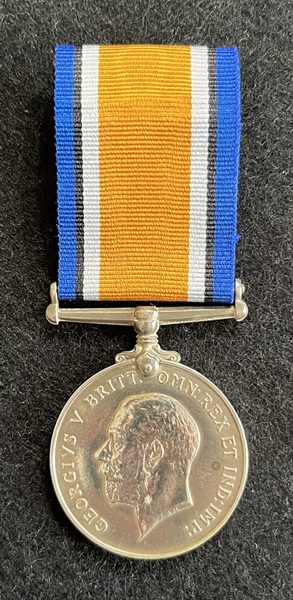 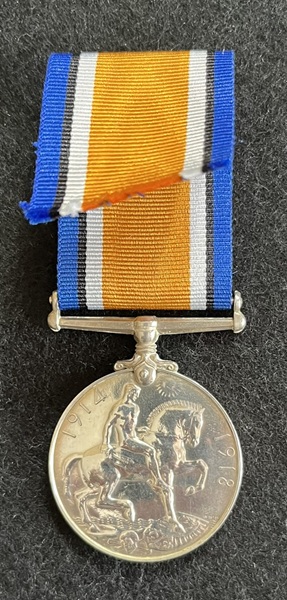 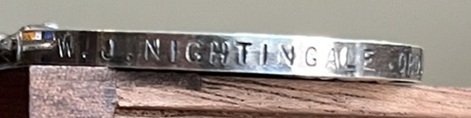 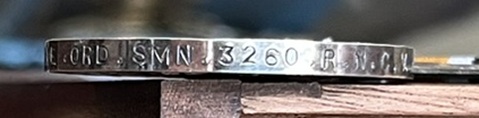 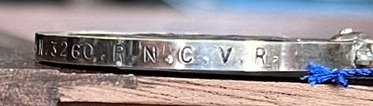 One. British War Medal 1914-20. Named to W.J. NIGHTINGALE ORD. SMN. 3250 R.N.C.V.R. Willie John Nightingale was born on 1 January 1895 in Innisfil, Ontario. He enrolled in the Royal Naval Canadian Volunteer Reserve at Toronto on 30 December 1916. Deploying overseas soon after, he was killed at sea while serving on the minesweeper H.M.Trawler Lock Eye near Waterford Harbour, South Ireland, on 20 April 1917, at the age of 22. Nightingale was the only son of the late William and Sarah Nightingale of Craigvale. An article in the Barrie Examiner detailed his memorial service as follows: "A fine tribute to the memory of the late W. J. Nightingale, son of Mr. and Mrs. Wm. Nightingale, of Craigvale, killed, at Dover on April 20, was paid in St. Paul's Church, Innisfil, on Wednesday evening, May 9. The church was filled with those who not only desired to honor his memory and extend their deep sympathy to his parents and sister, but also with those who wished to pay a tribute to all who on sea, on land and in the air, are fighting for the defence of home and country and the maintenance of all principles of liberty and righteousness." Nightingale is commemorated on the Halifax Memorial, Halifax, Nova Scotia. The ship he was serving on, H.M. Trawler Lock Eye, was sunk by a German submarine, U33, commanded by Kapitänleutnant Martin Schelle. Nightingale was one of seven casualties when this vessel was sunk. The VAC Canadian Virtual War Memorial website includes a portrait image of Nightingale in uniform, as well as images of the Halifax Memorial. A scarce First World War Canadian naval casualty medal. Good VF Condition $400 |
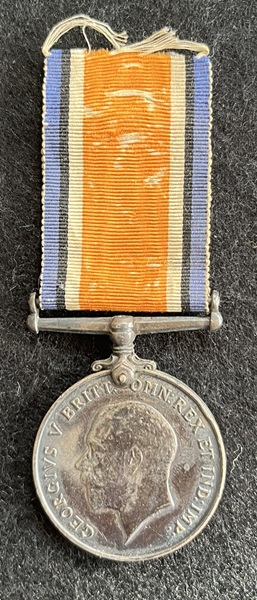 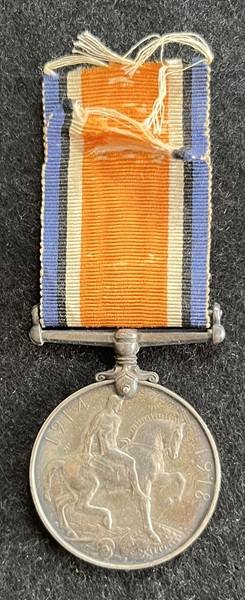   One. British War Medal 1914-20. Named to 670027 PTE. E.E. WOOD 38-CAN. INF. Wood was living in Toronto, Ontario and working as a bartender when he joined the 166th Battalion, Canadian Expeditionary Force on 24 March 1916. He served in France with the 38th Bn CEF, being wounded twice, receiving a gun shot wound to his hand on 22 January 1917, and later being wounded by gun shot wound to the left leg on 6 April 1917 at Vimy Ridge, losing his leg to amputation on 16 April. He was discharged in Toronto, medically unfit, on 19 October 1918. Medal is loose on length of old distressed ribbon. VF Condition $125 |
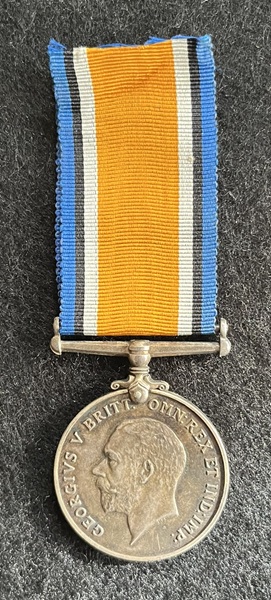 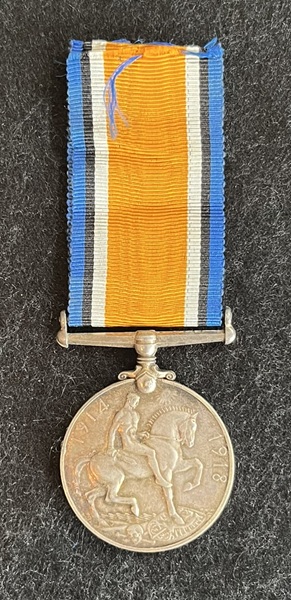   One. British War Medal 1914-20. Named to 9208 PTE. W.G. STAPLETON R.BERKS. R. Lance Corporal W.G. Stapleton of the 1st Battalion, Royal Berkshire Regiment was killed in action on 17 May 1915. He is buried in the Commonwealth War Graves Commission's enclosure at Bethune Town Cemetery, France. The letter 'B' in Berkshire appears to be restruck, but is as issued. Medal is loose on length of clean older ribbon. VF Condition $150 |
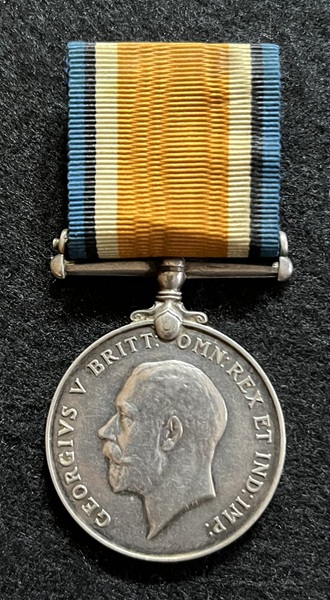 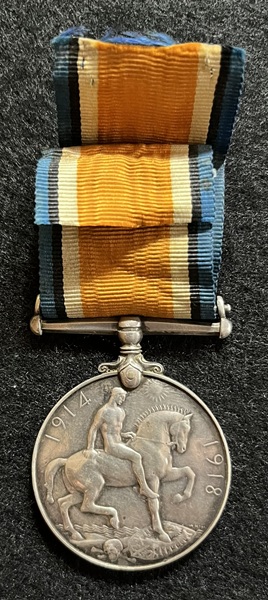 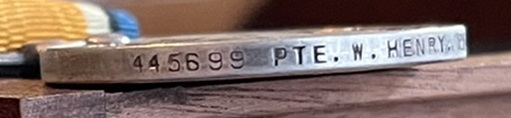 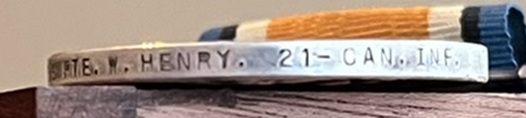 One. British War Medal 1914-20. Named to 445699 PTE. W. HENRY. 21-CAN.INF. Walter Henry was born on 16 January 1896 in St. George, New Brunswick. He was working as a labourer when he enlisted in the 55th Battalion, Canadian Expeditionary Force at Sussex, New Brunswick on 21 September 1915. He landed in England in October 1915, and was sent to France as a reinforcement, joining the 21st Battalion on 15 May 1916. Henry was wounded in action at Vimy Ridge on 9 April 1917, receiving a bullet wound that fractured his right tibia. This injury led to him being repatriated to Canada in late July 1917, due to an incomplete union of the bone in his right leg during recovery, which left him unfit for further miltary service. Medal suspension appears to have been repinned; loose on distressed original ribbon. Good VF Condition $125 |
   One. British War Medal 1914-20. Named to 187814 PTE. W. MAC DONALD. 90-CAN. INF. Accompanied by a single 90th Bn collar badge with tang backs and a small Great War Veterans lapel badge (enamel/Sterling).Loose on slightly soiled original ribbon. Good VF Condition $175 |
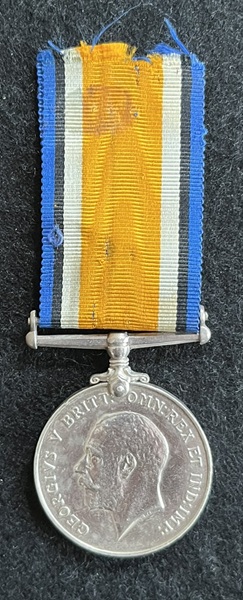 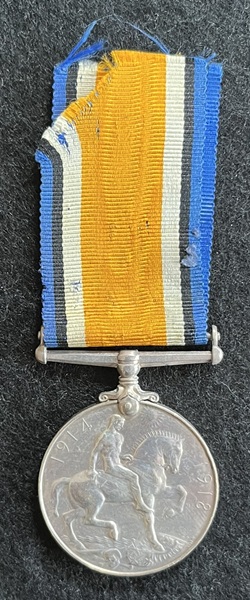  One. British War Medal 1914-20. Named to 410722 PTE. H. DAVENPORT. 38-CAN.INF. Henry Davenport was born in Manchester, England on 26 August 1888. He was working as a labourer when he enrolled in the 38th Battalion, Canadian Expeditionary Force at Lindsay, Ontario on 19 April 1915. Davenport served in D Company of the unit, and deployed to Bermuda with the battalion for garrison duty in August 1915, replacing the Royal Canadian Regiment. He served in Bermuda until May 1916, when the unit was replaced by the 163rd Battalion CEF. Sailing to England, they arrived in early June 1916, and were assigned to the 12th Canadian Infantry Brigade of the 4th Canadian Division, departing for France and service at the front in August the same year. Davenport received a gunshot wound to his right leg at Courcelette, France on 17 November 1916. He was invalided back to the UK, and spent the remainder of the war in England. Loose on piece of older ribbon. Good VF Condition $125 |
    One. British War Medal 1914-20. Named to 901759 A. SGT E.E. KELLEY. C.A.V.C. Edgar Emmerson Kelley was born in Allendale, New Brunswick on 18 May 1887. He was a reporter with several papers in New Brunswick before starting with the Halifax Herald in 1912. On 31 March 1916, he enlisted with the 193rd (Highland) Battalion, CEF. The 193rd Battalion was broken up in England and he joined the 17th Reserve Battalion and then the Canadian Army Veterinary Corps on 6 February 1917. The majority of Kelley's service was in administrative roles in England, including at the CAVC Headquarters in Shorncliffe. Deployed to France on 18 March 1918, he served with the Canadian Corps Headquarters - Sub Staff. Kelley returned to Canada in June 1919, and returned to work as a journalist. His obituary indicates he spent nearly 40 years with The Halifax Mail Star and the Halifax Chronicle-Herald as Editor-in-Chief and Vice President. Kelley passed away in May 1957. With hard copy research file including a photo taken prior to leaving Canada while he was with the 193rd Bn, extracts from his CEF service file, and an obituary. Medal is loose and unmounted on clean modern ribbon. Good VF Condition $250 |
    One. British War Medal 1914-20. Named to 730304 A. S. SJT. W.L. JARDINE. 111-CAN.INF. Walter Lorne Jardine was born in Galt, Ontario on 27 March 1894. An accountant in civilian life, Jardine joined the 111th (South Waterloo) Battalion, Canadian Expeditionary Force on 28 December 1915. He arrived in England on 6 October 1916, and served with the Department of the General Auditor with the CEF in England from 11 March 1917 to war's end. This medal represents his full entitlement for his service. Loose on original ribbon. A scarce odd-numbered battalion medal. Good VF Condition $150 |
    One. British War Medal 1914-20. Named to 1069769 PTE. P. JONES. 5-CAN-INF. Percy Jones was born in Oldham, Lancashire, England on 29 December 1882. He was working as a storekeeper in Fall River, Massachussets, USA when he enlisted in the 249th Battalion of the Canadian Expeditionary Force on 26 July 1917. Jones deployed to France in June 1918, and joined the 5th Battalion, CEF as a replacement on 8 August 1918. He was listed as missing on 1 September 1918, during the Canadian attacks preceding the assault on the Drocourt-Queant Line, and later as having been killed in action on that date. VF Condition $125 |
   One. British War Medal 1914-20. Named to 183005 A.SJT. T.J. WILLIAMS. 89-CAN.INF. Loose on clean older ribbon, accompanied by a single 'CANADA' shoulder title. Thomas John Williams was born in Abererch, Carnarvonshire, North Wales on 22 August 1878. He was working as a cotton manufacturer, and claimed past military service in the 15th Light Horse, 23rd Welsh Fusiliers and 2nd Manchester Volunteers when he joined the 89th Battalion, Canadian Expeditionary Force at Calgary, Alberta on 2 November 1915. Williams served in England only, with the bulk of his service time there spent at the Canadian Army Pay Office in London. A scarcer CEF battalion medal. Good VF Condition $150 |
    Two. British War Medal 1914-20 and Memorial Cross (GV). BWM named to 172173 A.L.CPL. E. FENSOM. 166-CAN. INF., and Memorial Cross named 172173 Pte. E. FENSOM. Accompanied by a small locket-sized circular portrait of Fensom in uniform (approx 1" wide). Ernest Fensom was born in Sydney, Australia on 25 March 1885. He joined the 83rd Battalion of the Canadian Expeditionary Force at Toronto, Ontario on 27 august 1915, giving his trade as bricklayer. Before proceeding overseas, he transferred to the 166th (Queen's Own Rifles) Battalion, CEF. Fensom embarked at Halifax on 18 October 1916, and disembarked at Liverpool on 28 October 1916. He sadly passed away in the UK as a result of illness, dying of spinal meningitis on 15 February 1917. Ernest Fensom is buried at Seaford Cemetery, UK. A scarce unit naming on the BWM, which was Fensom's full entitlement for overseas service. A poignant grouping to a CEF volunteer. Good VF Condition $400 |
| One. British War Medal 1914-20. Named to 22149 A.C.S. MJR. S. VAIL. 11-CAN. INF. - $150 One. British War Medal 1914-20. Named to 602897 PTE. G. THOMPSON 34-CAN. INF. - $150 One. British War Medal 1914-20. Named to 404983 A/SJT. A.J. ADAMS 35-CAN. INF. Apparent erasure affecting last three numbers of service number and first letters of rank. - $150 One. British War Medal 1914-20. Named to 436450 A. SJT H.P. MILLS 51/CAN. INF. Name officially corrected, style of unit naming suggests late issue.- $150 One. British War Medal 1914-20. Named to 455796 PTE D.C. MCDONALD 59-CAN. INF. - $150 One. British War Medal 1914-20. Named to 460197 PTE. P. TYDEMAN. 61-CAN. INF. - $150 One. British War Medal 1914-20. Named to 123797 A. SJT. D.S. MAC GREGOR. 70-CAN. INF. - $150 One. British War Medal 1914-20. Named to 163410 A.SJT. L.J. PALMER. 74-CAN. INF. - $150 One. British War Medal 1914-20. Named to 145085 PTE. C.H. HOLLAND. 77-CAN. INF. - $150 One. British War Medal 1914-20. Named to 152987 A.S.Q.M. SJT. A. HULME. 79-CAN. INF. - $150 One. British War Medal 1914-20. Named to 171971 R.Q.M. SJT. F. DOWNIE-BACON. 83-CAN. INF. - $150 One. British War Medal 1914-20. Named to 175340 PTE. W. DEXIER. 86-CAN. INF. - $150 One. British War Medal 1914-20. Named to 212253 A.S.SJT. A.E. PHIPPS. 98-CAN. INF. - $150 One. British War Medal 1914-20. Named to 700045 A.W.O.CL.2. D.J. HUMPHREY. 101-CAN. INF. - $150 One. British War Medal 1914-20. Named to 706648 PTE. H.C. WOODS. 103-CAN. INF. - $150 One. British War Medal 1914-20. Named to 757892 A. SJT. H. EARNSHAW. 120-CAN. INF. - $150 One. British War Medal 1914-20. Named to 760535 PTE. J.C. SHELLINGFORD. 121-CAN. INF. Naming rubbed. - $150 One. British War Medal 1914-20. Named to 772940 PTE. H. REEVE. 125-CAN. INF. - $150 One. British War Medal 1914-20. Named to 240008 A. SJT. D.J. SUTHERLAND. 164-CAN. INF. - $150 One. British War Medal 1914-20. Named to 679304 A.SJT. W.A. WEBB 169-CAN. INF. - $150 One. British War Medal 1914-20. Named to 690184 PTE. H. SAUNDERS. 173-CAN. INF. - $150 One. British War Medal 1914-20. Named to 02596 A. SJT. E. ST. GERMAIN. 183-CAN. INF. Suspender is damaged (missing roller bar and top of one ear) and medal has some edge knocks.- $125 One. British War Medal 1914-20. Named to 874112 PTE. C. CREWE. 184-CAN. INF.- $150 One. British War Medal 1914-20 (disk only). Named to 883708 PTE. A.J. LANE. 187-CAN. INF.- $100 One. British War Medal 1914-20 (disk only). Named to 161023 PTE. W.GERRIE. 194-CAN. INF. - $100 One. British War Medal 1914-20. Named to 237585 A/CPL. S.J. BURSTOW. 204TH CAN. INF. Late issue style naming in large impressed capitals.- $150 One. British War Medal 1914-20. Named to 1000237 PTE. H.E. MUNDY. 226-CAN. INF. - $150 One. British War Medal 1914-20. Named to 1037610 PTE. W.S. CORK 238-CAN. INF. - $150 |
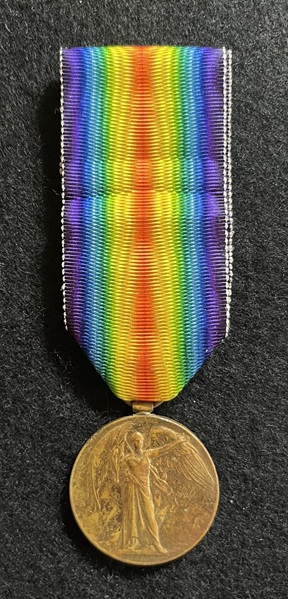 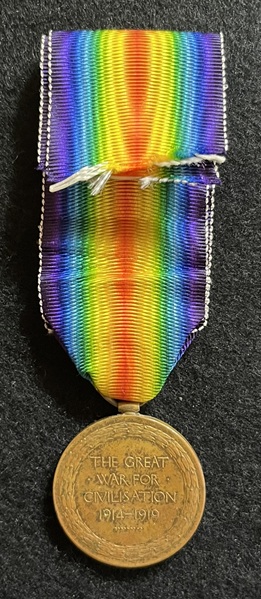   One. Victory Medal. Named to 34510 S.SJT. G. A. O'SHEA C.A.M.C. Gerald Arthur O'Shea was born in Merrut, West Bengal, India on 10 December 1889 to father Timothy (33) Quartermaster K.R.R.C. and mother Jamaial (30), a local woman. He was baptized on 30 December 1889, and his siblings included three brothers and one sister. O'Shea enlisted in the Canadian Army Medical Corps on 29 September 1914 at Quebec City, Quebec, giving his trade as 'clerk' and stating 6 years previous service with the Royal Canadian Regiment and the Permanent Army Medical Corps. One of the medical records in his CEF service file from May 1916 indicates he had enlisted 10 years previously in the RCR, serving in the latter regiment for 6 years before enrolling in the CAMC, in which he had served for 4 years and 2 months, which suggests he started his service in the Canadian Army Permanent Force in March 1906. O'Shea spent much of his early CEF service in England, dealing with illness including tonsilitis, gastritis, and disordered activity of the heart. He was also absent without leave for a period of time, and tried for desertion. He eventually deployed to France on 10 March 1917, joining No 6 Canadian Field Ambulance briefly, before requesting a transfer to the Royal Canadian Regiment on 23 March as a result of his reduction in rank to Private. This was granted, and O'Shea joined the latter unit before the battle of Vimy Ridge, where he was wounded in action on 10 April 1917 (left hand, slight). While in England, O'Shea went absent without leave again, on 27 August 1917, eventually being branded a deserter, before being apprehended on 27 February 1918. He was sentenced to 12 months of detention at Wandsworth Detention Barracks, and transferred there on 25 July 1918 to begin serving his sentence. On 5 September 1918, he was returned to the RCR in France for duty, with the remainder of his sentence commuted. O'Shea was wounded in action again (gunshot wounds arms and right shoulder) on 27 September 1918. He was repatriated to England for medical treatment, and remained there in hospital until war's end. He deserted again while in England on 4 February 1919, before ultimately being released from the CEF. One. Victory Medal. Named to 34510 S.SJT. G. A. O'SHEA C.A.M.C. Gerald Arthur O'Shea was born in Merrut, West Bengal, India on 10 December 1889 to father Timothy (33) Quartermaster K.R.R.C. and mother Jamaial (30), a local woman. He was baptized on 30 December 1889, and his siblings included three brothers and one sister. O'Shea enlisted in the Canadian Army Medical Corps on 29 September 1914 at Quebec City, Quebec, giving his trade as 'clerk' and stating 6 years previous service with the Royal Canadian Regiment and the Permanent Army Medical Corps. One of the medical records in his CEF service file from May 1916 indicates he had enlisted 10 years previously in the RCR, serving in the latter regiment for 6 years before enrolling in the CAMC, in which he had served for 4 years and 2 months, which suggests he started his service in the Canadian Army Permanent Force in March 1906. O'Shea spent much of his early CEF service in England, dealing with illness including tonsilitis, gastritis, and disordered activity of the heart. He was also absent without leave for a period of time, and tried for desertion. He eventually deployed to France on 10 March 1917, joining No 6 Canadian Field Ambulance briefly, before requesting a transfer to the Royal Canadian Regiment on 23 March as a result of his reduction in rank to Private. This was granted, and O'Shea joined the latter unit before the battle of Vimy Ridge, where he was wounded in action on 10 April 1917 (left hand, slight). While in England, O'Shea went absent without leave again, on 27 August 1917, eventually being branded a deserter, before being apprehended on 27 February 1918. He was sentenced to 12 months of detention at Wandsworth Detention Barracks, and transferred there on 25 July 1918 to begin serving his sentence. On 5 September 1918, he was returned to the RCR in France for duty, with the remainder of his sentence commuted. O'Shea was wounded in action again (gunshot wounds arms and right shoulder) on 27 September 1918. He was repatriated to England for medical treatment, and remained there in hospital until war's end. He deserted again while in England on 4 February 1919, before ultimately being released from the CEF. Good VF Condition $125 |
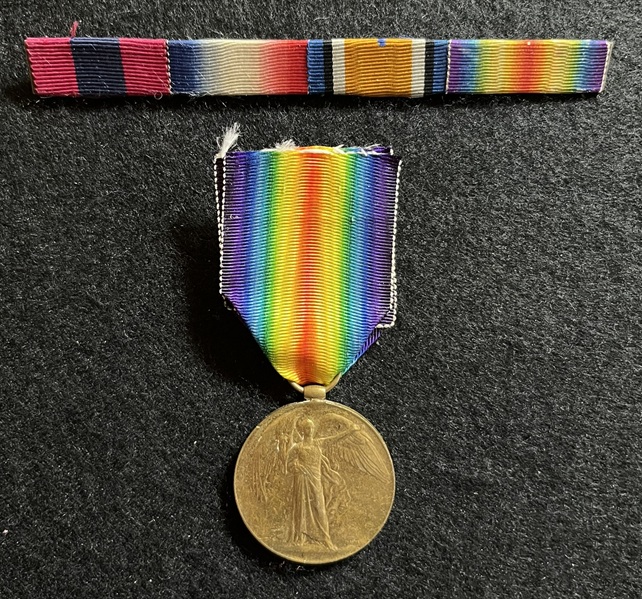 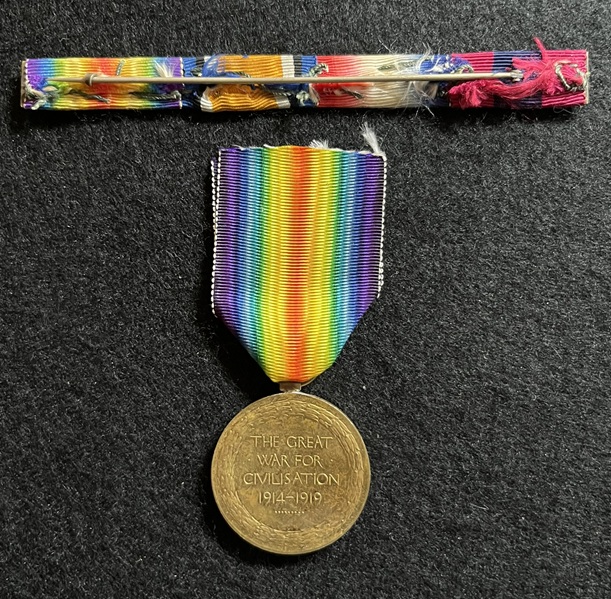 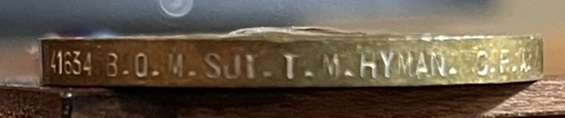 One. Victory Medal. Named to 41634 B.Q.M.SJT.T.M.HYMAN C.F.A. Thomas Michaud Hyman was born in Huish, Somersetshire in June 1889. A carriage builder by trade, and resident of Montreal, Quebec, he attested into the 2nd Brigade Canadian Field Artillery at Valcartier, Quebec on 26 September 1914. Proceeding to England that fall, he deployed to France with the 1st Canadian Division in February 1915. Hyman rose to the rank of Battery Quarter Master Sergeant, and he was awarded the Distinguished Conduct Medal in London Gazette 30716 of 3 June 1918 while serving with 48th Battery, 2nd CFA Brigade. His citation states: One. Victory Medal. Named to 41634 B.Q.M.SJT.T.M.HYMAN C.F.A. Thomas Michaud Hyman was born in Huish, Somersetshire in June 1889. A carriage builder by trade, and resident of Montreal, Quebec, he attested into the 2nd Brigade Canadian Field Artillery at Valcartier, Quebec on 26 September 1914. Proceeding to England that fall, he deployed to France with the 1st Canadian Division in February 1915. Hyman rose to the rank of Battery Quarter Master Sergeant, and he was awarded the Distinguished Conduct Medal in London Gazette 30716 of 3 June 1918 while serving with 48th Battery, 2nd CFA Brigade. His citation states: For conspicuous gallantry and devotion to duty. During the three and a half years this N.C.O. has served in France, he has on many occasions displayed great courage and determination in supplying his battery with ammunition and stores, often under conditions of great danger and difficulty. His desregard of danger and resolute endurance of fatigue have been a fine example ot all ranks of the battalion. Medal is accompanied by a ribbon bar including ribbons for the Distinguished Conduct Medal, 1914-15 Star, British War Medal 1914-20 and Victory Medal. Medal is loose on short length of clean original ribbon. VF Condition $150 |
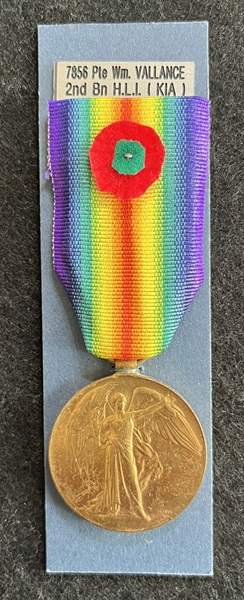   One. Victory Medal. Named to 7856 PTE. W. VALLANCE. HIGH. L.I. Vallance was killed in action on 3 October 1915 while serving with the 2nd Battalion, Highland Light Infantry. He is commorated on the Commonwealth War Graves Commission's Loos Memorial, Loos-en-Gohelle, France. Medal is mounted for diplay on a card backing on length of clean modern ribbon. VF Condition $70 |
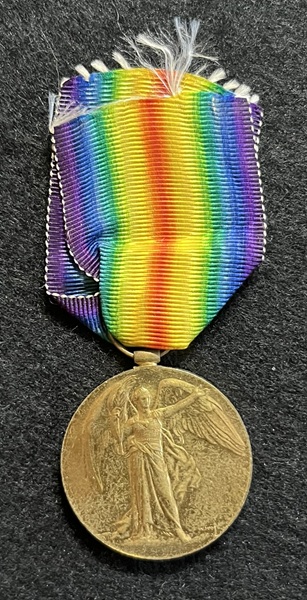 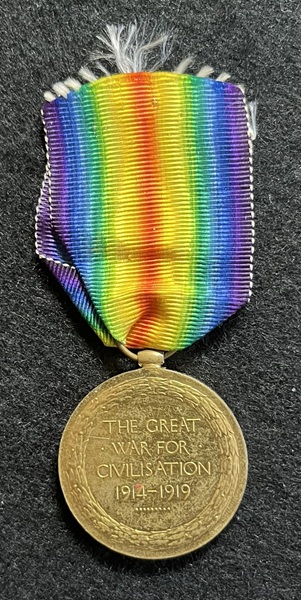  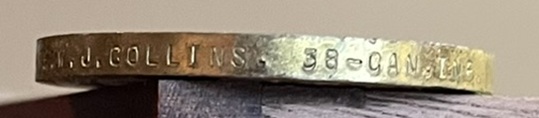 One. Victory Medal. Named to 806297 PTE. W.J. COLLINS 38-CAN.INF. With hard copy of extracts from Wood's CEF service file. William James Collins was born in Seattle, Washington, USA, and was living in Millbrook, Ontario, where he worked as a bank clerk, before joining the 136th Battalion, Canadian Expeditionary Force on 29 January 1916. Collins served with the 38th Bn, Canadian Expeditionary Force in France from 5 June 1917. Medal is loose on clean length of older ribbon. Good VF Condition $80 |
    One. Victory Medal. Named to 464433 PTE. E.M. JONES. 29-CAN.INF. Accompanied by a small holed 1905 Belgian coin on a short linked chain, and a pin back celluloid image of a photo, possibly Jones. Jones died of wounds on 30 September 1916. Good VF Condition $120 |
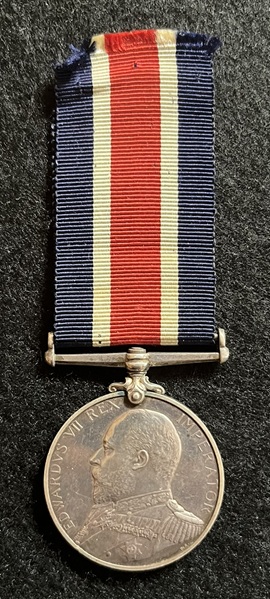 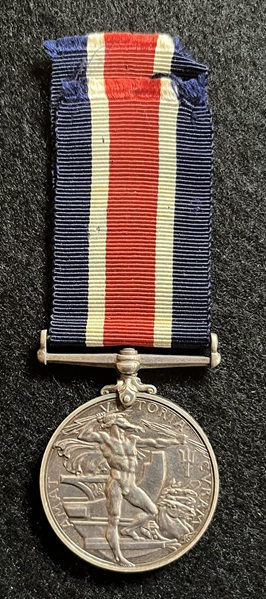    One. Naval Good Shooting Medal (EVII). Named to 147660 P.O. 1ST. CL. H.H. OSENTON H.M.S. SUPERB 1909 12 IN. B.L. With hard copy research showing Horace Hambridge Osenton was born on 1 November 1873 in Cliffe, Rochester, Kent, and joined the Royal Navy on 1 November 1891, aged 18, for an initial period of service of 12 years. Ships he served on include HMS Alexandra, HMS Resolution, HMS Albacore, HMS Hannibal, HMS Ocean, HMS Grafton, HMS Prince George, HMS Superb, HMS Jupiter, HMS Achilles, HMS Irresistable, and HMS Barham. Research also includes confirmation of his entitlement to the Naval Good Shooting Medal, as well as the 1914-15 Star, British War Medal 1914-20 and Victory Medal for his service in the First World War. One. Naval Good Shooting Medal (EVII). Named to 147660 P.O. 1ST. CL. H.H. OSENTON H.M.S. SUPERB 1909 12 IN. B.L. With hard copy research showing Horace Hambridge Osenton was born on 1 November 1873 in Cliffe, Rochester, Kent, and joined the Royal Navy on 1 November 1891, aged 18, for an initial period of service of 12 years. Ships he served on include HMS Alexandra, HMS Resolution, HMS Albacore, HMS Hannibal, HMS Ocean, HMS Grafton, HMS Prince George, HMS Superb, HMS Jupiter, HMS Achilles, HMS Irresistable, and HMS Barham. Research also includes confirmation of his entitlement to the Naval Good Shooting Medal, as well as the 1914-15 Star, British War Medal 1914-20 and Victory Medal for his service in the First World War. Good VF Condition $1100 |
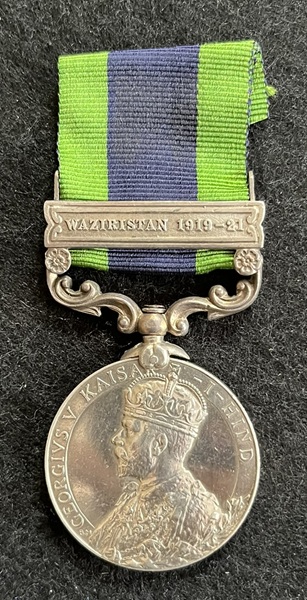 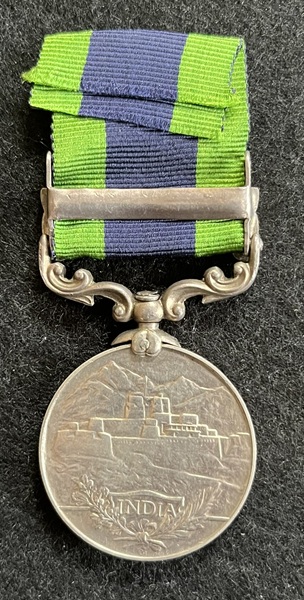  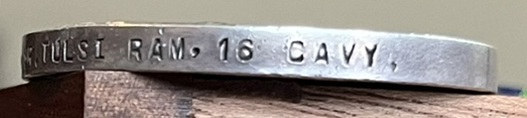 One. India General Service Medal 1908-1935 with clasp "WAZIRISTAN 1919-21". Named to 2850 SR JULSI RAM. 16 CAVY. Un-researched. Medal is loose on clean older ribbon. VF Condition $150 |
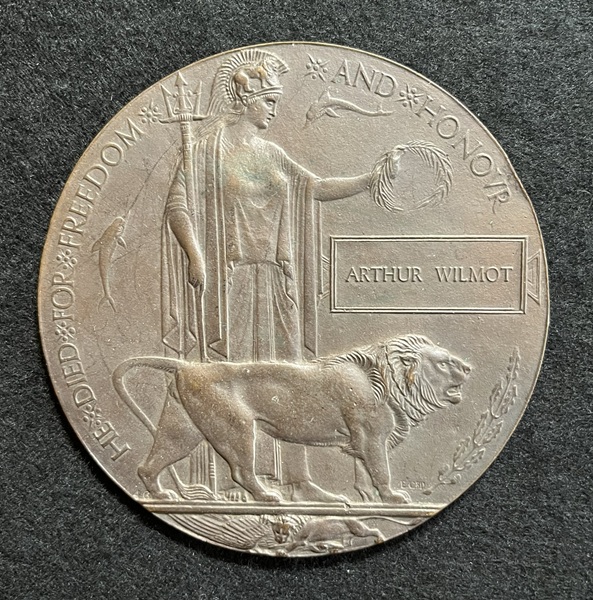 One. Memorial Plaque. Named to ARTHUR WILMOT. There are two casualties with this name in the Commonwealth War Graves Commission's database, one (7297, 1st Bn Gloucestershire Regt) died 29 October 1914 and is commemorated on the Menin Gate in Ypres; the second, (65350, 60th Coy MGC), died 14 August 1917 and is buried in the CWGC's Bard Cottage Cemetery, Belgium. Good VF Condition $225 |
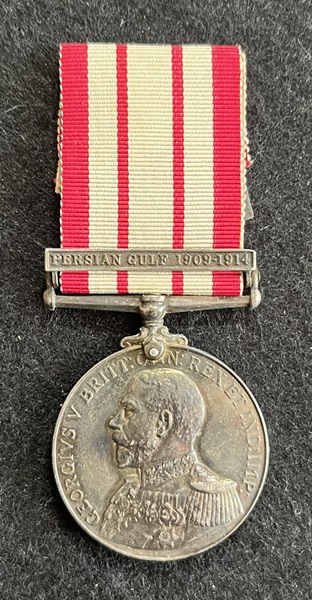 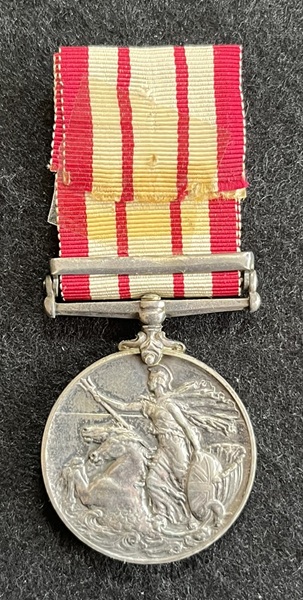 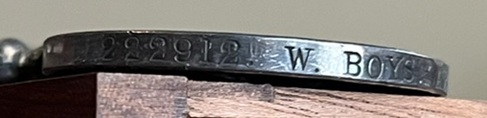 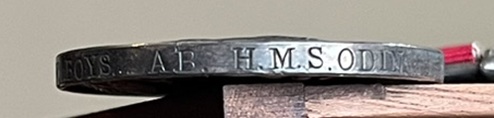 One. Naval General Service Medal (GV) with clasp PERSIAN GULF 1909-1914. Named to 222912 W. BOYS A.B. H.M.S. ODIN. Boys was born on 9 June 1887 in Portsmouth, England. He joined the Royal Navy in 1905, with his service including time aboard HMS Prince of Wales, HMS Excellent, HMS Odin, HMS Dido, and HMS Dreadnaught. He served on he latter ship for much of the First World War. With electronic copy of service record; medal is loose on soiled period ribbon. Good VF Condition $275 |
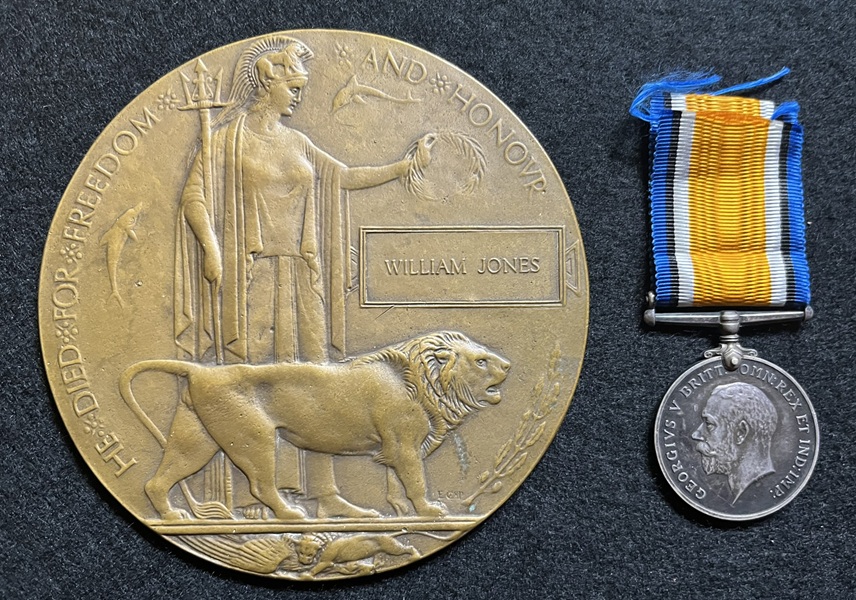 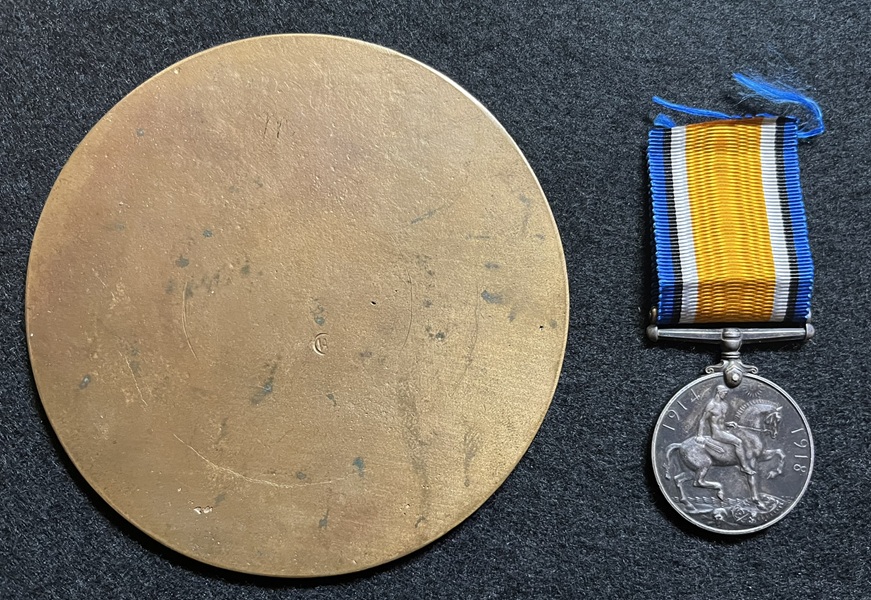   Two. British War Medal 1914-20 and Memorial Plaque. BWM named to 13711 PTE. W. JONES DURH. L.I. Memorial Plaque named to WILLIAM JONES. William Jones was killed in action on 28 March 1918 while serving with the 18th Bn Durham Light Infantry. He is commeorated on the CWGC's Arras Memorial, France. Good VF Condition $325 |
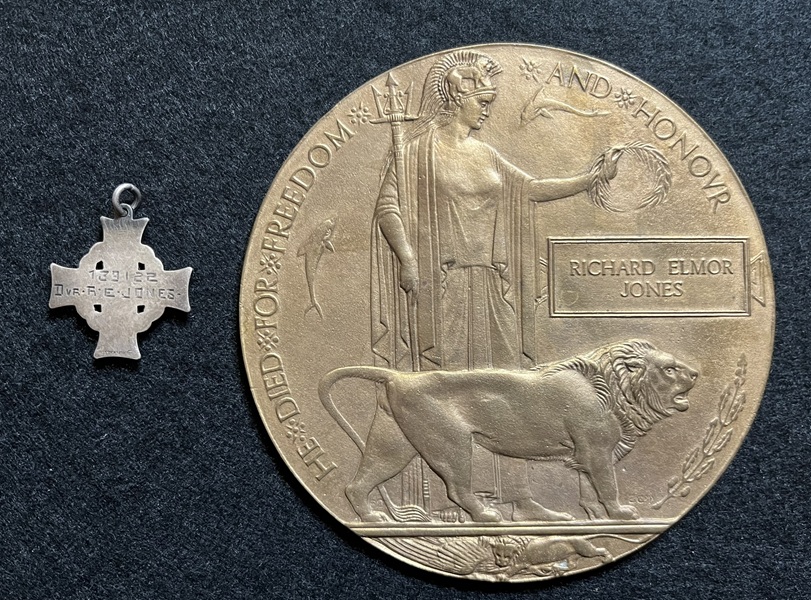   Two. Memorial Cross (GV) and Memorial Plaque. Cross named to 139122 DVR. R.E. JONES , and plaque named to RICHARD ELMOR JONES. Jones served with the 3rd Divisional Ammunition Column, Canadian Field Artillery. He was a Driver, with service number 139312. Jones was born in Vroncysyllte, North Wales on 21 January 1889. A miner in civilian life, with previous service in the 9th Mississauga Horse, he joined the 75th Battalion, Canadian Expeditionary Force on 23 July 1915 at Toronto, Ontario. He arrived in England on 9 April 1916, and was posted to the 3rd Battalion CEF in France as a reinforcement, joining the unit on 19 June 1916. He was wounded (shell shock/concussion and gas) a week later, on 28 June 1916. On 21 August 1916, shortly after rejoining the 3rd Battalion from hospital, he was transferred to the 3rd Canadian Division Ammunition Column as a driver. Jones was reported as missing, and later preseumed to have died on 9 October 1916, near Courcellette, France. Jones has no known grave, with his name appearing on the CWGC's Vimy Memorial, Vimy, France. Jones plaque was previously ;isted as a single item, but the client who consigned it recently located the Memorial Cross, which had become separated in storage. Good VF Condition $525 |
  One. Memorial Cross (GV). Named to 43757 Gnr.W. McPHEE. William McPhee was born on 10 July 1876 in Dalhousie, Ontario. He was working as a cook when he enlisted in the 1st Canadian Division's Divisional Ammunition Column as a Gunner at Valcartier, Quebec on 25 September 1914. McPhee died of wounds resulting from internal injuries caused by a kick from a horse while on actve duty in Belgium on 16 April 1916. He is buried in the Commonwealth War Graves Commission's Lijssenthoek Military Cemetery, Poperinge, Belgium. Cross is loose on a short length of clean modern ribbon. Good VF Condition $325 |
  One. Memorial Cross (GV). Named to LIEUT. G.A. DALZELL. George Alden Dalzell was the Battalion Sergeant Major of the 115th (New Brunswick) Battalion CEF before being commissioned in the Canadian Forestry Corps. He was from Grand Manan, New Brunswick, and died of illness (tuberculosis) on 24 March 1920. He is buried in North Head Anglican Church Cemetery, Grand Manan, New Brunswick. Good VF Condition $250 |
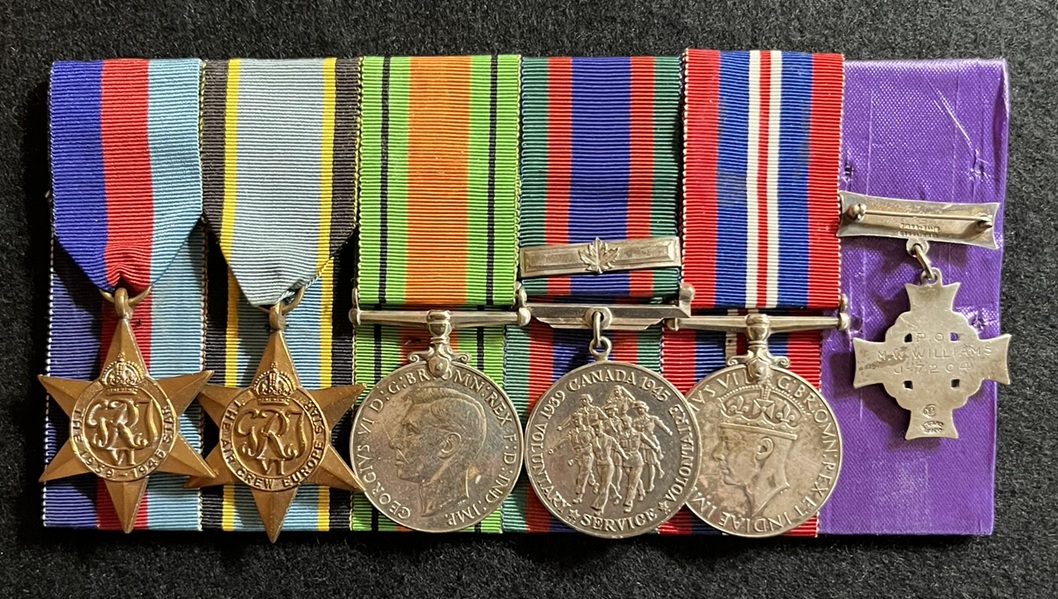 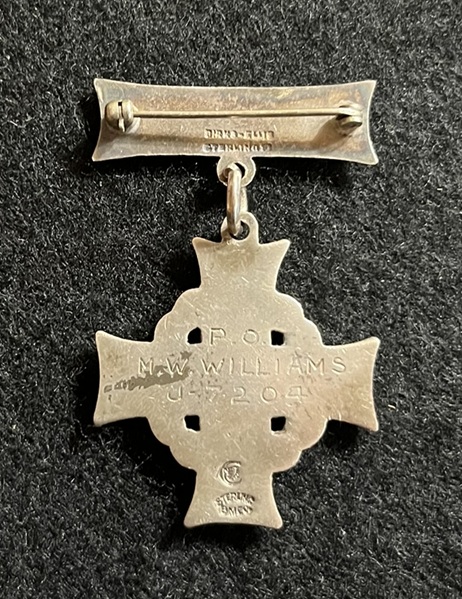 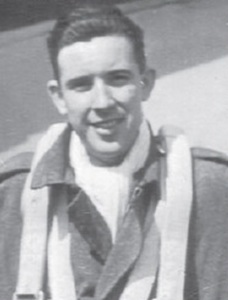 Six. 1939-45 Star, Air Crew Europe Star, Defence Medal, Canadian Volunteer Service Medal with Overseas bar, War Medal 1939-45, Memorial Cross (GVI). Cross named to P.O. M.W. WILLIAMS J-7204. Maldwyn Wyn Williams was born in Bettws, near Newtown, in mid Wales. His father was a minister in the area. The family moved to the United States in 1920 for a brief period and then moved to Canada in 1926. “Maldie”, as he was known, attended high school at Listowel, Ontario and graduated from the University of Toronto in 1938. He was an ordained Presbyterian minister, and married, at the time of his enlistment in the RCAF in August 1940. He joined the RCAF as a pilot trainee and was transferred to the Air Observer course. On successful completion of his training he left for Britain in September 1941. After a period of further training he was posted from OTU to 103 Squadron, Royal Air Force at Elsham Wolds on 7 May 1942. On the night of the 19/20th May 1942 Maldwyn was sadly killed taking part in his first operation. On this night 103 Squadron detailed 5 crews to bomb the German U Boat base at St Nazaire on the West coast of France. The crew, of which Maldwyn was a part, consisted of F/L P E Rees RAFVR, F/S L C Taylor RCAF, P/O M W Williams RCAF, Sgt B W Harris RAF, Sgt H C Watson RCAF, and Sgt W Mitchell RCAF. They took off from Elsham Wolds in a Vickers Wellington 1C serial number Z1141 at 2248. It was reported that there was slight heavy and light flak over the target by the returning crews. Wellington Z1141 was shot down in flames in the vicinity of the target. There were no survivors from the crew, who now rest at Escoublac-La-Baule War Cemetery, 13 km West of St Nazaire. Williams is also commemorated on a plaque located in the chapel of Knox College, a seminary of The Presbyterian Church in Canada situated on the St. George campus of the University of Toronto. A poignant and unusual early Canadian RCAF casualty, an ordained minister who died as a combatant. Six. 1939-45 Star, Air Crew Europe Star, Defence Medal, Canadian Volunteer Service Medal with Overseas bar, War Medal 1939-45, Memorial Cross (GVI). Cross named to P.O. M.W. WILLIAMS J-7204. Maldwyn Wyn Williams was born in Bettws, near Newtown, in mid Wales. His father was a minister in the area. The family moved to the United States in 1920 for a brief period and then moved to Canada in 1926. “Maldie”, as he was known, attended high school at Listowel, Ontario and graduated from the University of Toronto in 1938. He was an ordained Presbyterian minister, and married, at the time of his enlistment in the RCAF in August 1940. He joined the RCAF as a pilot trainee and was transferred to the Air Observer course. On successful completion of his training he left for Britain in September 1941. After a period of further training he was posted from OTU to 103 Squadron, Royal Air Force at Elsham Wolds on 7 May 1942. On the night of the 19/20th May 1942 Maldwyn was sadly killed taking part in his first operation. On this night 103 Squadron detailed 5 crews to bomb the German U Boat base at St Nazaire on the West coast of France. The crew, of which Maldwyn was a part, consisted of F/L P E Rees RAFVR, F/S L C Taylor RCAF, P/O M W Williams RCAF, Sgt B W Harris RAF, Sgt H C Watson RCAF, and Sgt W Mitchell RCAF. They took off from Elsham Wolds in a Vickers Wellington 1C serial number Z1141 at 2248. It was reported that there was slight heavy and light flak over the target by the returning crews. Wellington Z1141 was shot down in flames in the vicinity of the target. There were no survivors from the crew, who now rest at Escoublac-La-Baule War Cemetery, 13 km West of St Nazaire. Williams is also commemorated on a plaque located in the chapel of Knox College, a seminary of The Presbyterian Church in Canada situated on the St. George campus of the University of Toronto. A poignant and unusual early Canadian RCAF casualty, an ordained minister who died as a combatant. Good VF Condition $1600 |
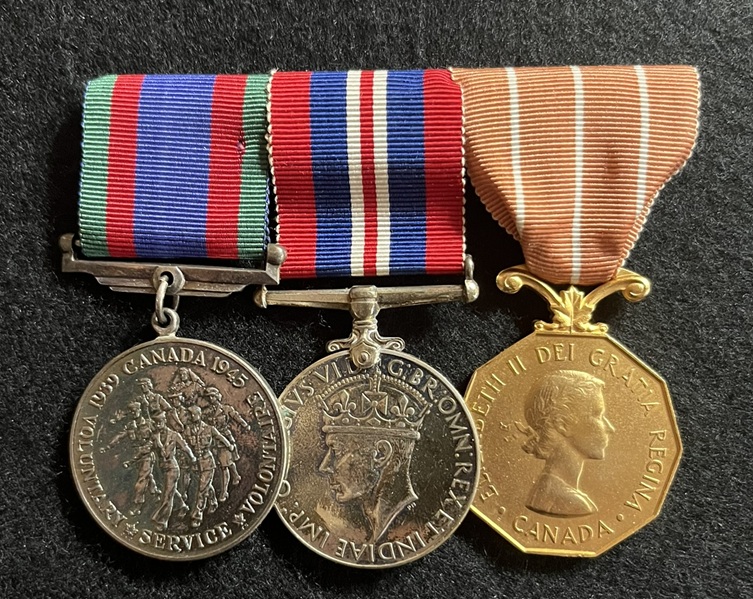 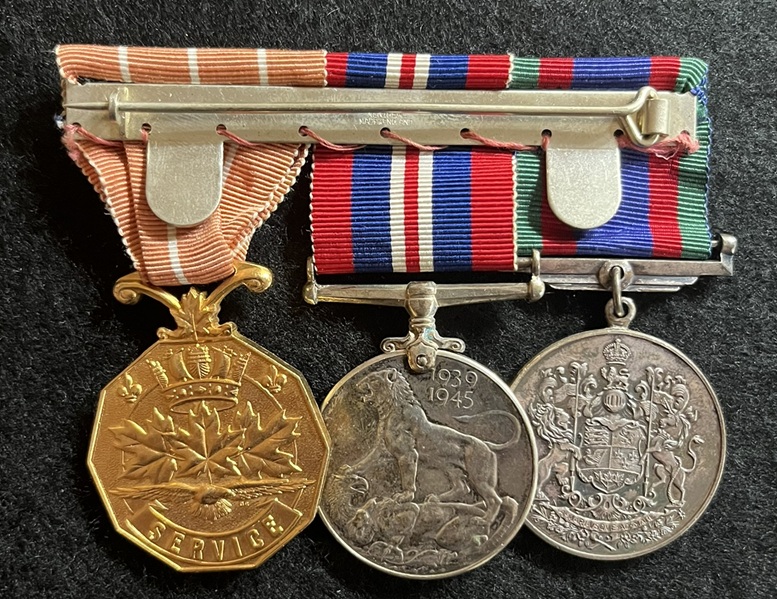 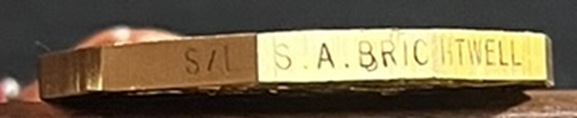 Three. Canadian Volunteer Service Medal, War Medal 1939-45 and Canadian Forces Decoration (EIIR). CD named to S/L S.A. BRIGHTWELL. Stanley Arthur Brightwell was born in Montreal, Quebec on 12 September 1925. He died on 24 June 2005, and he is buried in Mountain View Cemetery, Vancover, BC. Otherwise unresearched. Letter B in Brightwell's surname appears to have been double struck when medal was named (see images). Medals are swing mounted as worn on clean original ribbons. Three. Canadian Volunteer Service Medal, War Medal 1939-45 and Canadian Forces Decoration (EIIR). CD named to S/L S.A. BRIGHTWELL. Stanley Arthur Brightwell was born in Montreal, Quebec on 12 September 1925. He died on 24 June 2005, and he is buried in Mountain View Cemetery, Vancover, BC. Otherwise unresearched. Letter B in Brightwell's surname appears to have been double struck when medal was named (see images). Medals are swing mounted as worn on clean original ribbons. EF Condition $250 |
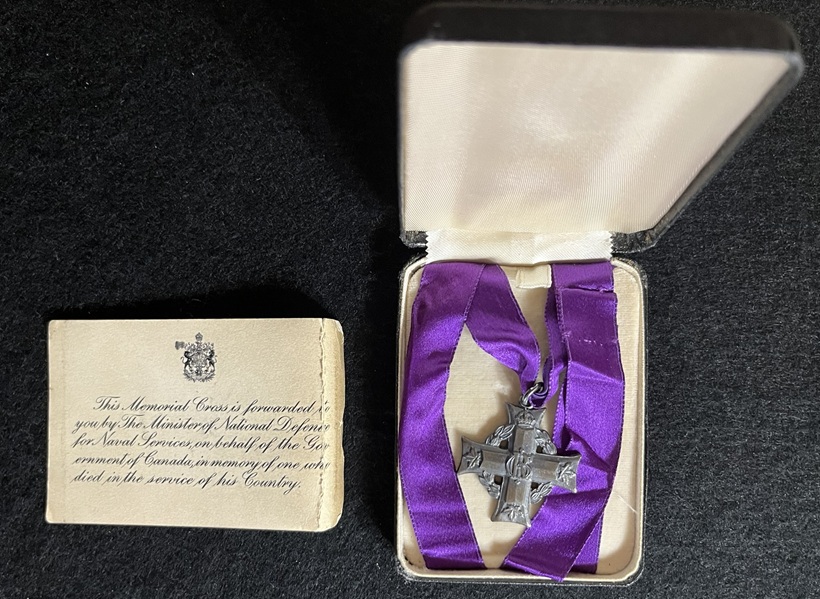 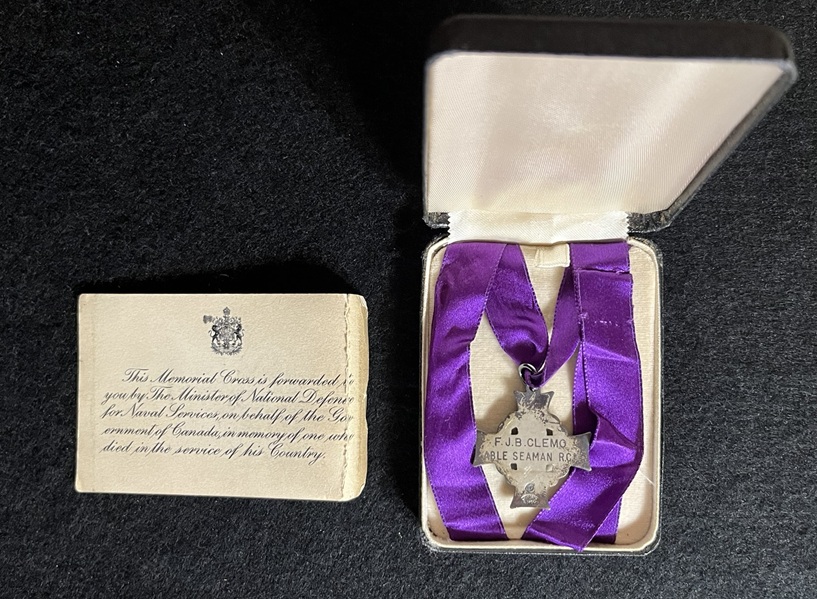 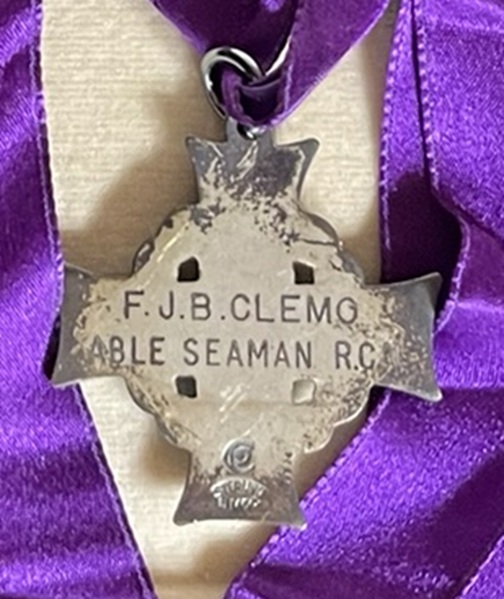 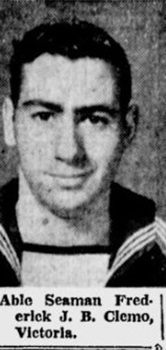 One. Memorial Cross (GVI). Cross named to F.J.B. CLEMO ABLE SEAMAN R.C.N. Frederick John Byron Clemo was born on 7 September 1922 in Victoria, British Columbia. He joined the Royal Canadian Navy Volunteer Reserve on 23 February 1941; at the time of his enlistment, he was working as a cook and living on Salt Spring Island in BC. He was assigned to HMCS Naden until 26 March 1941, when he was transferred to the Royal Canadian Navy as an Ordinary Seaman. Clemo had previously served in the militia, as a member of the 3rd Battalion Canadian Scottish Regiment, between August 1940 and February 1941. Clemo began his service on HMCS Ottawa on 3 September 1941. He was aboard the ship on the night of September 13-14, 1942, when HMCS Ottawa was torpedoed and sunk by the German submarine U-91 while escorting Convoy ON-127. The destroyer broke in half and sank about 500 miles east of St. John's, Newfoundland, resulting in the tragic deaths of 114 of her crew. A C-class destroyer originally built as HMS Crusader, HMCS Ottawa was serving in the 4th Escort Group. Just three days before she was sunk, Ottawa had heroically rescued 24 survivors from the British steam tanker Empire Oil, which had also been torpedoed in the North Atlantic. HMCS Ottawa was first attacked around 11:00 PM on September 13, when the U-91 fired a spread of torpedoes. One struck Ottawa, severely damaging the ship and crippling its engines. Less than 30 minutes later, a second torpedo hit the defenceless Ottawa, breaking it in half and sending it to the ocean floor. Only 65 survivors were pulled from the frigid waters by nearby allied vessels. Climo was sadly one of those who perished. He is commemorated on the Halifax Memorial (Panel 5). Clemo is entitled to the 1939-45 Star, Atlantic Star, Canadian Volunteer Service Medal with Overseas clasp, and War Medal 1939-45. Cross is in box of issue on original ribbon, with creased forwarding card from MND for Naval Services. One. Memorial Cross (GVI). Cross named to F.J.B. CLEMO ABLE SEAMAN R.C.N. Frederick John Byron Clemo was born on 7 September 1922 in Victoria, British Columbia. He joined the Royal Canadian Navy Volunteer Reserve on 23 February 1941; at the time of his enlistment, he was working as a cook and living on Salt Spring Island in BC. He was assigned to HMCS Naden until 26 March 1941, when he was transferred to the Royal Canadian Navy as an Ordinary Seaman. Clemo had previously served in the militia, as a member of the 3rd Battalion Canadian Scottish Regiment, between August 1940 and February 1941. Clemo began his service on HMCS Ottawa on 3 September 1941. He was aboard the ship on the night of September 13-14, 1942, when HMCS Ottawa was torpedoed and sunk by the German submarine U-91 while escorting Convoy ON-127. The destroyer broke in half and sank about 500 miles east of St. John's, Newfoundland, resulting in the tragic deaths of 114 of her crew. A C-class destroyer originally built as HMS Crusader, HMCS Ottawa was serving in the 4th Escort Group. Just three days before she was sunk, Ottawa had heroically rescued 24 survivors from the British steam tanker Empire Oil, which had also been torpedoed in the North Atlantic. HMCS Ottawa was first attacked around 11:00 PM on September 13, when the U-91 fired a spread of torpedoes. One struck Ottawa, severely damaging the ship and crippling its engines. Less than 30 minutes later, a second torpedo hit the defenceless Ottawa, breaking it in half and sending it to the ocean floor. Only 65 survivors were pulled from the frigid waters by nearby allied vessels. Climo was sadly one of those who perished. He is commemorated on the Halifax Memorial (Panel 5). Clemo is entitled to the 1939-45 Star, Atlantic Star, Canadian Volunteer Service Medal with Overseas clasp, and War Medal 1939-45. Cross is in box of issue on original ribbon, with creased forwarding card from MND for Naval Services. EF Condition $900 |
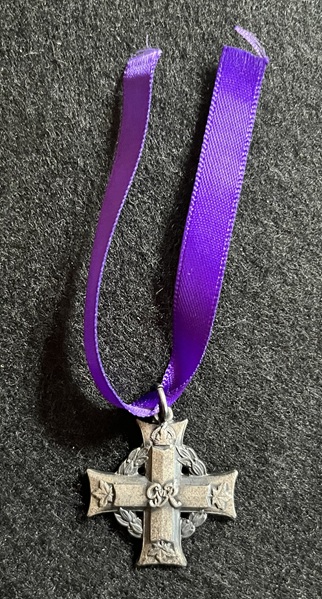 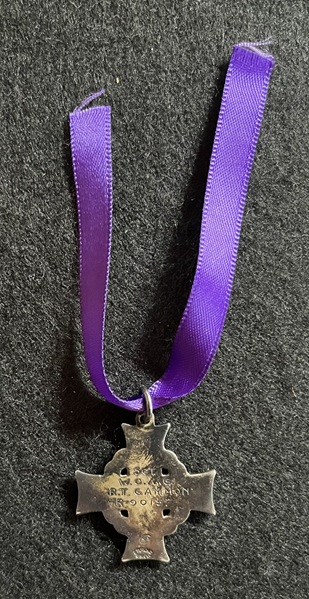 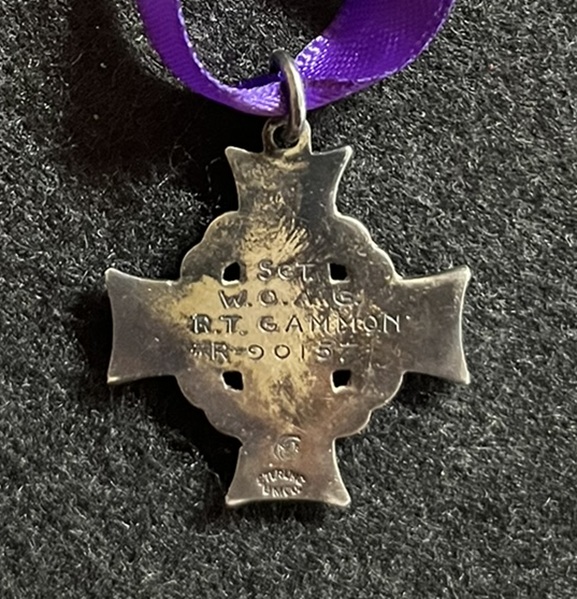 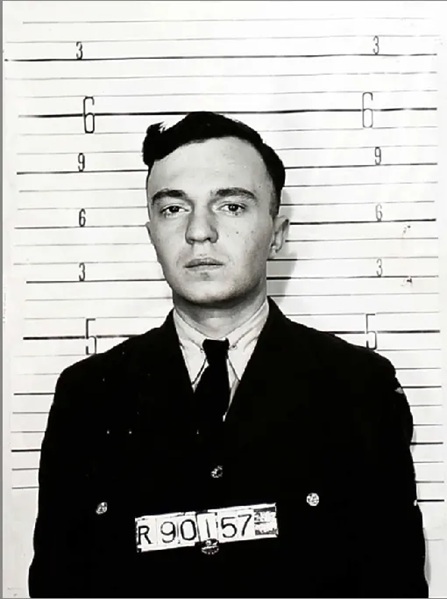 One. Memorial Cross (GVI). Named to SGT. W.O.A.G. R.T. GAMMON #R-90157. Rex Thomas Gammon was born in Sarnia, Ontario on 11 December 1916. He enrolled in the Royal Canadian Air Force in February 1941, and was serving as a Wireless Air Gunner with 22 Operational Training Unit, Royal Air Force when he was killed in action during a bombing mission targeting Hamburg, Germany on 28 July 1942. Loose on short length of replacement ribbon. One. Memorial Cross (GVI). Named to SGT. W.O.A.G. R.T. GAMMON #R-90157. Rex Thomas Gammon was born in Sarnia, Ontario on 11 December 1916. He enrolled in the Royal Canadian Air Force in February 1941, and was serving as a Wireless Air Gunner with 22 Operational Training Unit, Royal Air Force when he was killed in action during a bombing mission targeting Hamburg, Germany on 28 July 1942. Loose on short length of replacement ribbon. Good VF Condition $600 |
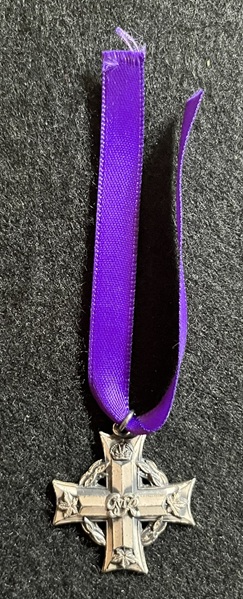 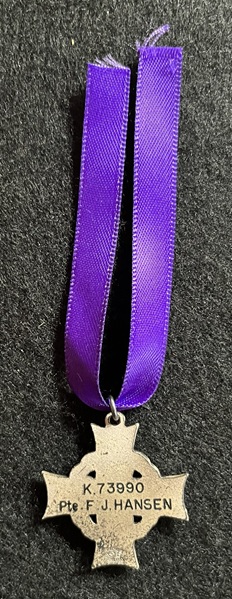 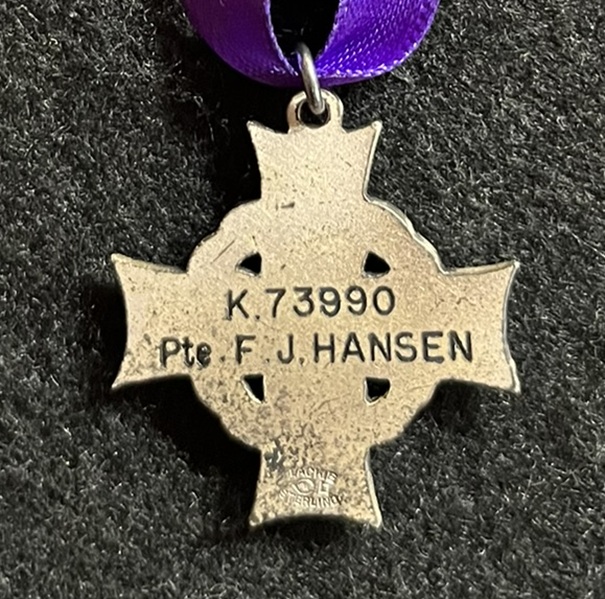 One. Memorial Cross (GVI). Named to K.73990 Pte. F.J. HANSEN. Frederick John Hansen was born on 26 June 1917 in Vancouver, British Columbia. He enlisted in the Canadian Active Service Force on 10 December 1940, and served with the Westminster Regiment. He was killed in action in Italy on 13 April 1944, at the age of 26, and he is buried in the Commonwealth War Graves Commission's Cassino War Cemetery, Cassino, Italy. Hansen is entitled to the 1939-45 Star, Italy Star, Defence Medal, War Medal 1939-45 and Canadian Volunteer Service Medal with Overseas clasp. Loose on short length of replacement ribbon. One. Memorial Cross (GVI). Named to K.73990 Pte. F.J. HANSEN. Frederick John Hansen was born on 26 June 1917 in Vancouver, British Columbia. He enlisted in the Canadian Active Service Force on 10 December 1940, and served with the Westminster Regiment. He was killed in action in Italy on 13 April 1944, at the age of 26, and he is buried in the Commonwealth War Graves Commission's Cassino War Cemetery, Cassino, Italy. Hansen is entitled to the 1939-45 Star, Italy Star, Defence Medal, War Medal 1939-45 and Canadian Volunteer Service Medal with Overseas clasp. Loose on short length of replacement ribbon. Good VF Condition $800 |
    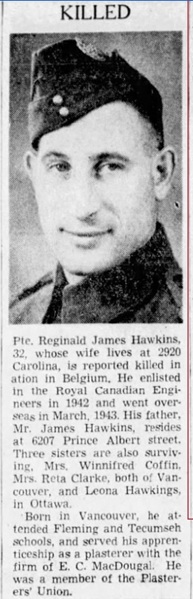 Six. 1939-45 Star, France and Germany Star, Defence Medal, Canadian Volunteer Service Medal with Overseas clasp, War Medal, and Memorial Bar. Bar named L.CPL. R.J. HAWKINS R.H.L.I. DIED IN HIS COUNTRY'S SERVICE 22 NOV 1944. Reginald James Hawkins was a plasterer/construction worker in civilian life, aged 30 and married, when he enrolled in the Royal Canadian Engineers as a Sapper in November 1942 at Vancouver, British Columbia. He appears to have worked as a plasterer while serving in the UK in 1943 and 1944, receiving specialist pay in this role, before being reclassified to general duties in August 1944, and then transferred to an infantry role in the Rocky Mountain Rangers, still in the UK. On 17 October 1944, he was sent forward to Belgium as an infantry reinforcement, joining the Royal Hamilton Light Infantry on 24 October. Promoted to Lance Corporal a short time later, on 15 November, Hawkins was killed in action a week later, on 22 November 1944, while on a fighting patrol under the command of Lt J.D. Bell in Groesbeek, The Netherlands. Hawkins is buried in the Commmonwealth War Graves Commission's Groesbeek Canadian War Cemetery, Groesbeek, Netherlands. Hawkins' medals and the Memorial Bar issued in his memory are accompanied by the slip for Memorial Bar, card to next of kin in envelope named to Hawkins' wife Elizabeth at an address in Vancouver, British Columbia, and a bestowal slip for the medals named to K.9687 PTE. R.J. HAWKINS in mailing envelope with medals, which remain in their original boxes. Also with the group is a telegram reporting Hawkins' death in action, and several letters and envelopes marked OHMS from Veterans' Affairs addressed to his wife Elizabeth, dealing with survivor benefits due to her. An incredible archive, with much scope for further research. Six. 1939-45 Star, France and Germany Star, Defence Medal, Canadian Volunteer Service Medal with Overseas clasp, War Medal, and Memorial Bar. Bar named L.CPL. R.J. HAWKINS R.H.L.I. DIED IN HIS COUNTRY'S SERVICE 22 NOV 1944. Reginald James Hawkins was a plasterer/construction worker in civilian life, aged 30 and married, when he enrolled in the Royal Canadian Engineers as a Sapper in November 1942 at Vancouver, British Columbia. He appears to have worked as a plasterer while serving in the UK in 1943 and 1944, receiving specialist pay in this role, before being reclassified to general duties in August 1944, and then transferred to an infantry role in the Rocky Mountain Rangers, still in the UK. On 17 October 1944, he was sent forward to Belgium as an infantry reinforcement, joining the Royal Hamilton Light Infantry on 24 October. Promoted to Lance Corporal a short time later, on 15 November, Hawkins was killed in action a week later, on 22 November 1944, while on a fighting patrol under the command of Lt J.D. Bell in Groesbeek, The Netherlands. Hawkins is buried in the Commmonwealth War Graves Commission's Groesbeek Canadian War Cemetery, Groesbeek, Netherlands. Hawkins' medals and the Memorial Bar issued in his memory are accompanied by the slip for Memorial Bar, card to next of kin in envelope named to Hawkins' wife Elizabeth at an address in Vancouver, British Columbia, and a bestowal slip for the medals named to K.9687 PTE. R.J. HAWKINS in mailing envelope with medals, which remain in their original boxes. Also with the group is a telegram reporting Hawkins' death in action, and several letters and envelopes marked OHMS from Veterans' Affairs addressed to his wife Elizabeth, dealing with survivor benefits due to her. An incredible archive, with much scope for further research. Good VF Condition $825 |
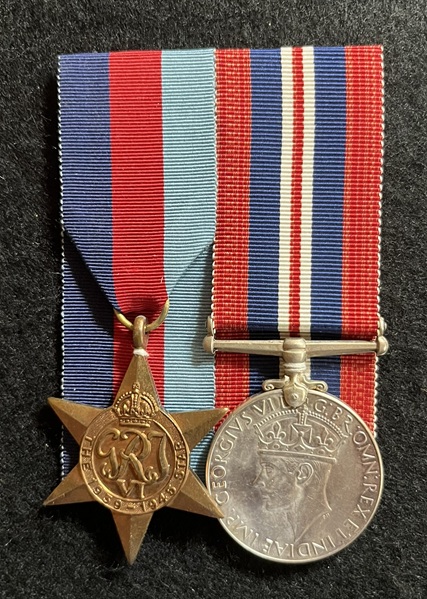   Two. 1939-45 Star and War Medal 1939-45 (Canadian issue). War Medal officially named THOMAS MCNAMEE in engraved capitals. The War Medal 1939-45 was issued officially named to Canadian Merchant Navy members, and McNamee's medal is named in a known engraving style used by one of the contractors involved. Thomas Constantine McNamee was born on 24 July 1906 in Jamaica, British West Indies. He came to Canada at a young age and was living in Halifax, Nova Scotia when he joined the Merchant Navy, signing on to his first ship, S.S. Northstar, in 1937. He apparently continued to serve in the Merchant Marine when the Second World War began and signed on to the S.S.Kantara on 14 January 1941 as a Trimmer / Fireman. The S.S. Kantara was a British steel screw cargo steamer owned by the Moss Hutchison Line Ltd. As part of Convoy SC20, the S.S. Kantara was sunk off Iceland by the German battleship Gneisenau on 22 February 1941. Gneisenau and her sister battleship Scharnhorst were involved in this engagement, in which three other cargo ships were also lost. The survivors, including McNamee, were taken to Marlag u Milag Nord, which was a Merchant Marine Prisoner of War camp in Germany. After the war, McNamee served in the Merchant Marine from 1946 to 1949, and it is believed that he became a taxi driver in Halifax, Nova Scotia. McNamee passed away in Halifax on 21 October 1978 and is interred in Fairview Cemetery. The group includes a picture of McNamee, a copy of his Merchant Marine ID certificate, a complete crew list obtained from the Department of Transport (UK), his obituary, as well as other supporting documentation. Medals are court-mounted on clean original ribbons. Two. 1939-45 Star and War Medal 1939-45 (Canadian issue). War Medal officially named THOMAS MCNAMEE in engraved capitals. The War Medal 1939-45 was issued officially named to Canadian Merchant Navy members, and McNamee's medal is named in a known engraving style used by one of the contractors involved. Thomas Constantine McNamee was born on 24 July 1906 in Jamaica, British West Indies. He came to Canada at a young age and was living in Halifax, Nova Scotia when he joined the Merchant Navy, signing on to his first ship, S.S. Northstar, in 1937. He apparently continued to serve in the Merchant Marine when the Second World War began and signed on to the S.S.Kantara on 14 January 1941 as a Trimmer / Fireman. The S.S. Kantara was a British steel screw cargo steamer owned by the Moss Hutchison Line Ltd. As part of Convoy SC20, the S.S. Kantara was sunk off Iceland by the German battleship Gneisenau on 22 February 1941. Gneisenau and her sister battleship Scharnhorst were involved in this engagement, in which three other cargo ships were also lost. The survivors, including McNamee, were taken to Marlag u Milag Nord, which was a Merchant Marine Prisoner of War camp in Germany. After the war, McNamee served in the Merchant Marine from 1946 to 1949, and it is believed that he became a taxi driver in Halifax, Nova Scotia. McNamee passed away in Halifax on 21 October 1978 and is interred in Fairview Cemetery. The group includes a picture of McNamee, a copy of his Merchant Marine ID certificate, a complete crew list obtained from the Department of Transport (UK), his obituary, as well as other supporting documentation. Medals are court-mounted on clean original ribbons. Good VF Condition $400 |
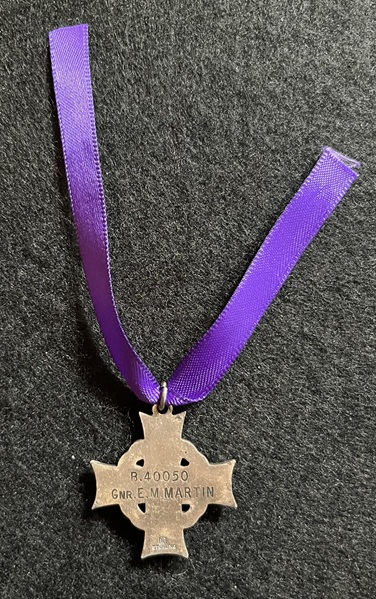 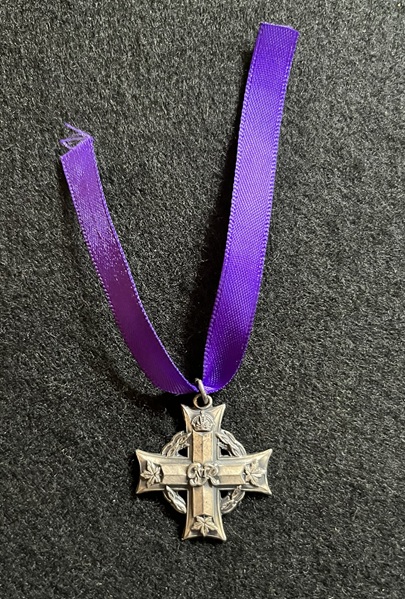 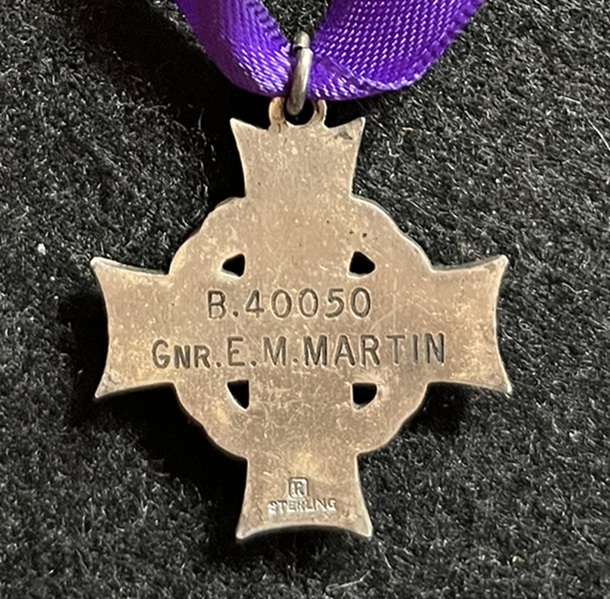 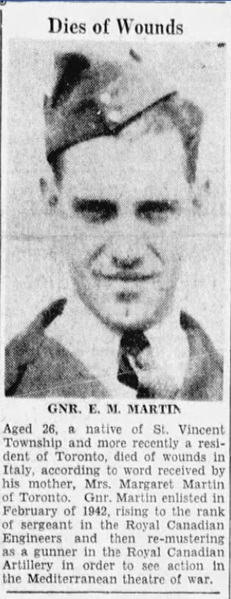 One. Memorial Cross (GVI). Named to B.40050 Gnr. E.M. MARTIN. Ernest Melbourne Martin was born on 15 March 1918 in Meaford, Ontario. He was a sheet metal worker when he enrolled in the No. 2 District Depot (Active Force) Royal Canadian Engineers on 16 February 1942. He proceeded overseas to England in June 1942, landing on 26 June, and being taken into 1 CARU. Martin continued his training overseas, advancing in rank to Acting Lance Sergeant before embarking for Italy as a reinforcement for the RCA in November 1943. He reverted to the rank of Gunner on joining 3rd Field Regiment in late January 1944. Martin was wounded in action (shell fragment wounds to chest and right hand) on 24 October 1944, when a German 88 shell landed amongst a group of gunners, killing one and wounding 4, including him. He was promoted to Lance Bombardier on 9 December 1944, before being wounded again on 10 January 1945, dying of his wounds on 11 January 1945. Martin is buried in the Commonwealth War Graves Commission's Argenta Gap War Cemetery. Italy. Cross is loose on short length of replacement ribbon. One. Memorial Cross (GVI). Named to B.40050 Gnr. E.M. MARTIN. Ernest Melbourne Martin was born on 15 March 1918 in Meaford, Ontario. He was a sheet metal worker when he enrolled in the No. 2 District Depot (Active Force) Royal Canadian Engineers on 16 February 1942. He proceeded overseas to England in June 1942, landing on 26 June, and being taken into 1 CARU. Martin continued his training overseas, advancing in rank to Acting Lance Sergeant before embarking for Italy as a reinforcement for the RCA in November 1943. He reverted to the rank of Gunner on joining 3rd Field Regiment in late January 1944. Martin was wounded in action (shell fragment wounds to chest and right hand) on 24 October 1944, when a German 88 shell landed amongst a group of gunners, killing one and wounding 4, including him. He was promoted to Lance Bombardier on 9 December 1944, before being wounded again on 10 January 1945, dying of his wounds on 11 January 1945. Martin is buried in the Commonwealth War Graves Commission's Argenta Gap War Cemetery. Italy. Cross is loose on short length of replacement ribbon. EF Condition $725 |
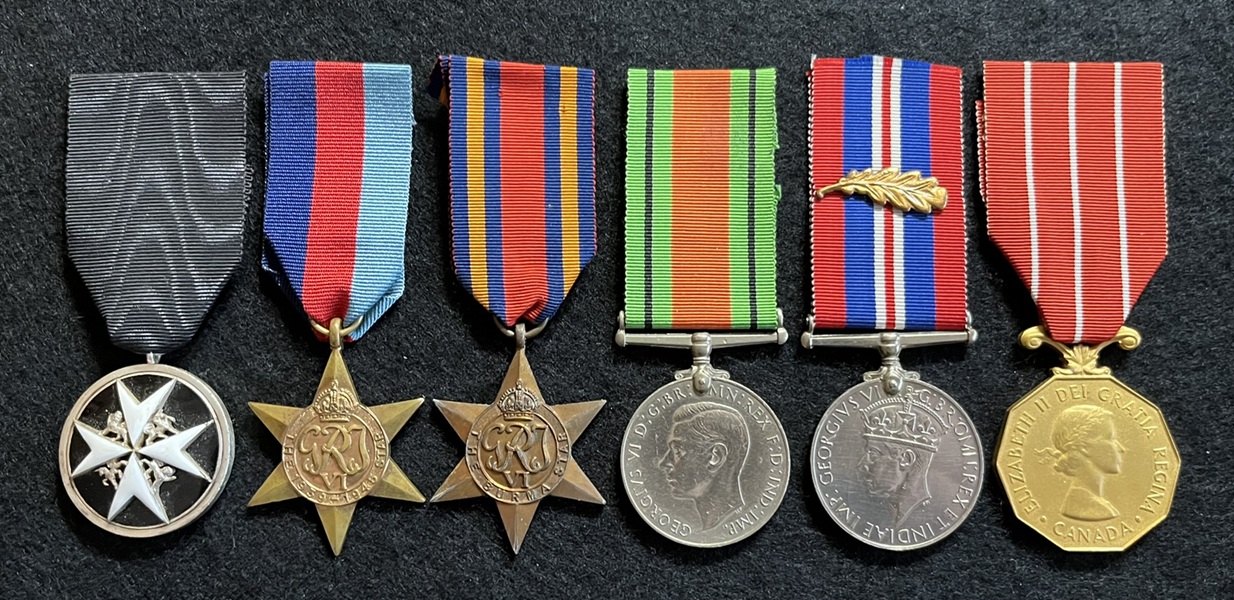 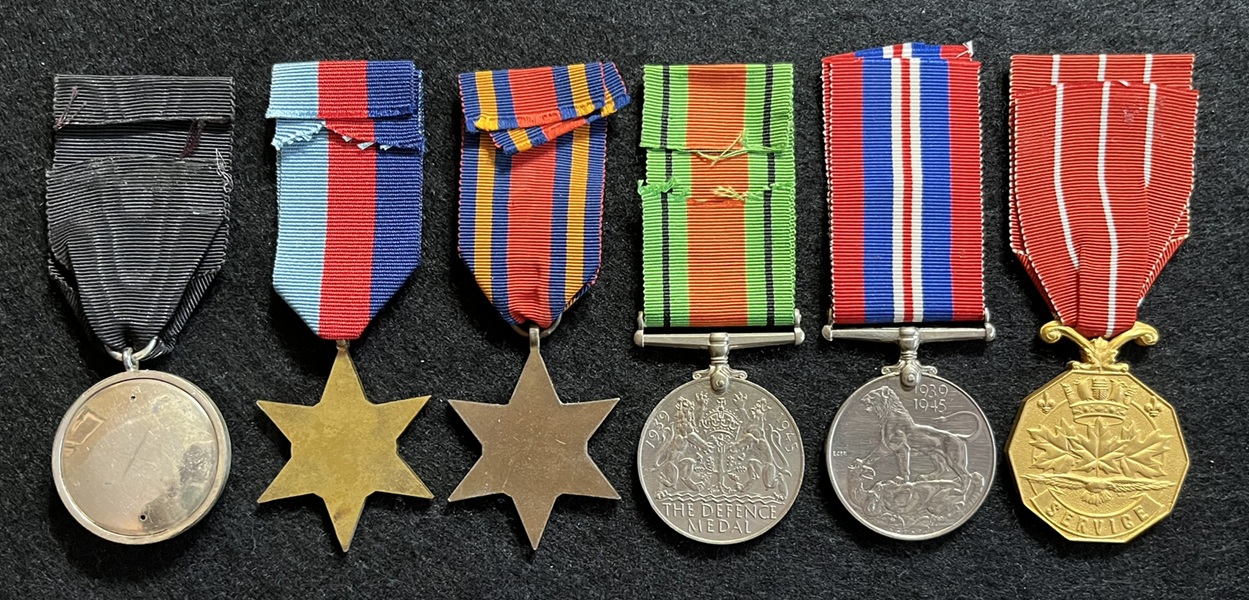  Six. Serving Brother Order of St. John, 1939-1945 Star, Burma Star, Defence Medal (British issue), War Medal 1939-45 (British issue) with Mention in Dispatches, Canadian Forces Decoration (EIIR). CD named to LT COL G. McCRACKEN. George McCracken was a doctor whose military service included time spent in the Royal Army Medical Corps as a Lieutenant between April and November 1942, before his transfer to the Indian Army Medical Service, where he practiced for the remainder of the war. His roles included Staff Surgeon, General Duties Major, Medical Specialist, and time as Senior Medical Officer and Officer Commanding the Medical Division Ambala. He emigrated to Canada sometime after the war, and joined the Royal Canadian Army Medical Corps in October 1951. He served at 1 Field Ambulance and 11 Medical Company in Kingston, Ontario, at the Cadet Summer Camp Blackdown, and as a member of the Central Command Medical Advisory Staff. McCracken commanded 11 Medical Company as a Lieutenant Colonel between 1954 and 1960, before retiring from military service in 1964. His CD was awarded in May 1960. McCracken appears to have claimed a replacement Defence Medal, MiD emblem, and CD in 1977. Medals are loose on clean ribbons. Good VF Condition $400 |
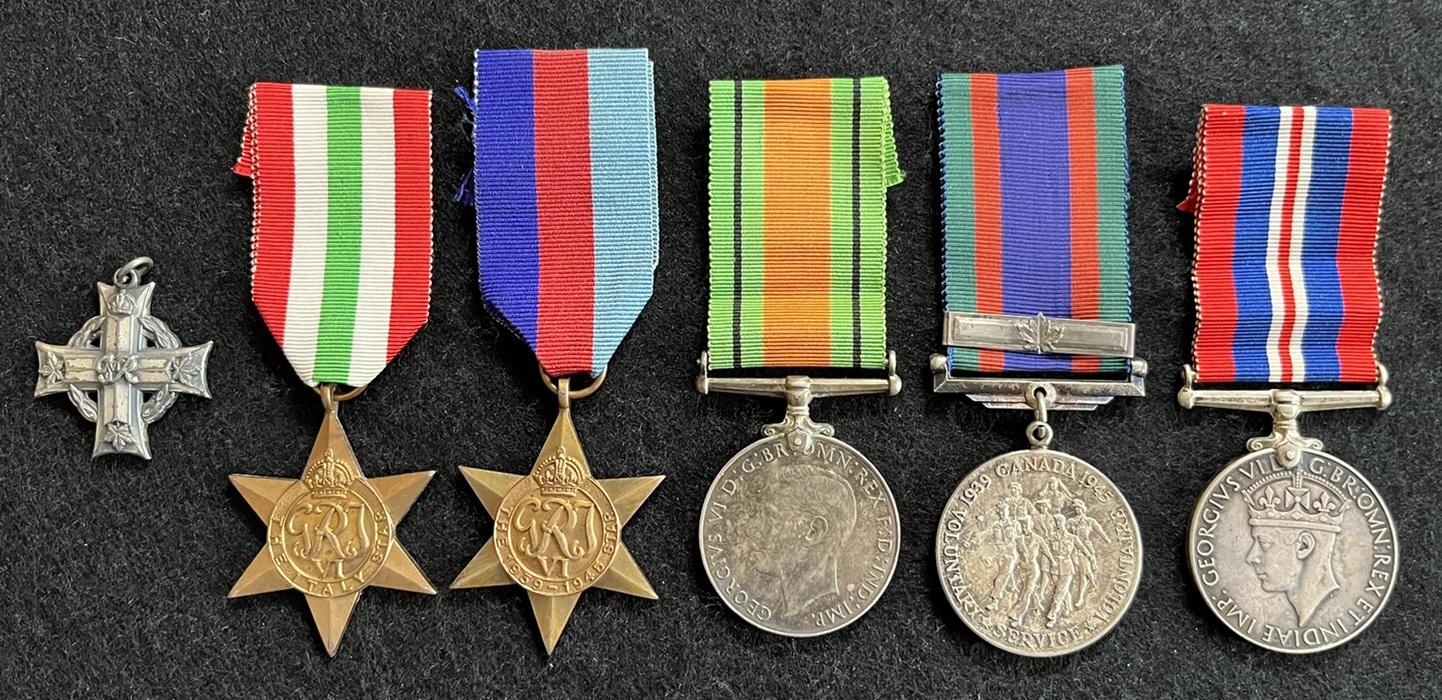 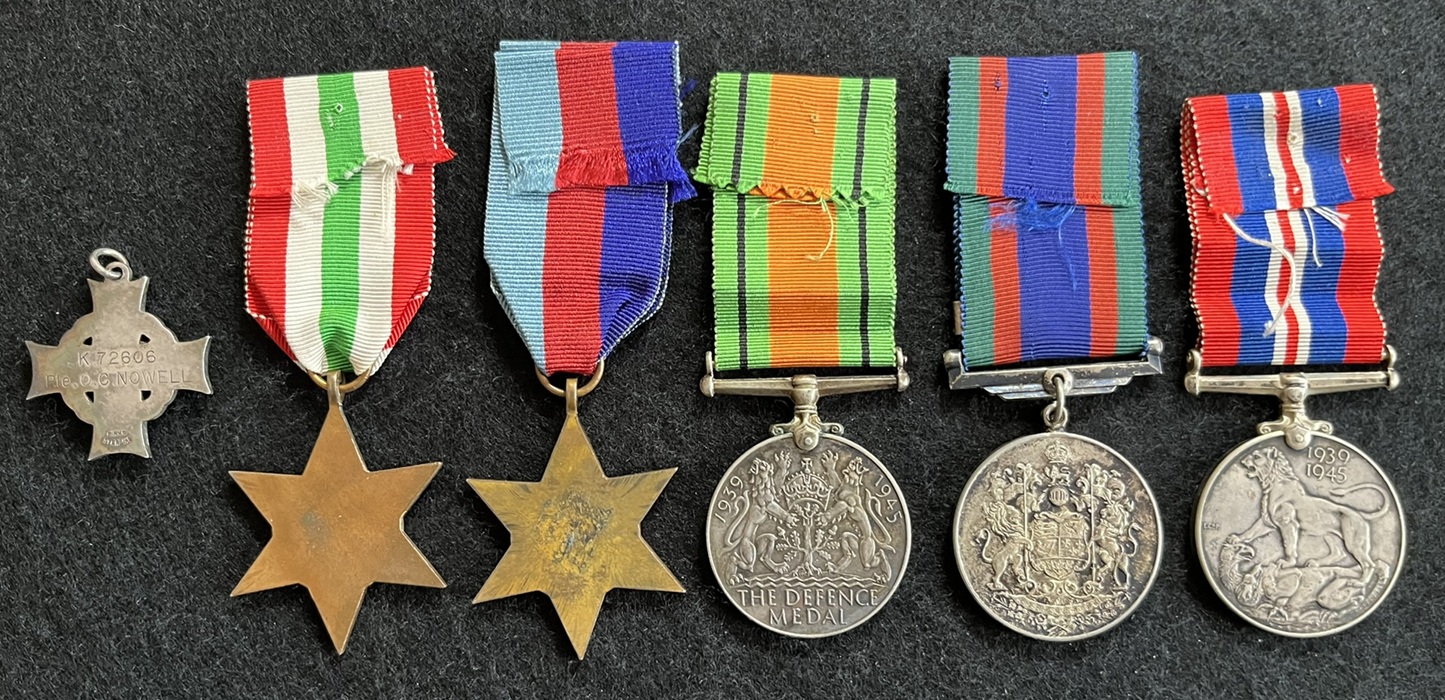 Six. 1939-45 Star, Italy Star, Defence Medal (Canadian issue), Canadian Volunteer Service Medal with Overseas bar, War Medal 1939-45 (Canadian issue), Memorial Cross (GVI). Cross named to K.72606 PTE. O.C. NOWELL (first initial should be "N" for Norville; error on "Overseas Casualty Notification" has first name spelled as "Orville" hence the "O" instead of "N"). Norville Carl Nowell was born on 7 December 1919 in Chilliwack, British Columbia. He was a farmer, living with his father in Yarrow, British Columbia, when he enlisted in 18 Company, Canadian Forestry Corps, Canadian Active Service Force on 16 September 1940 in Vancouver, British Columbia. Nowell was transferred to No. 10 Company CFC in Valcartier, Quebec in February 1941. He deployed overseas to the United Kingdom with his unit in June 1941, and transferred to the Westminster Regiment in December 1942, and to No 1 Canadian Infantry Replacement unit in January 1943. Nowell appears to have spent a good deal of time absent without leave and in hospital while in the UK, and his record includes mention of a two month prison sentance for a civil conviction in early 1943, which was ultimately shortened by 19 days. He joined the Seaforth Highlanders of Canada as a reinforcement on 3 June 1943, embarking the following month on 15 August for Italy. Nowell joined the Seaforth Highlanders of Canada in the field on 27 August 1943, and served in the unit until he was killed in action on 11 December 1943. He is buried in the Commonwealth War Graves Commission's Moro River Cemetery, Italy. Medals are loose on clean ribbons; cross without ribbon or case. Good VF Condition $1000 |
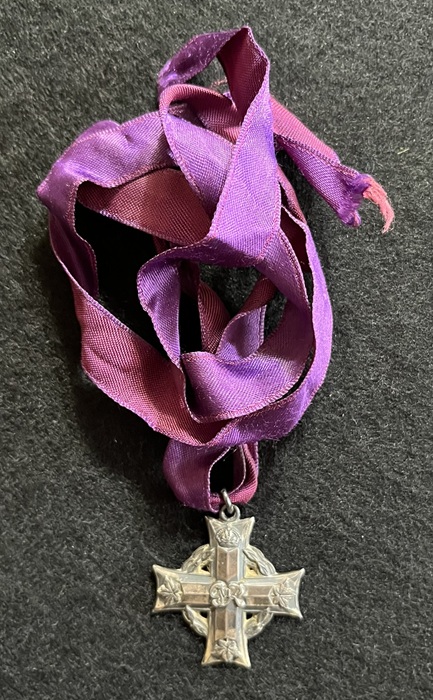 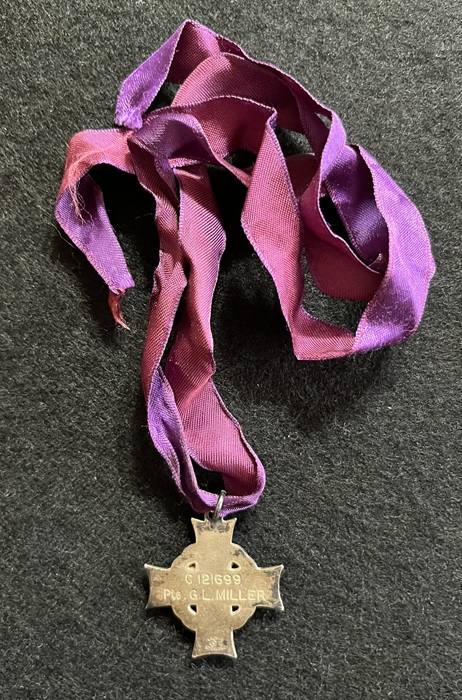 One. Memorial Cross (GVI). Named to C.121699 Pte. G.L. MILLER. Gilbert Lawrence Miller was born on 25 December 1921 in Prescott, Ontario. He enrolled in the Canadian Active Service Force at Kingston, Ontario on 11 July 1943 in the No 3 District Depot Officer Training Centre, with his attestation form noting that he had served with The Brockville Rifles A&T Staff OTC as a Private since April 1941. He embarked for the United Kingdom in February 1944, joining 1 Canadian Infantry Replacement Unit on 14 March. Miller was deployed to Italy as a reinforcement on 27 March 1944, joining the Seaforth Highlanders of Canada on 25 May. He died of wounds received in action on 1 June 1944. Miller is buried in the Commonwealth War Graves Commission's Cassino War Cemetery, Cassino, Italy. Cross is suspended on original slightly distressed ribbon; Miller is also entitled to the 1939-45 Star, Italy Star, Canadian Volunteer Service Medal with Overseas clasp, and the War Medal 1939-45. Good VF Condition $800 |
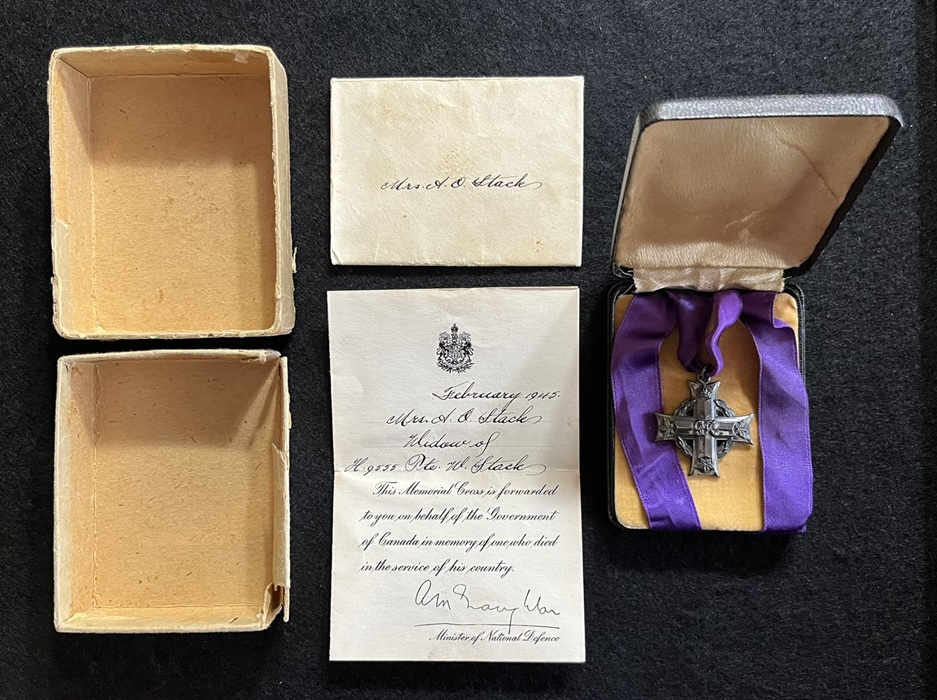 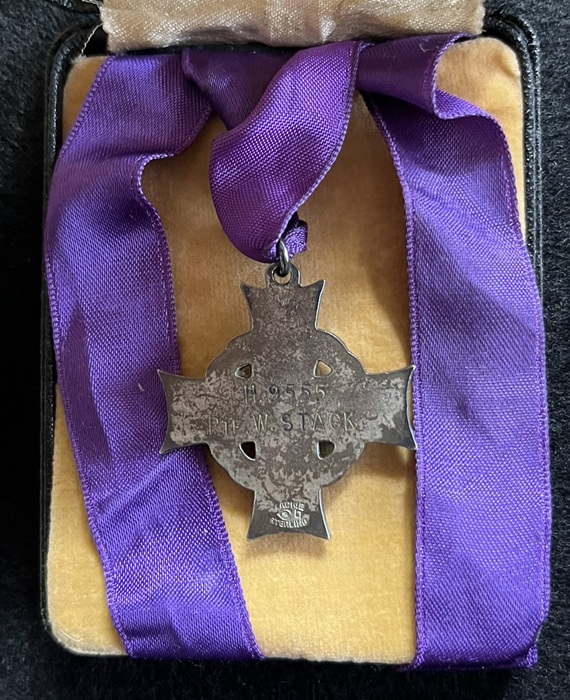 One. Memorial Cross (GVI). Named to H.9555 Pte. W. STACK. Walter Stack was born on 9 February 1915 in Lorette, Manitoba. He enrolled in the Canadian Active Service Force at No. 10 District Depot in Winnipeg, Manitoba on 28 April 1943. Stack's enrollment paperwork notes that he was married, and his wife, Ada, gave birth to their daughter, Judy, just a few days before he enrolled. He was working as a tractor operator when he joined the Canadian Army, and his file notes that he spoke English, French and Ukrainian. Stack was deployed to the UK in April 1944, arriving in England on 12 April, before being quickly embarked for service in Italy in May 1944 as a reinforcement for the Royal Canadian Regiment, which he joined in the field on 25 June. Stack was wounded in action on 4 September 1944, receiving a shrapnel wound (slight) to his left leg. After returning to action on 10 September, he fought with the RCR until he was wounded again, receiving a pentrating wound to the abdomen on 17 September 1944. Stack died of wounds on 18 September 1944. Originally interred south-east of Rimini, near Ravenna, his remains were later moved and reinterred in the Commonwealth War Graves Commission's Gradara War Cemetery, Gradara, Italy. Cross is suspended on original purple ribbon in case of issue with cardboard transmittal box (this slightly damaged, with one side torn) and trasmittal card addressed to Mrs. A.O. Stack, W Stack's widow. EF Condition $1000 |
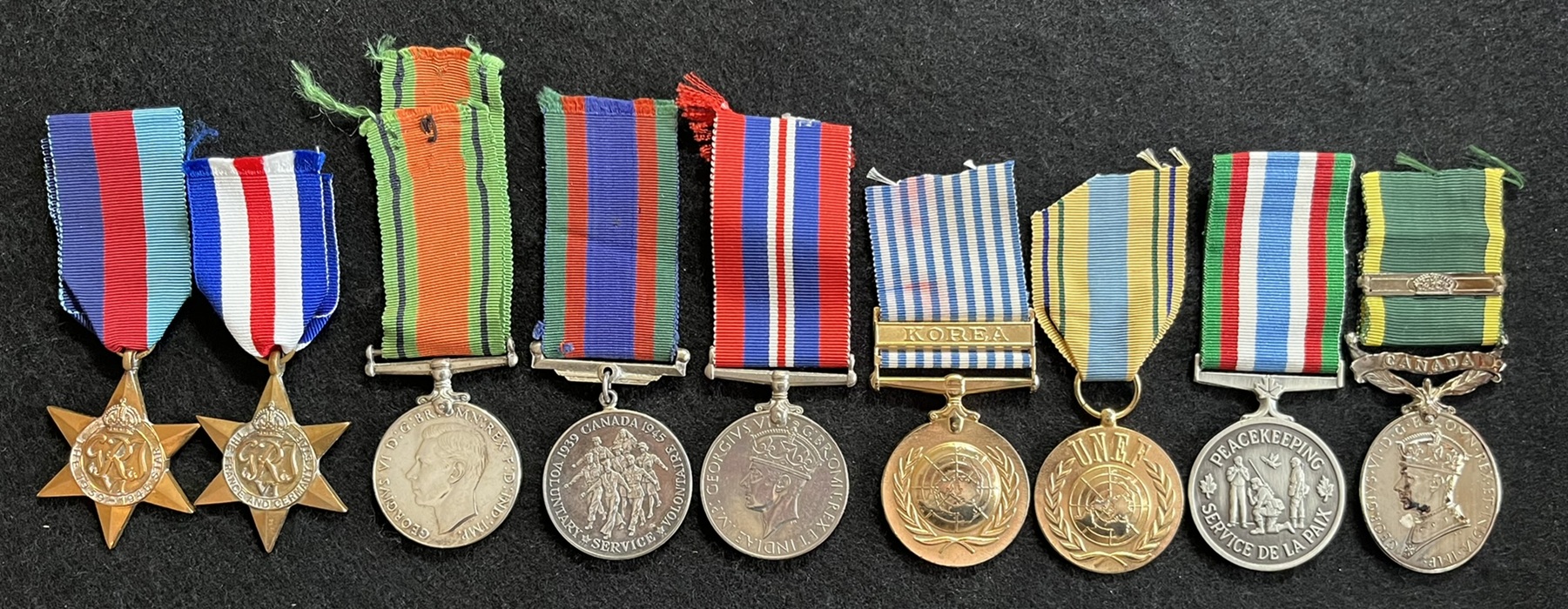 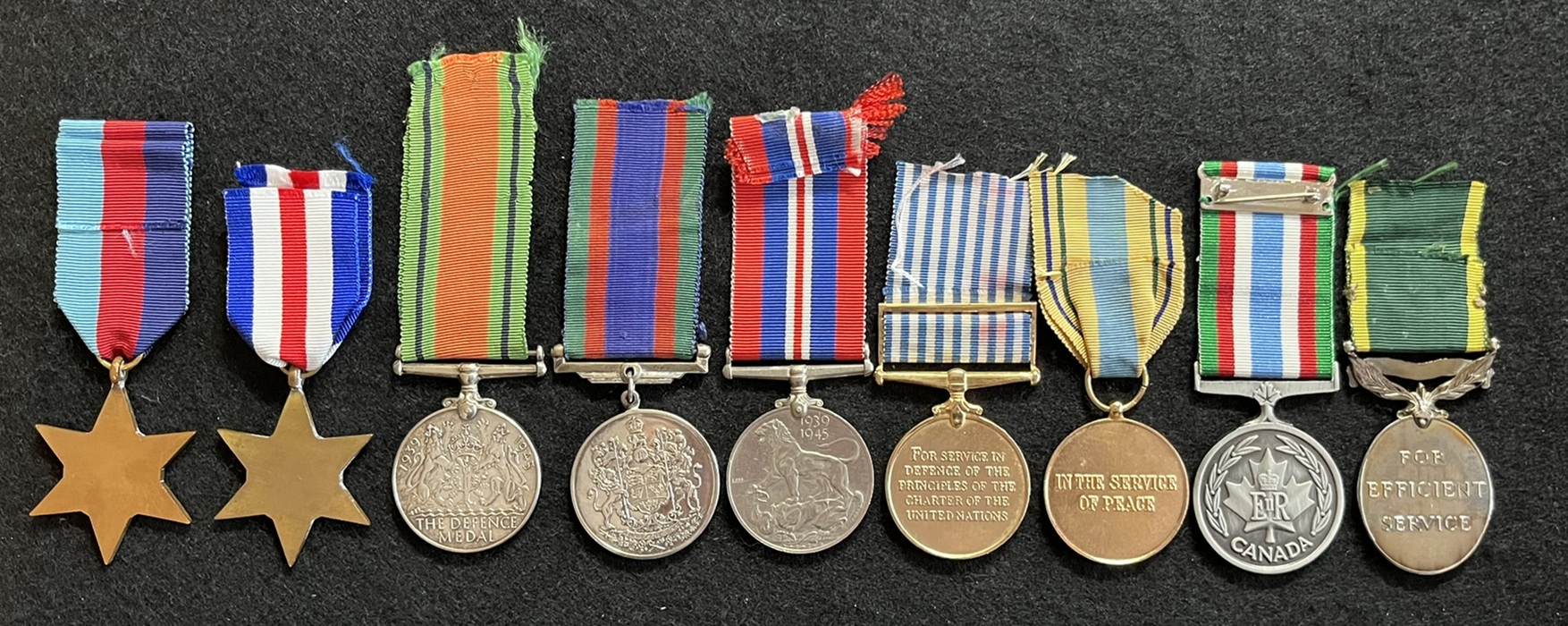   Nine. 1939-45 Star, France and Germany Star, Defence Medal (Canadian issue), Canadian Volunteer Service Medal, War Medal 1939-45, UN Korea Medal with KOREA suspender, UN Emergency Force (UNEF) Medal, Canadian Peacekeeping Service Medal, Efficiency Medal (GVI) with CANADA suspension with bar. UN Korea named SC 29716 A LINDEN; EM named CPL. A. LINDEN RCIC. Medals are loose on lengths of mostly clean older ribbons, with the CPSM retaining its original issue brooch. UN Korea, UNEF and Efficiency Medal are plated. This group of medals was purchased together, but it is unclear whether they all belonged to the same soldier, and the lot is unresearched. VF Condition $700 |
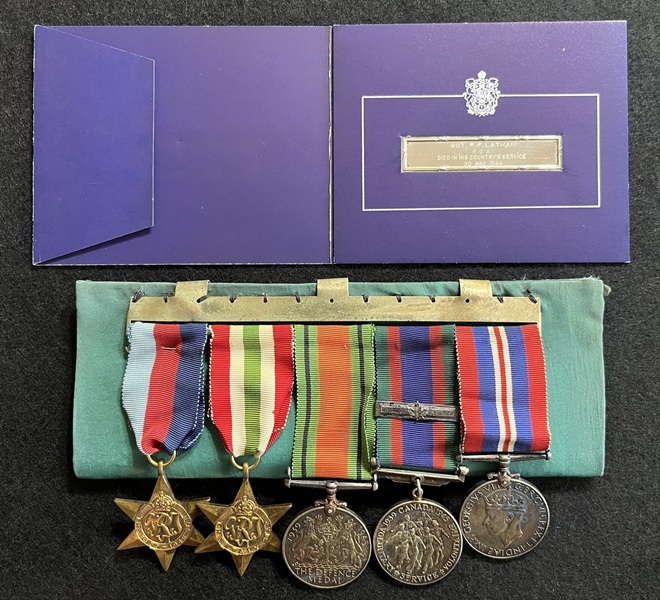 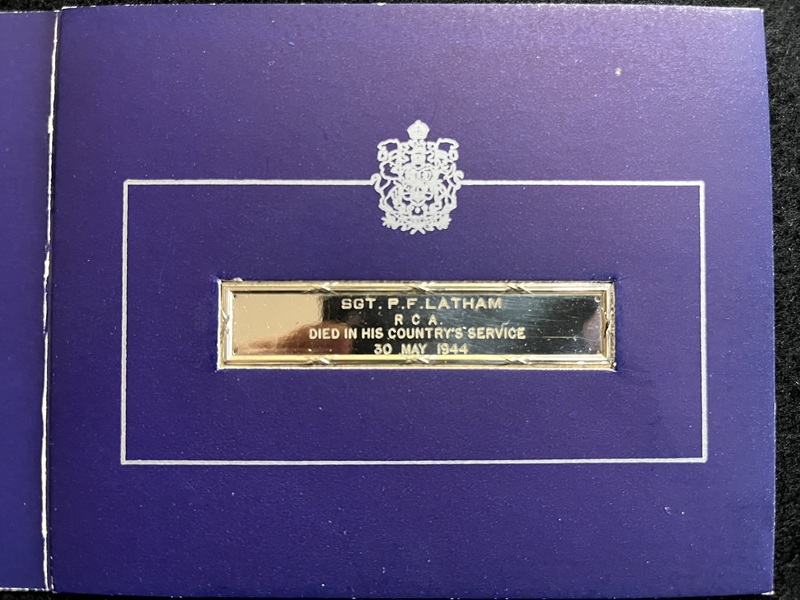 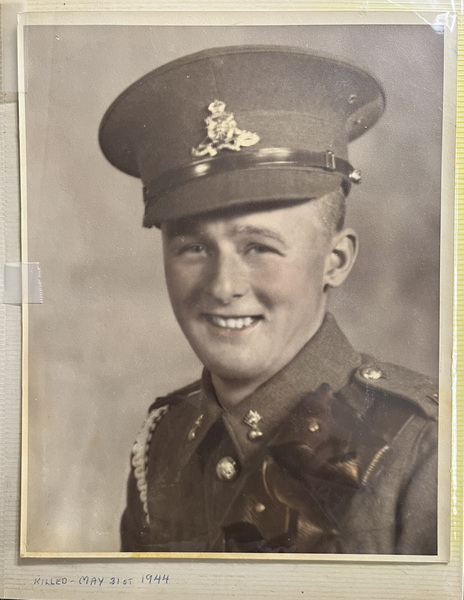 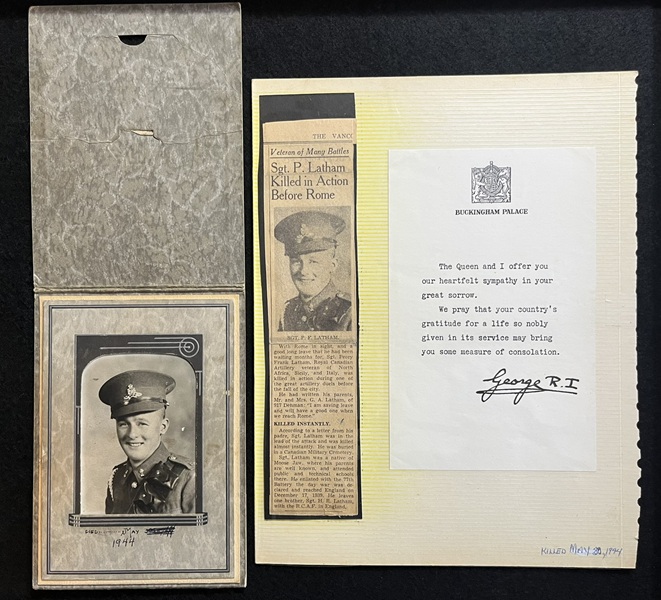 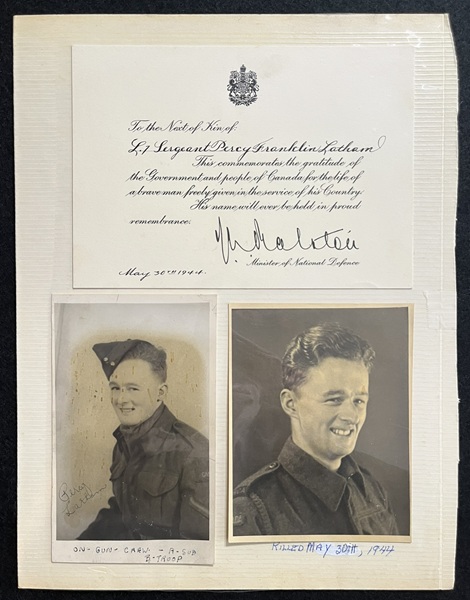   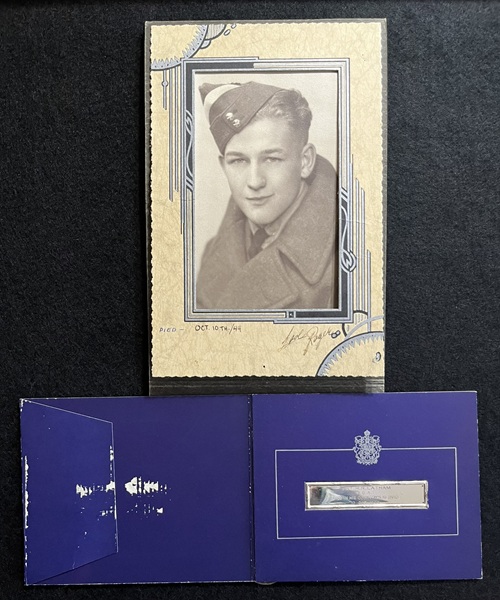 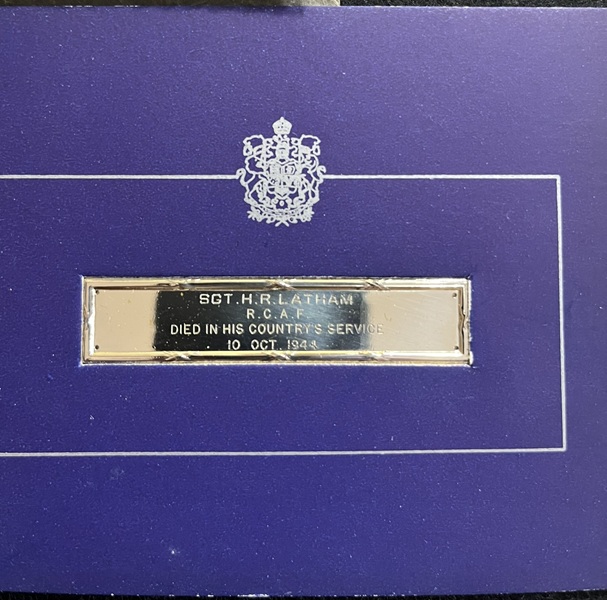 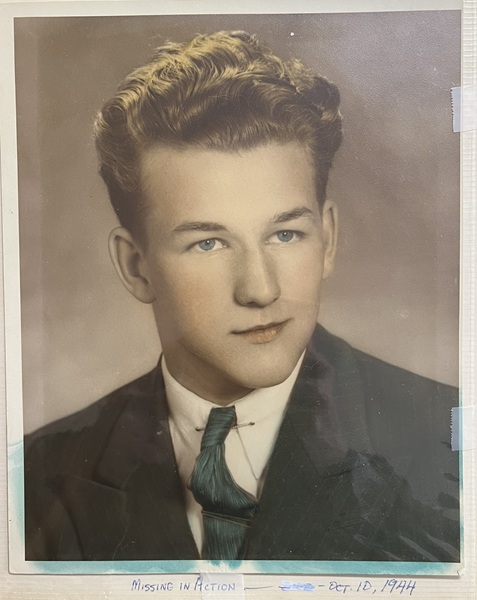 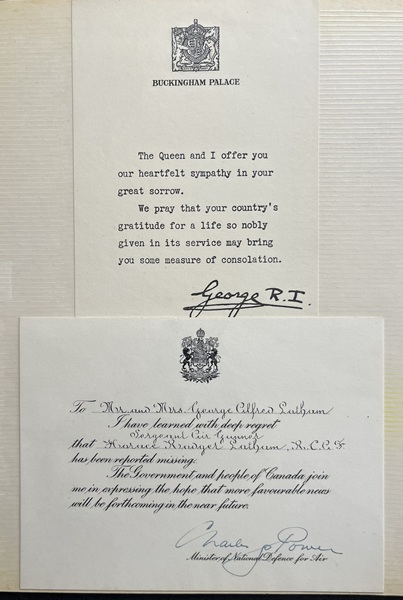 Family Group: Brother 1 - 1939-45 Star, Italy Star, Defence Medal (Canadian issue), Canadian Volunteer Service Medal with Overseas clasp, War Medal 1939-45, and Birk's Memorial Bar. Bar is named SGT P.F. LATHAM RCA DIED IN HIS COUNTRY'S SERVICE 30 MAY 1944. Accompanied by five original portrait photos of Percy Latham in uniform (one smaller image in a photo studio folder, a larger 8" x 11" colourized version of the latter, a loose small image taken when he was a Lance Bombardier, another portrait photo the same size without headdress, and two wallet sized images), a press clipping with details of his death, condolence slip from Buckingham Palace, condolence slip from Canadian Minister of National Defence, Memorial Scroll from the city of Moose Jaw, Saskatchewan, an image of his original grave marker, transmittal slip for his medals, a silk handkerchief with UK and US flags and a personalized dedication, and a silk Royal Artillery themed embrodiered handkerchief. Brother 2 - Birk's Memorial Bar. Bar is named SGT H.R. LATHAM RCAF DIED IN HIS COUNTRY'S SERVICE 10 OCT 1944. Accompanied by two original portait photos of him in uniform, once with cap in a photo studio folder, the other a larger 8" x 11" colourized photo in civilian clothes, condolence slip from Buckingham Palace, condolence slip from Canadian Minister of National Defence, and a RCAF Bible inscribed to him. L.7 Sgt Percy Franklin Latham joined the Canadian Active Service Force in Moose Jaw, Saskatchewan on 4 September 1939. He was 19 years old, and had been serving in the 77th Battery, RCA in Moose Jaw since 1937. He was transferred to 3rd Field Regiment RCA in December 1939 in Aldershot, Nova Scotia, before embarking for overseas service. Arriving in Glasgow, Scotland in mid-December, he was promoted to Bombardier in June 1940. Recerting to the rank of Gunner at his own request in June 1941, he continued training in England, qualifying as an Assistant Surveyor in March 1943, before deploying with his unit to Italy in June. Landing on 10 July 1943, he received a series of promotions, being made an acting Lance Bombardier on landing, and an Acting Bombardier on 20 July, being confirmed in the rank of Bombardier in October, and made an Acting Sergeant in December. He was comfirmed in this rank in March 1944, just a couple of months before he died of wounds received in action in Frosinoni, Italy, during his unit's approach to Rome, on 30 May 1944. Just weeks before, on 12 May, the 3rd Field Regiment, Royal Canadian Artillery provided fire support for the fourth and final Allied assault on Monte Cassino. The war diarist recorded that this was “the biggest barrage we or anyone else here has ever taken part in…”. Percy Latham is buried in the Commonwealth War Graves' Cassino War Cemetery, Italy. Latham's younger brother, Horace Roger Latham, joined the Royal Canadian Air Force in Vancouver, British Columbia on 17 August 1943, being assigned service number K.268113. He was 18 years old at the time, with previous service experience in 59 Air Cadet Squadron. After training in Canada, he qualified as an Air Gunner on 12 March 1944, before embarking for England in May, and being appointed to the rank of T/Sergeant. Latham was serving with 1667 Heavy Conversion Unit RAF, based at RAF Sandtoft when he was pronounced missing, presumed dead, on 10 October 1944. He was a member of the crew of Halifax LL-501, which was returning from a night cross-country exercise when the crew mistook a bombing range for an airfield. The aircraft went out of control at a low altitude, hit a river bank at a narrow angle and sank at the mouth of the River Trent, England, where it joins the Humber Estuary. Latham's body was not recovered. He is commemorated on the Runnymede Air Forces Memorial, Surrey, England. Good VF Condition $1300 |
 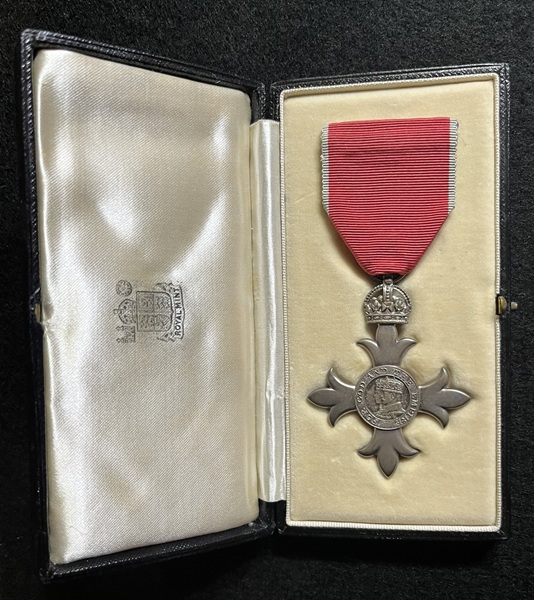 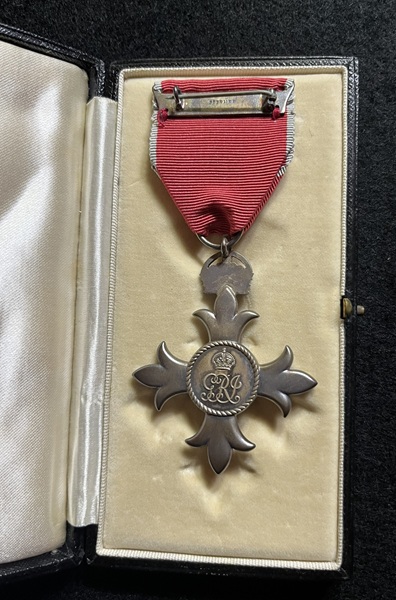 One. Member of the Order of the British Empire (GVI), Civil Division, in monogrammed case of issue. On original ribbon. The case contained in what appears to be its original shipping box. EF Condition $350 |
    Three. Canadian Volunteer Service Medal, War Medal 1939-45, and Canadian Forces Decoration (EIIR). CD named to MAJ. A.H. MacKINNON. Alexander Huntley MacKinnon was an engineer with service ranging from COTC in the 1930s to time spent in the Militia in the 1960s. A graduate of St. Francis Xavier University and Nova Scotia Technical College, he served during the Second World War inside Canada with the Signal Communications Branch of the R.C.A.F. on the West Coast. Between 1949 and 1964, MacKinnon was a militia officer with the East Coast Signal Regiment, commanding the latter unit as a Lieutenant Colonel between 31 August 1957 and 22 June 1960, and later serving as a staff officer (G.S.O. (1)) at Eastern Command HQ , 4th Military Group HQ between 1960 and 1964. In civilian life, MacKinnon spent 40 years with Martime Tel and Tels, retiring as Vice President (Planning) in Halifax, Nova Scotia. A hard copy reserach file, which includes his service record as well as an obituary, accompanies his group, which is swing mounted as worn. Good VF Condition $250 |
   Six. 1939-45 Star, Italy Star, Defence Medal (Canadian issue), Canadian Volunteer Service Medal with Overseas bar, War Medal 1939-45, and Memorial Cross (GVI). Memorial Cross named to A.11453 Pte. R.B. LANG. Electronic copy of Lang's service file which accompanies the group indicates that Ronald Bell Lang died of wounds received in action on 22 January 1944, while serving with the 48th Highlanders in Italy. Lang was born in Owen Sound, Ontario in 1913, and he joined the Perth Regiment (MG) at Stratford, Ontario on 26 September 1939, indicating that he was employed as a knitter at the time of his enrollment, and that he had 2 years of previous military service with the "Owen Sound Grey's" back in 1935. Lang was single, listing his mother, who lived in Owen Sound, as his next of kin. served overseas with the Perth Regiment and the 3rd Canadian Infantry Replacement Unit in England from November 1941-October 1943, when he embarked for the Mediterranean Theatre, joining the 48th Highlanders on 9 November 1943. Lang was wounded on 21 January 1944, dying of his wounds the following day. He is buried in the Commmonwealth War Graves Commission's Moro River Canadian War Cemetery, Italy. Lang's medals and the Memorial Cross issued in his memory, which were sent to his mother, are accompanied by his identity disk and a War Service Badge numbered 1252593 (likely not Lang's, but possibly a relatives). Good VF Condition $1100 |
  Two. Australian War Service Medal and War Medal 1939-45. Named to 146492 L.M. KAY. Lesley Malcolm Kay was born on 3 September 1925 in Sale, Victoria. He enlisted in the Royal Australian Air Force at Melbourne, Victoria on 13 January 1944. He was serving at 12 Local Air Supply Unit when he was discharged from active service on 3 April 1946. Group is court-mounted on card with plaque indicating Kay served in the R.A.A.F. Good VF Condition $150 |
  One. Memorial Cross (GVI) Named to B.43613 PTE. A.J. PATTERSON. Alvin John Patterson was born in Tecumseh, Ontario on 7 March 1908. He was living in Hamilton when he enrolled in 6th LAA Regt RCA on 24 August 1942. His next of kin was indicated to be his mother, Mary Jane Patterson, who lived at 63 Hess Street North in Hamilton. He left Canada for England on 29 March 1943, arriving 5 April. He served with 3rd LAA Regt RCA from 27 April 1943, and was embarked for France as an artillery reinforcement on 17 July 1944, landing on the 18th. He joined 6 LAA Regt, RCA, and appears to have returned to the UK in October, returning to France as an infantry reinforcement in late December 1944, and joining the South Saskatchewan Regiment on 25 December. Patterson died in an accident, falling from the balcony of his hotel room at a leave centre in Brussels, Belgium on 11 May 1945, and fracturing his skull. A Court of Inquiry determined that his death was accidental. Patterson is buried in Evere Civilian Cemetery, Brussels, Belgium. A tragic Canadian Army casualty of the South Saskatchewan Regiment, who perished shortly after VE Day. EF Condition $500 |
 One. IndianWar Service Medal. Un-named as issued. Loose on originalribbon. Good VF Condn $40 |
| A selection of un-named Second World War medals |
| 1939-45 War Medal in silver.Canadian Issue. VF $100 |
| 1939-45 War Medal (BritishIssue). Cupro-nickel. VF $30 |
| Defence Medal. Canadian issuein silver. VF $110 |
| Canadian Volunteer ServiceMedal without clasp. VF $100 |
| Canadian Volunteer ServiceMedal with clasp. VF $125 |
| 1939-45 Star. Unnamed asissued. VF $35 |
| Italy Star. Unnamed as issued. VF $35 |
| Atlantic Star. Unnamed asissued. VF $75 |
| Africa Star. Unnamed asissued. VF $50 |
| France and Germany Star.Unnamed as issued. VF $45 |
| Burma Star. Unnamed as issued. VF $75 |
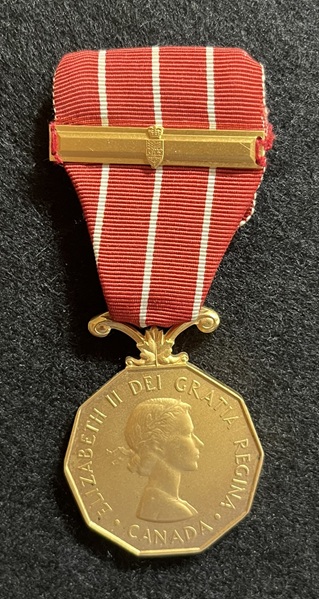 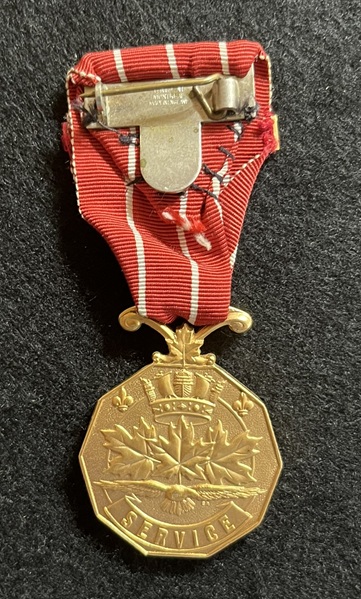 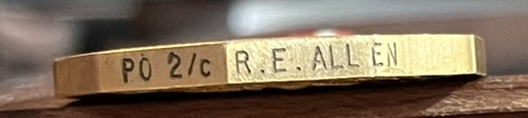 One. Canadian Forces Decoration (EIIR) with bar. Named to PO 2/C R.E. ALLEN. With copy service record which indicates that Ronald Edwin Allen served in the Royal Canadian Navy with service number 11908-H from 17 October 1950 to 19 July 1980. He was based in Halifax and served in Shearwater for most of his career (from 1969-80), reaching the rank of Sgt/PO 2 and being employed as an aviation technician, with qualifications for servicing the Sea King helicopter. Allen died on 23 February 2003. Medal is swing mounted as worn. One. Canadian Forces Decoration (EIIR) with bar. Named to PO 2/C R.E. ALLEN. With copy service record which indicates that Ronald Edwin Allen served in the Royal Canadian Navy with service number 11908-H from 17 October 1950 to 19 July 1980. He was based in Halifax and served in Shearwater for most of his career (from 1969-80), reaching the rank of Sgt/PO 2 and being employed as an aviation technician, with qualifications for servicing the Sea King helicopter. Allen died on 23 February 2003. Medal is swing mounted as worn. Good VF Condition $150 |
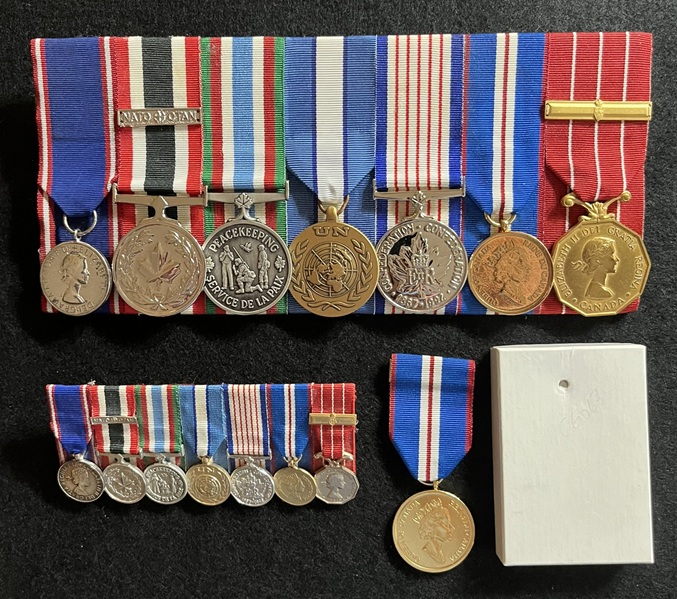 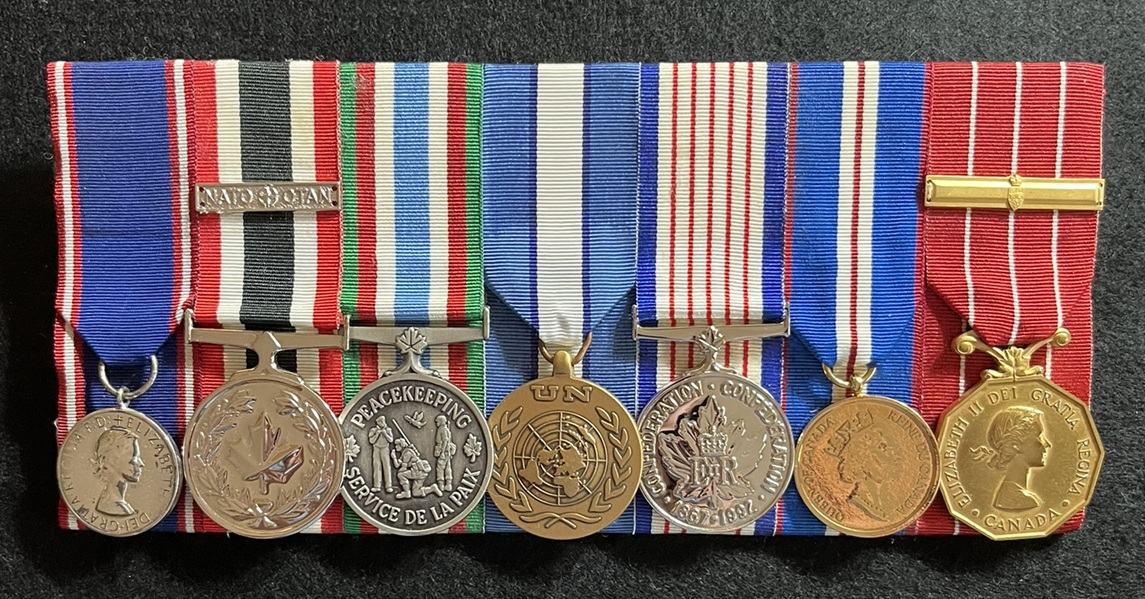  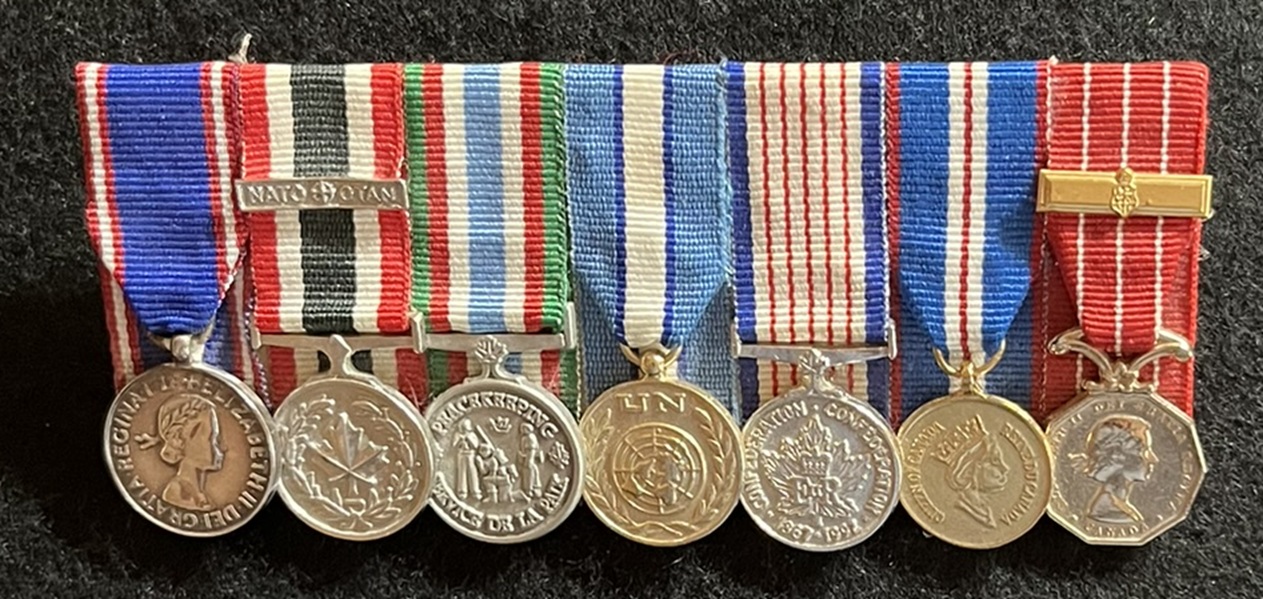 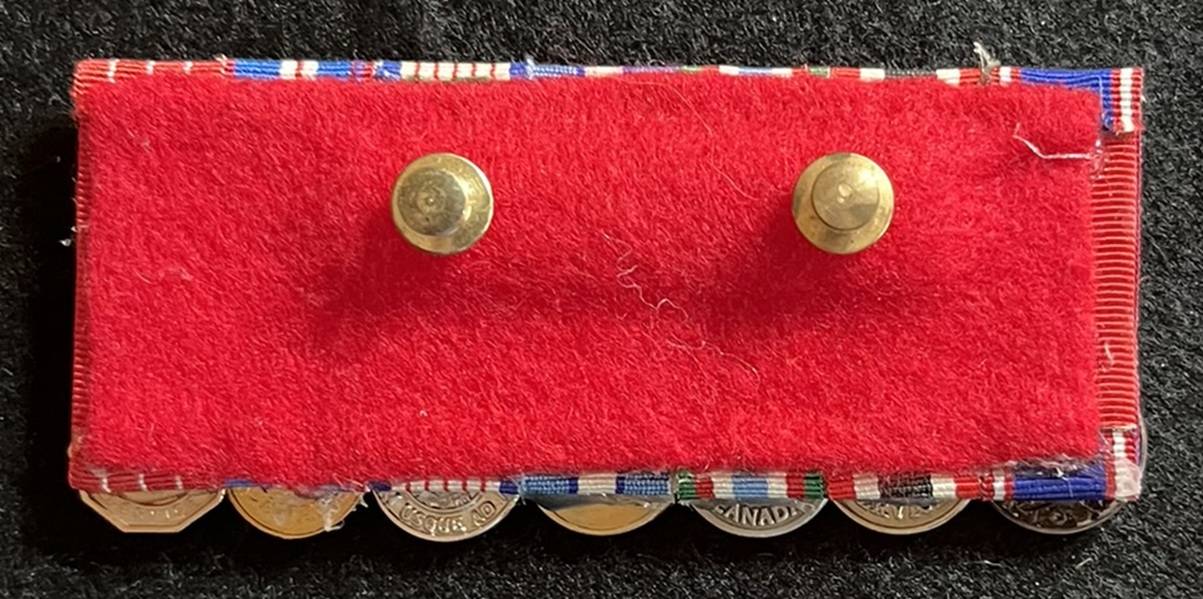 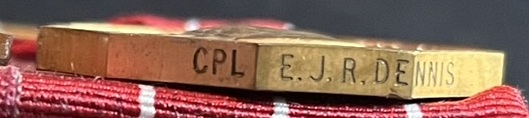 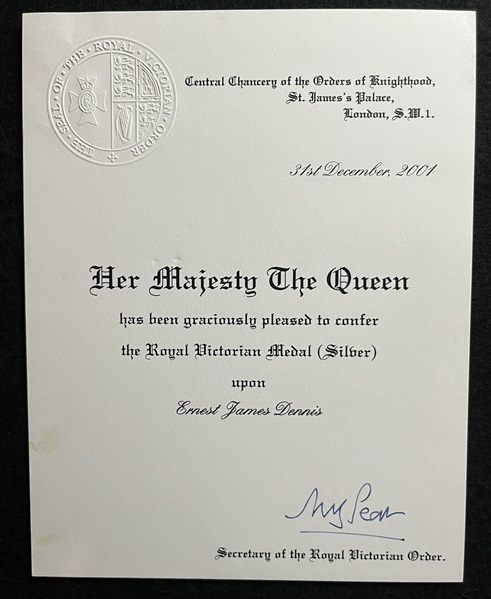 Seven. Royal Victorian Medal (EIIR), Special Service Medal with NATO bar, Canadian Peacekeeping Service Medal, UNFICYP Medal, Canada 125 Medal, Canadian Golden Jubilee Medal, Canadian Forces Decoration (EIIR) with clasp. CD named to CPL. E.J.R. DENNIS. Ernest James Dennis joined the Canadian Army on 17 September 1958, serving with the Canadian Guards in Canada, in Germany from 4 October 1959 to 10 September 1962, and in Cyprus with 1st Canadaian Guards as part of UNFICYP from 3 October 1964 to 8 April 1965. He later transferred to the Royal Canadian Regiment at Unification, serving with the latter unit from 2 December 1968 to 1 December 1971, including an attachment to 3 Mechanized Commando from 1 July to 16 September 1970. Dennis transferred to the Steward occupation in July 1971, and continued his service with the Naval Branch of the Canadian Forces, serving on the west coast based in Esquimault with tours on HMCS CHAUDIERE, HMCS SASKATCHEWAN, at Royal Roads Military College, and aboard HMCS MACKENZIE. He completed his career as a Warrant Officer serving at CFB Borden, where he took his release on 24 September 1982. After retiring from the Canadian Armed Forces, Ernie Dennis served as the Chief Steward to the Lieutenant Governor of Ontario at Government House in Toronto, filling this post for over 20 years. He also served as a Lieutenant on the Cadet Instructors Cadre from 7 February 1990 to 31 October 1991. Dennis was recognized for his service to successive Lieutenant Governors of Ontario with the award of a Royal Victorian Medal (Silver) by Queen Elizabeth II in the UK Honours List of 31 December 2001. His medals are court-mounted, with a copy Golden Jubilee Medal; an original boxed example is included with the group, along with a set of court-mounted miniatures, and the original award certificate for his RVM. An extremely scarce RVM award to a Canadian. Seven. Royal Victorian Medal (EIIR), Special Service Medal with NATO bar, Canadian Peacekeeping Service Medal, UNFICYP Medal, Canada 125 Medal, Canadian Golden Jubilee Medal, Canadian Forces Decoration (EIIR) with clasp. CD named to CPL. E.J.R. DENNIS. Ernest James Dennis joined the Canadian Army on 17 September 1958, serving with the Canadian Guards in Canada, in Germany from 4 October 1959 to 10 September 1962, and in Cyprus with 1st Canadaian Guards as part of UNFICYP from 3 October 1964 to 8 April 1965. He later transferred to the Royal Canadian Regiment at Unification, serving with the latter unit from 2 December 1968 to 1 December 1971, including an attachment to 3 Mechanized Commando from 1 July to 16 September 1970. Dennis transferred to the Steward occupation in July 1971, and continued his service with the Naval Branch of the Canadian Forces, serving on the west coast based in Esquimault with tours on HMCS CHAUDIERE, HMCS SASKATCHEWAN, at Royal Roads Military College, and aboard HMCS MACKENZIE. He completed his career as a Warrant Officer serving at CFB Borden, where he took his release on 24 September 1982. After retiring from the Canadian Armed Forces, Ernie Dennis served as the Chief Steward to the Lieutenant Governor of Ontario at Government House in Toronto, filling this post for over 20 years. He also served as a Lieutenant on the Cadet Instructors Cadre from 7 February 1990 to 31 October 1991. Dennis was recognized for his service to successive Lieutenant Governors of Ontario with the award of a Royal Victorian Medal (Silver) by Queen Elizabeth II in the UK Honours List of 31 December 2001. His medals are court-mounted, with a copy Golden Jubilee Medal; an original boxed example is included with the group, along with a set of court-mounted miniatures, and the original award certificate for his RVM. An extremely scarce RVM award to a Canadian. Good VF Condition $1050 |
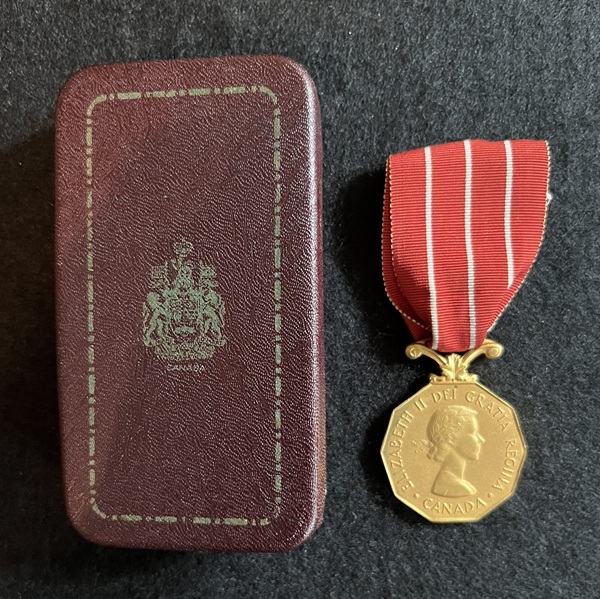 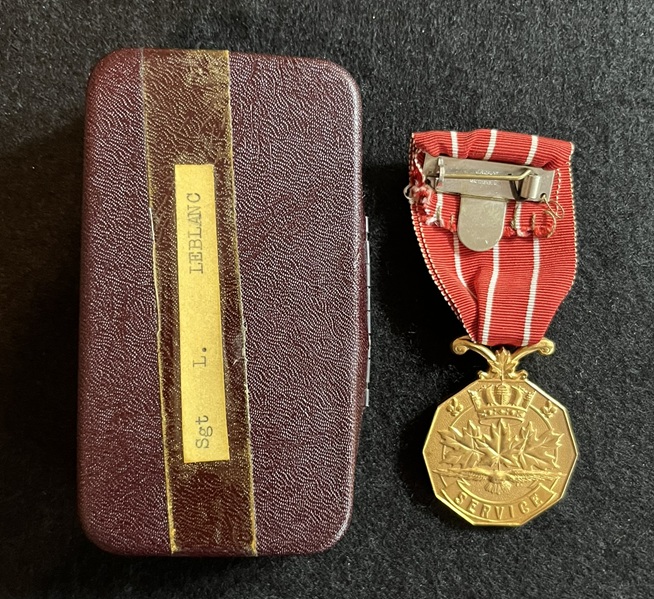 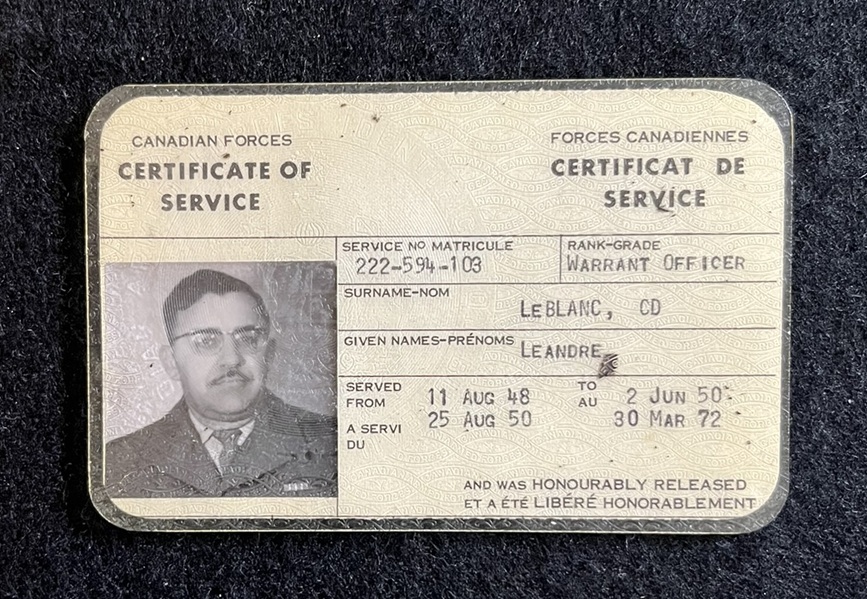 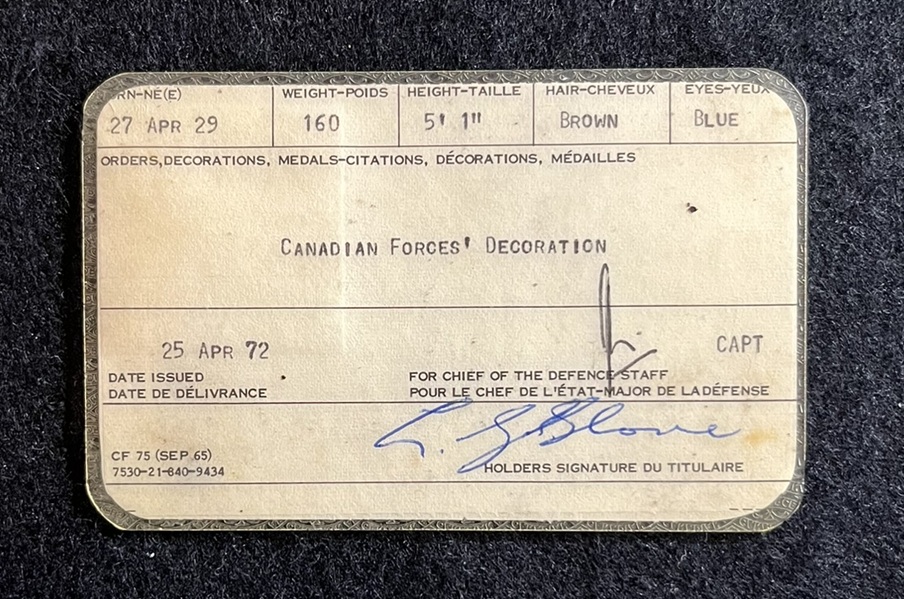 One. Canadian Forces Decoration (EIIR). Named to SGT. L. LEBLANC. With Leblanc's plasticized original Certificate of Service that includes an image of Warrant Officer Leandre Leblanc wearing the ribbon to the CD, and indicating dates of service from 11 August 1948-2 June 1950, and 25 August 1950 - 30 March 1972. Leblanc was born on 27 April 1929, and was described as being 5' 1" tall, weighing 160 lbs, with brown hair and blue eyes. Medal is swing mounted as worn, with its box of issue which has a cellophone taped label with Leblanc's name on the reverse. One. Canadian Forces Decoration (EIIR). Named to SGT. L. LEBLANC. With Leblanc's plasticized original Certificate of Service that includes an image of Warrant Officer Leandre Leblanc wearing the ribbon to the CD, and indicating dates of service from 11 August 1948-2 June 1950, and 25 August 1950 - 30 March 1972. Leblanc was born on 27 April 1929, and was described as being 5' 1" tall, weighing 160 lbs, with brown hair and blue eyes. Medal is swing mounted as worn, with its box of issue which has a cellophone taped label with Leblanc's name on the reverse. Good VF Condition $135 |
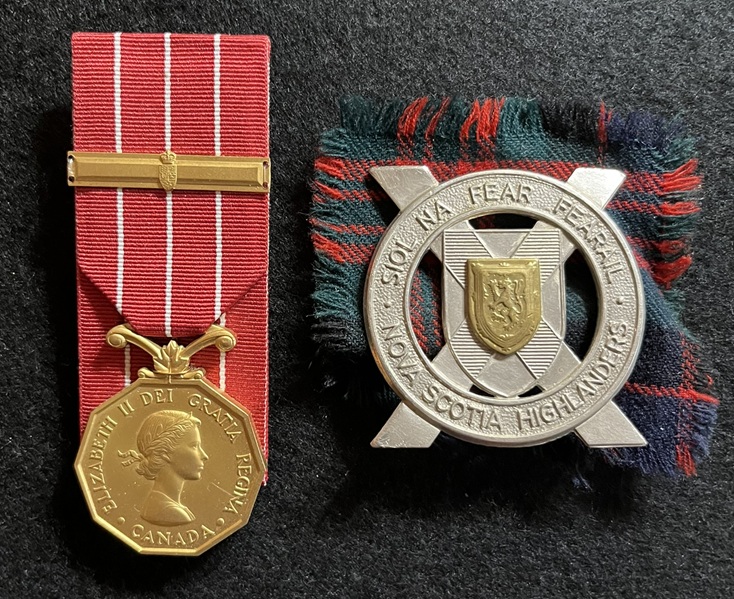 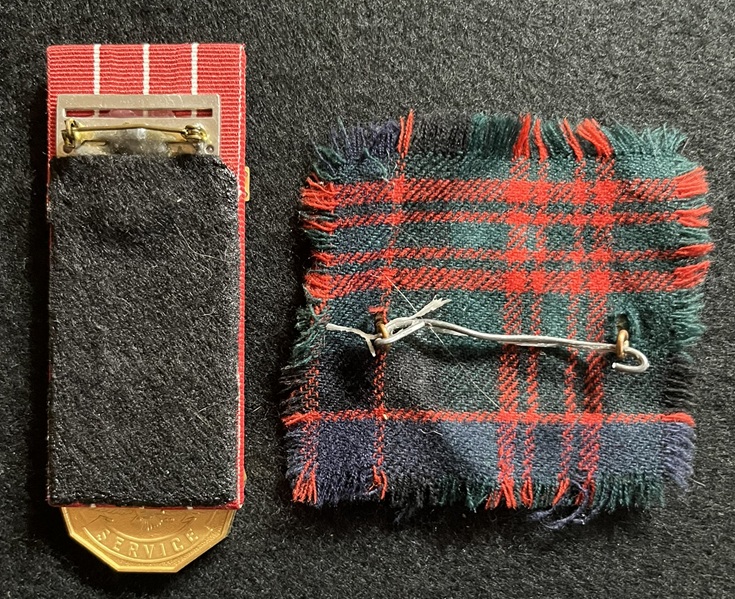 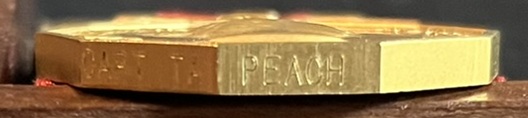 One. Canadian Forces Decoration (EIIR) with bar. Named to CAPT TA PEACH. Accompanied by a modern Nova Scotia Highlanders cap badge with tartan backing. Medal is court-mounted for wear. Unresearched. One. Canadian Forces Decoration (EIIR) with bar. Named to CAPT TA PEACH. Accompanied by a modern Nova Scotia Highlanders cap badge with tartan backing. Medal is court-mounted for wear. Unresearched. VF Condition $90 |
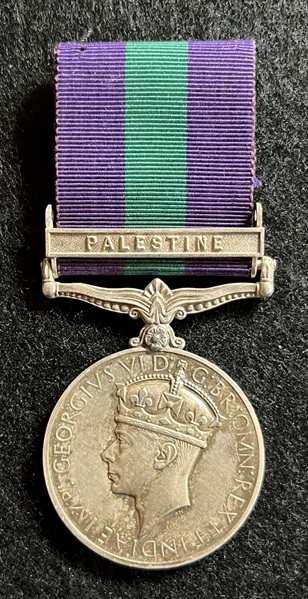 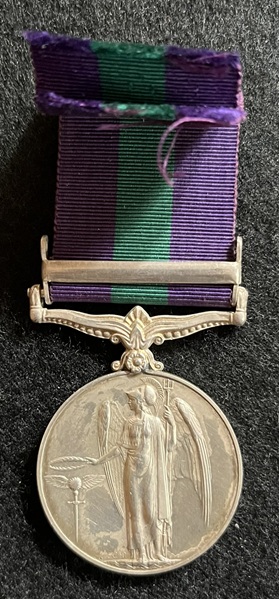   One. General Service Medal 1918-62 (EIIR) with clasp PALESTINE. Named to 59781 GDSMN. L. WILLMOTT. C. GDS. Un-researched One. General Service Medal 1918-62 (EIIR) with clasp PALESTINE. Named to 59781 GDSMN. L. WILLMOTT. C. GDS. Un-researched VF Condition $175 |
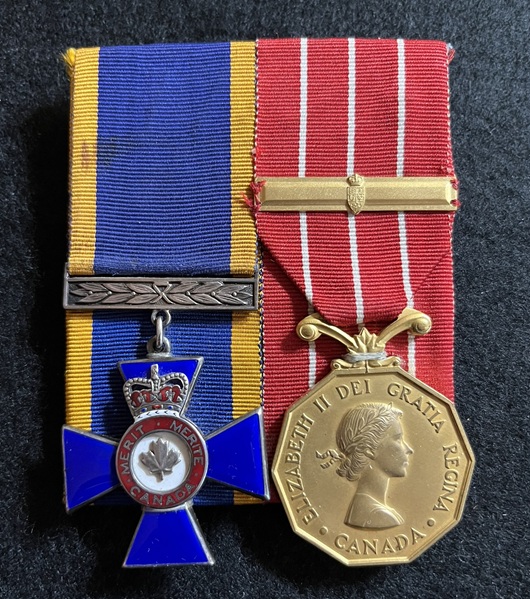   Two. Member of the Order of Military Merit (Manufactured by Spink, numbered 552), and Canadian Forces Decoration (EIIR) with bar. CD named to CPL. E.G. PRIEST. Edison Gordon Priest was awarded the MMM on 11 December 1978, while serving as a member of the Physical Education and Recreation Instructor (PERI) trade. Medals are accompanied by a photocopy from the OMM Register showing details of date of award, but is otherwise unresearched. Group is court mounted as worn on original, slightly soiled ribbons. Two. Member of the Order of Military Merit (Manufactured by Spink, numbered 552), and Canadian Forces Decoration (EIIR) with bar. CD named to CPL. E.G. PRIEST. Edison Gordon Priest was awarded the MMM on 11 December 1978, while serving as a member of the Physical Education and Recreation Instructor (PERI) trade. Medals are accompanied by a photocopy from the OMM Register showing details of date of award, but is otherwise unresearched. Group is court mounted as worn on original, slightly soiled ribbons. VF Condition $2000 |
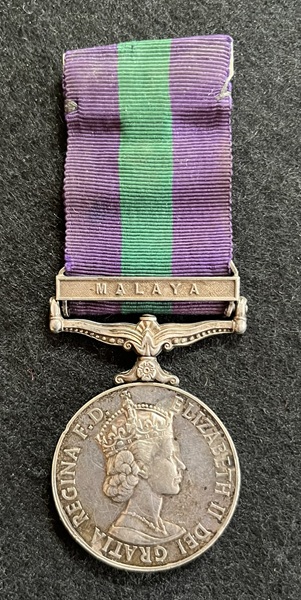  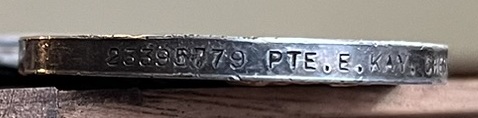 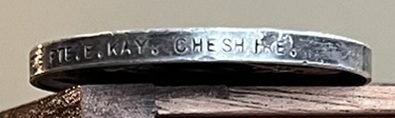 One. General Service Medal 1918-62 (EIIR) with clasp MALAYA. Named to 23395779 PTE. E. KAY. CHESHIRE. Mounted for wear on old pin with original, slightly soiled ribbon. Un-researched. VF Condition $175 |
  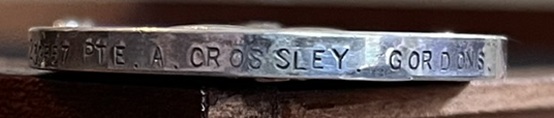 One. General Service Medal 1908-1962 (EIIR) with clasp CYPRUS. Named to 23239557 PTE. A. CROSSLEY GORDONS. With notes indicating medal was awarded for service April 1955 to April 1959. Otherwise unresearched. Loose on clean modern ribbon. VF Condition $135 |
    One. Naval General Service Medal 1909-1962 with clasp 'NEAR EAST'. Named to P/JX 237080 E.R. JONES. A.B. R.N. Un-researched. Loose on clean modern ribbon. Good VF Condition $200 |
  Two. Korea Medal (Canada) and UN Korea Medal clasp Korea. Korea and UN Korea named to B-802127 R.G. SMART. The 7 in his service number is larger than the other numbers, and may be reimpressed. Smart served during the Second World War in the RCE and the RCASC as a driver, earning the 1939-45 Star, Italy Star, France & Germany Star, Defence Medal, CVSM and clasp, and War Medal (these not included with the group). He had previously served from 1931-35 with the Governor General's Horse Guards in Toronto. His Korea service was with the Royal Canadian Ordnance Corps as a storesman, serving with 25 Canadian Infantry Brigade Ordnance Company overseas from May 1951 - May 1952, before returning to Canada and being released in July 1952. Electronic copy of Smart's service record accompanies the group. Good VF Condition $350 |
   Two. Korea Medal (Canada) and UN Korea Medal clasp Coree. Korea and UN Korea named to SB-34372 R.M. AUDET. Audet served as a member of 1 Royal 22ieme Regt in Korea from April 1952-May 1953. He earned his parachute wings in October 1953, serving with 1 R22eR until his release in June 1954. He re-enlisted in 1959, serving until 1970 in the RCAMC and qualifying for the Canadian Forces Decoration, which was awarded in 1970 but is not with his group. His RCAMC service included postings in Ontario (Borden, Toronto), Manitoba (Rivers), and Quebec (Valcartier). With copy service record. Medals loose on well-worn original ribbons. VF Condition $350 |
   One. Africa General Service Medal (EIIR) with clasp "KENYA". Named to 23045978 FUS. T.P. LLOYD. R. INNISKS. Good VF Condition $250 |
   Two. Korea Medal (Canada) and UN Korea Medal clasp Korea. Korea and UN Korea named to SD 800329 E.H. JODOIN. Jodoin served during the Second World War in the Royal Canadian Navy, earning a 1939-45 Star, France and Germany Star, Italy Star, CVSM and clasp and War Medal (not included with group), and in 2nd Battalion Royal Canadian Regiment (RCR), 1 RCR and 2 CAU during his service with the CASF. His time in Korea seems to have been focused with 2 Canadian Administration Unit (2 CAU), although he returned to 2 RCR at the tail end of his time overseas in September 1952, and continued to serve with them on his return from Korea, earning his Parachute wings and serving an additional three years before taking his release in November 1955. A set of replacement medals were issued in 1973, according to his file, and the naming style on these suggests that they are the replacement medals. There is a Second World War MID emblem sewn to the ribbon of the UN Korea Medal, but no indication of any entitlement to an MiD for his service in either conflict. Medals are loose on ribbon, with Korea Medal (Canada) sporting a length of Korea Volunteer Service Medal ribbon in lieu of the correct ribbon for the medal. With electronic copy of service file. VF Condition $300 |
  Two. Queen's Korea Medal and modern US copy UN Korea Medal with clasp KOREA. Queen's Korea named to L/FX. 853600 D.G. VALLANCE A/L.A. R.N. Medals are court-mounted on original ribbons on a hard card backing. Un-researched. Good VF Condition $150 |
   Three. Special Service Medal with NATO*OTAN bar, UN Disengagement Observer Force (UNDOF) Medal, Canadian Forces Decoration with bar.. CD named to CPL. J.A. CLEAL Medals court-mounted as worn. Unresearched. Good VF Condition $300 |
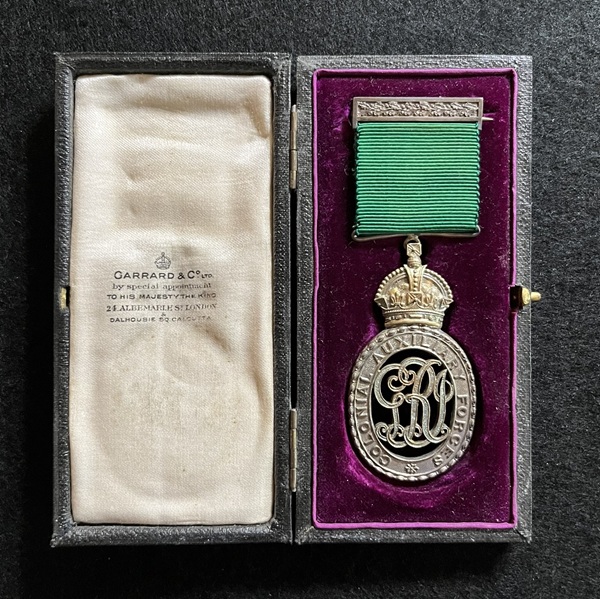    One. Colonial Auxiliary Forces Officers' Decoration (GV). Named to Major G.H.S. Campbell Front. Regt. George Herbert Stanley Campbell was born on 15 June 1888 at Cole Lake, Ontario. He joined the 146th Battalion, Canadian Expeditionary Force on 28 March 1916 at Kingston, Ontario, serving as a Captain in the unit. He embarked for the United Kingdom on 25 September 1916, disembarking in England on 6 October. He was attached to the Royal Flying Corps on 1 July 1917, qualifying as a pilot, and serving in 191 Squadron and 155 Squadron in France, piloting DH 9 bombers, including time spent ferrying aircraft to France. After the war, Campbell appears to have continued his service in the militia, as he was awarded his CAFOD as a Major in the Frontenac Regiment, in Canadian Army General Order 133 of 1924. Campbell's obituary suggests he moved to Saskatoon, Saskatchewan in 1920, where he lived for 33 years while working as a conductor for the Canadian National Railway. He retired in Kingston and died there at the age of 73. Electronic copy of RFC service record sheet and obituary accompany the decoration, which is in its box of issue (this slightly mottled in places, but clean and sound), and swing mounted on original pin back suspension, One. Colonial Auxiliary Forces Officers' Decoration (GV). Named to Major G.H.S. Campbell Front. Regt. George Herbert Stanley Campbell was born on 15 June 1888 at Cole Lake, Ontario. He joined the 146th Battalion, Canadian Expeditionary Force on 28 March 1916 at Kingston, Ontario, serving as a Captain in the unit. He embarked for the United Kingdom on 25 September 1916, disembarking in England on 6 October. He was attached to the Royal Flying Corps on 1 July 1917, qualifying as a pilot, and serving in 191 Squadron and 155 Squadron in France, piloting DH 9 bombers, including time spent ferrying aircraft to France. After the war, Campbell appears to have continued his service in the militia, as he was awarded his CAFOD as a Major in the Frontenac Regiment, in Canadian Army General Order 133 of 1924. Campbell's obituary suggests he moved to Saskatoon, Saskatchewan in 1920, where he lived for 33 years while working as a conductor for the Canadian National Railway. He retired in Kingston and died there at the age of 73. Electronic copy of RFC service record sheet and obituary accompany the decoration, which is in its box of issue (this slightly mottled in places, but clean and sound), and swing mounted on original pin back suspension, VF Condition $750 |
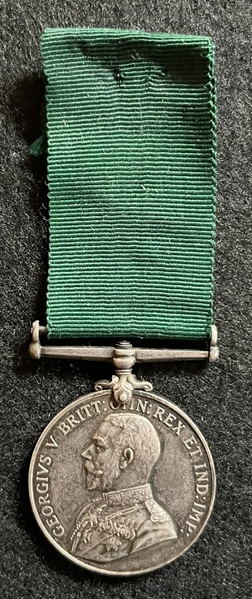 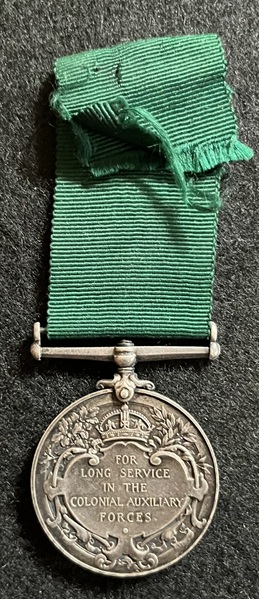   One. Colonial Auxiliary Force Long Service Medal (GV). Named to Lt. & Qr. Mr. G. BRUNELLE. Les. Chas. C. Awarded in G.O. 5, 1924. Medal is loose on a length of faded original ribbon. One. Colonial Auxiliary Force Long Service Medal (GV). Named to Lt. & Qr. Mr. G. BRUNELLE. Les. Chas. C. Awarded in G.O. 5, 1924. Medal is loose on a length of faded original ribbon. VF Condition $275 |
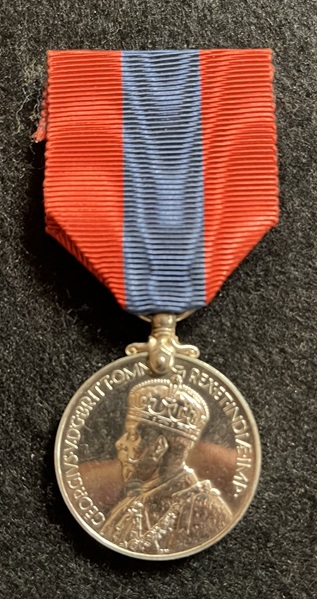 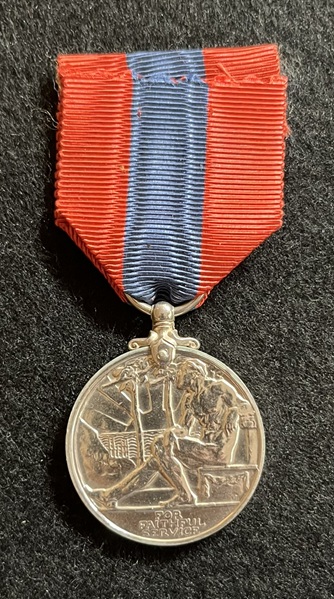 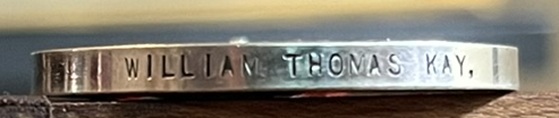 One. Imperial Service Medal (GVR). Named to WILLIAM THOMAS KAY. With note indicating Kay was a postman (London Postal Service) and received notification of his award in the London Gazette of 22 August 1932. Medal is loose on short length of original ribbon. One. Imperial Service Medal (GVR). Named to WILLIAM THOMAS KAY. With note indicating Kay was a postman (London Postal Service) and received notification of his award in the London Gazette of 22 August 1932. Medal is loose on short length of original ribbon. EF Condition $60 |
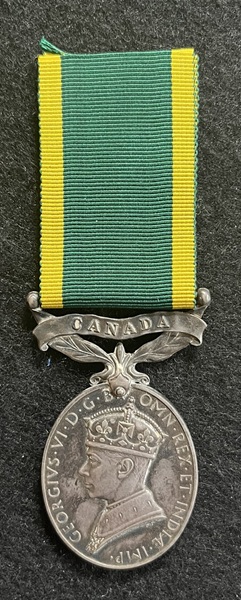 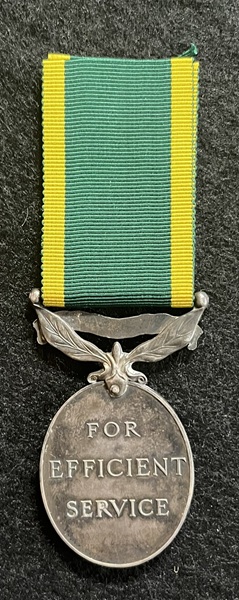 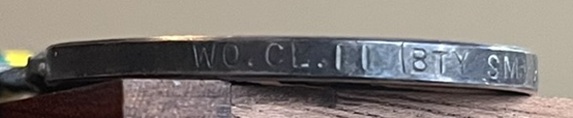  One. Efficiency Medal with CANADA suspender. Named to W.O. CL. II (BTY SM) A. GREGORY. RCA. Loose on clean older ribbon. Un-researched. Good VF Condition $275 |
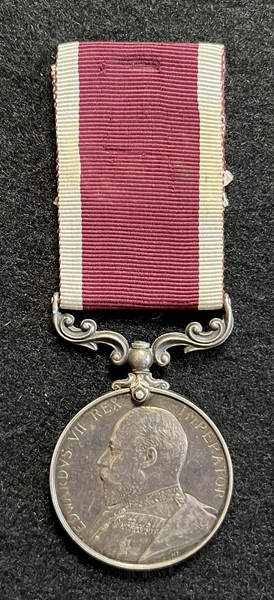 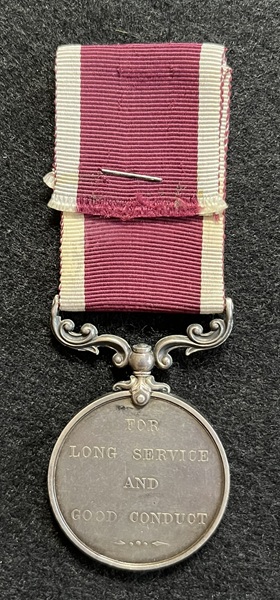 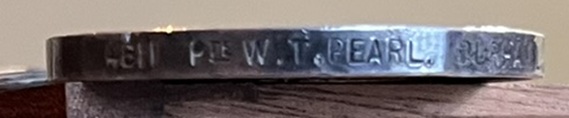 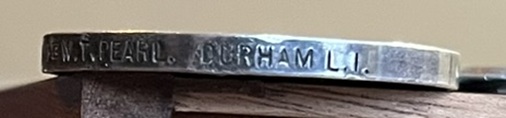 One. Army Long Service and Good Conduct Medal (EVII). Named to 4611 PTE. W.T. PEARL DURHAM L.I. One large edge knock to unit name; medal is loose on older original ribbon. Unresearched. VF Condition $200 |
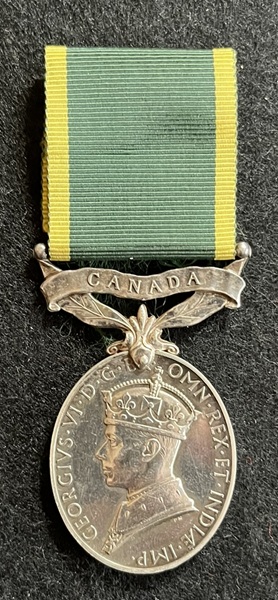 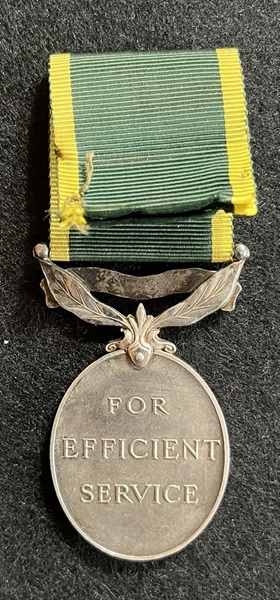 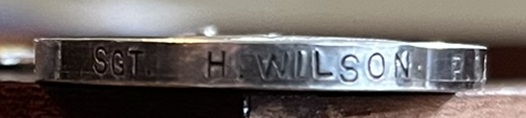 One. Efficiency Medal (GVI) with CANADA suspender. Named to SGT. H. WILSON R.C.A.. Un-researched. Loose on original ribbon. Good VF Condition $200 |
    One. Corrections Exemplary Service Medal. Named to S.COUTURE. In box of issue on original ribbon. Good VF Condition $150 |
    One. Efficiency Medal with TERRITORIAL suspender. Named to 2058389 GNR. R.J. CANNONS R.A. Unresearched. Loose on clean older ribbon. Good VF Condition $160 |
    One. Royal Navy Long Service and Conduct Medal (VR). Named to HENRY JOHNS LG. SHIPWt. H.M.S. WILDFIRE. Un-researched, other than a short note indicating that Henry Johns was Welsh, and originally from Vars Market, Pembrokeshire. Loose on clean older ribbon. Good VF Condition $250 |
   One. Special Constabulary Long Service Medal (GVI). Named to JAMES W. KAY. Un-researched. Loose on clean modern ribbon. Good VF Condition $40 |
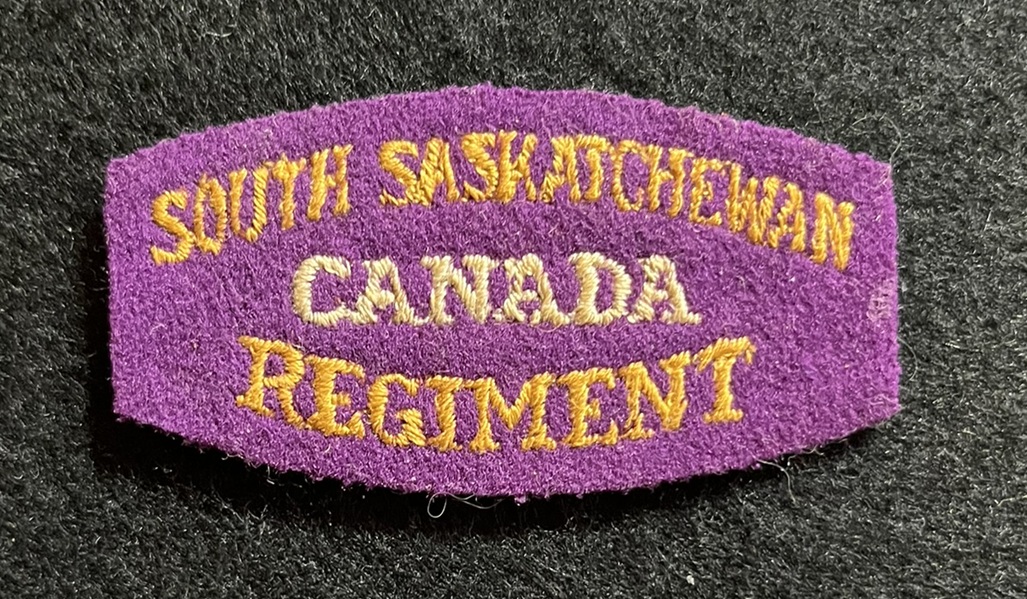  One. South Saskatchewan Regiment Second World War embroidered shoulder title. Adopted in 1942 (see Bill Alexander's Fabric of War pp. 135-139). Some glue and paper residue on reverse. One. South Saskatchewan Regiment Second World War embroidered shoulder title. Adopted in 1942 (see Bill Alexander's Fabric of War pp. 135-139). Some glue and paper residue on reverse. VF Condition $75 |
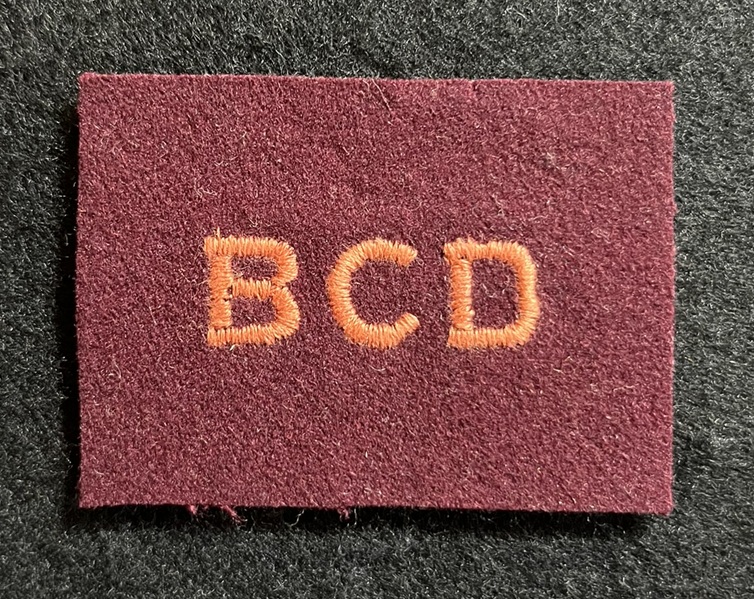 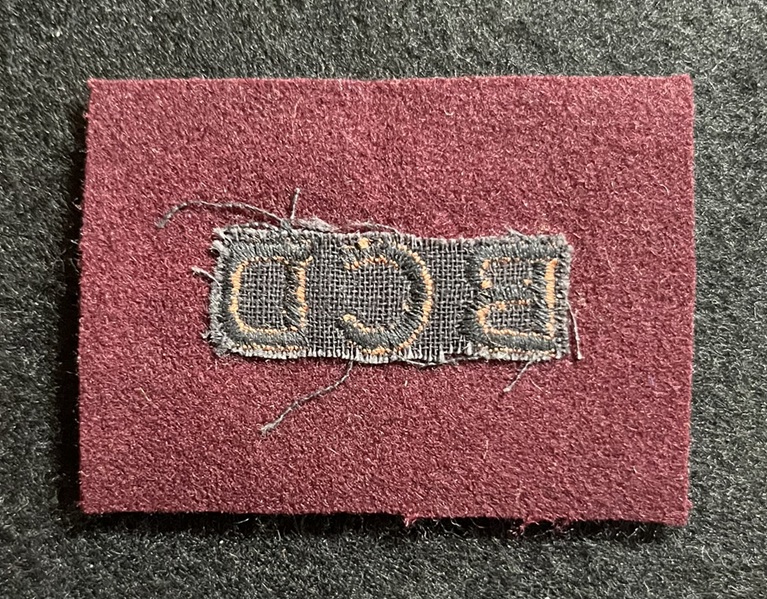 One. British Columbia Dragoons Second World War embroidered 5th Division formation patch. Adopted in 1940 (see Bill Alexander's Fabric of War p. 78). Clean with undamaged reverse. One. British Columbia Dragoons Second World War embroidered 5th Division formation patch. Adopted in 1940 (see Bill Alexander's Fabric of War p. 78). Clean with undamaged reverse. VF Condition $150 |
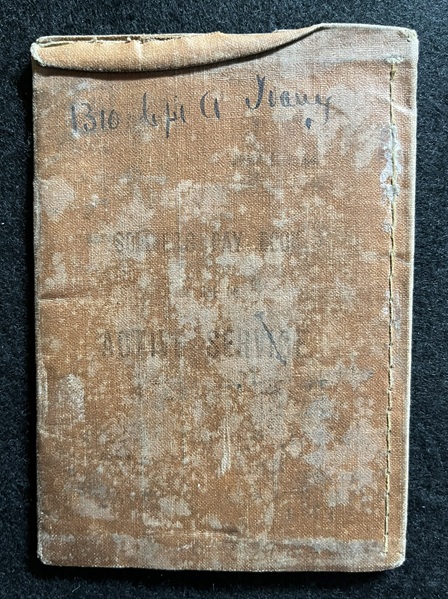 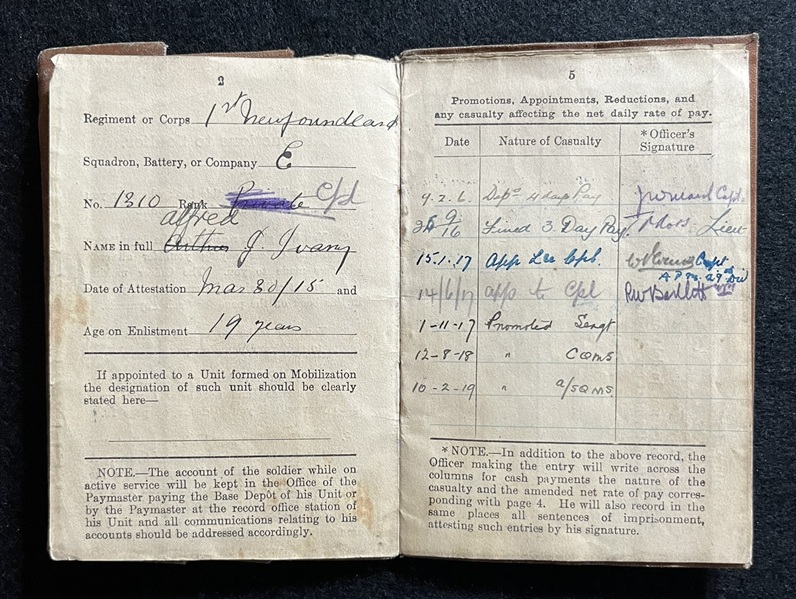 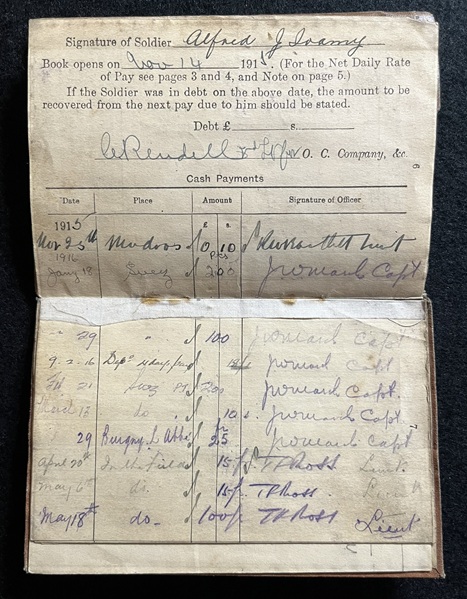 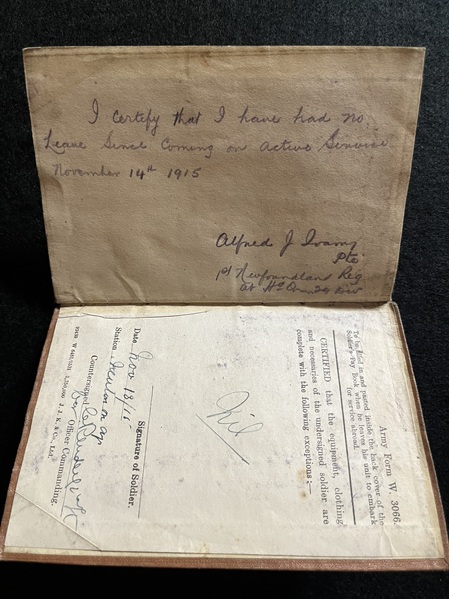 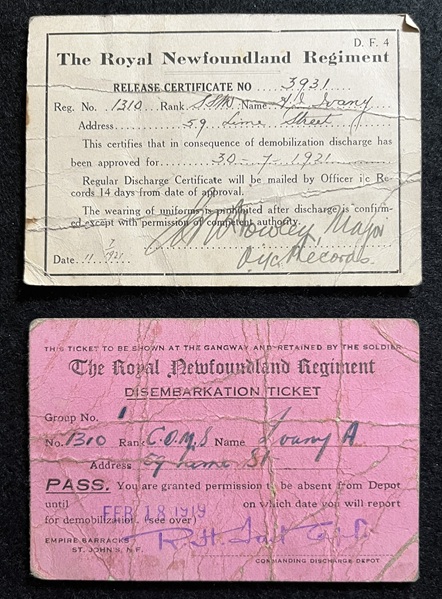 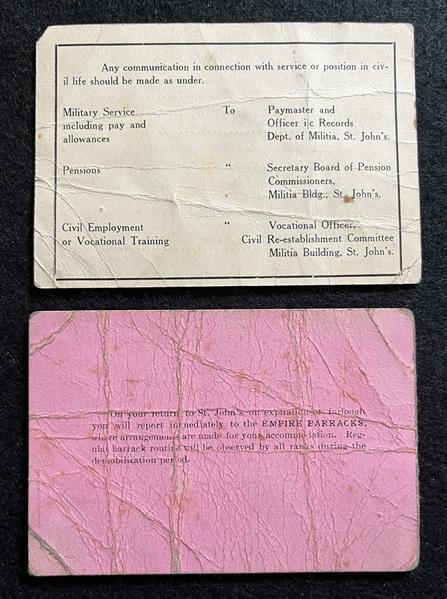 Three. A First World War paybook to 1310 Corporal/CQMS Corporal Alfred J. Ivany, Royal Newfoundland Regiment. Accompanied by a card Disembarkation Ticket and an original card Release Certificate named to Ivany, dated 30 July 1921. Alfred James Ivany attested into the First Newfoundland Regiment at the age of 19 on 4 March 1915. He served at Gallipoli and in France. Ivany was married in England on 12 November 1918, just after the armistice, and he continued his service after war's end, being employed in a clerical capacity in England and in Newfoundland. Alfred Ivany died in St. John's, Newfoundland on 6 August 1979. Some very scarce paper ephemera attributed to a member of the Royal Newfoundland Regiment. Three. A First World War paybook to 1310 Corporal/CQMS Corporal Alfred J. Ivany, Royal Newfoundland Regiment. Accompanied by a card Disembarkation Ticket and an original card Release Certificate named to Ivany, dated 30 July 1921. Alfred James Ivany attested into the First Newfoundland Regiment at the age of 19 on 4 March 1915. He served at Gallipoli and in France. Ivany was married in England on 12 November 1918, just after the armistice, and he continued his service after war's end, being employed in a clerical capacity in England and in Newfoundland. Alfred Ivany died in St. John's, Newfoundland on 6 August 1979. Some very scarce paper ephemera attributed to a member of the Royal Newfoundland Regiment. Good VF Condition $400 |
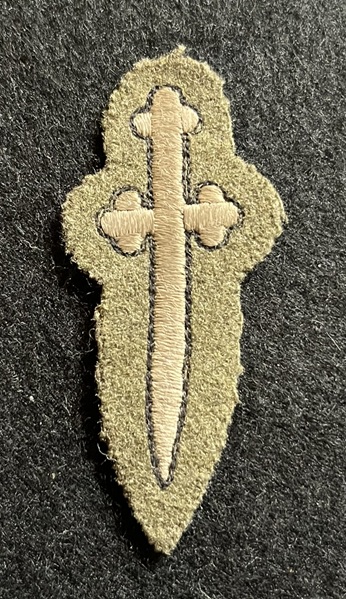  One. Second World War era 2nd Canadian Army Tank Brigade Formation Badge. Worn by members of this formation in Canada from July 1942 - 1943. Shows evidence of wear, but clean and undamaged. One. Second World War era 2nd Canadian Army Tank Brigade Formation Badge. Worn by members of this formation in Canada from July 1942 - 1943. Shows evidence of wear, but clean and undamaged. VF Condition $100 |
  Two. A pair of 85th Battalion Canadian Expeditionary Force (Nova Scotia Highlanders) collar badges. Babin E - 85. Matched pair in brass with original lugs. No maker's mark. Good VF Condition $175 |
 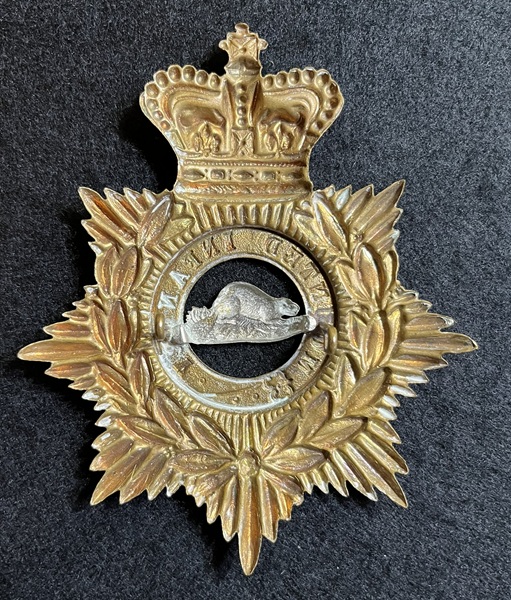 One. Mounted Infantry School Helmet Plate c. 1885. Brass with silvered beaver centre. Original lugs. Mazeas Reference HP.44. This helmet plate was worn by members of the Mounted Infantry School in Winnipeg, Manitoba. This short-lived units members were re-designated the Canadian Mounted Rifle Corps in 1891, before being amalgamated with the Raoyal Canadian Dragoons, becoming B Squadron of the latter unit in 1892. A very rare early helmet plate worn by some of the first members of Canada's Permanent Force. Good VF Condition $1250 |
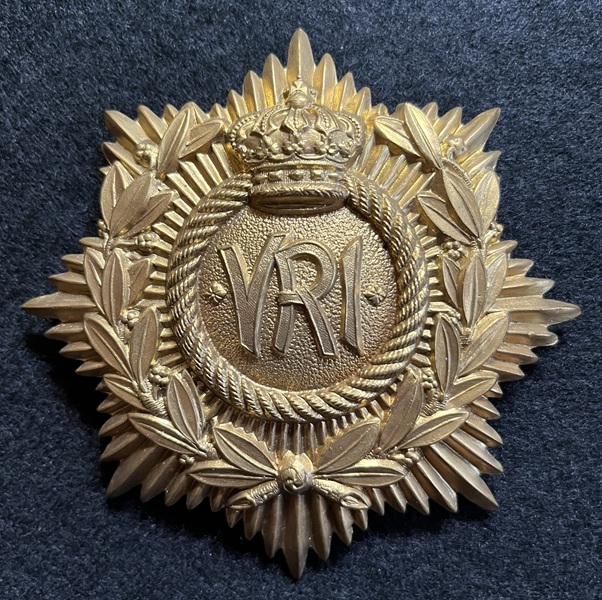  One. Royal Canadian Regiment Victorian Helmet Plate c. 1894. Mazeas # HP.71. Bright brass finish with original lugs. EF Condition $475 |
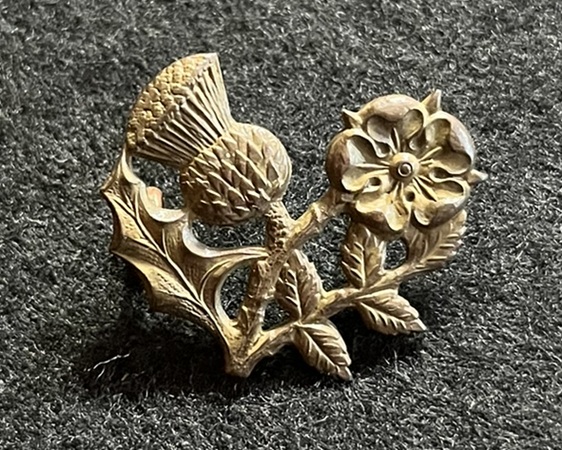  One. Collar - Annapolis Regt. c. 1924. Mazeas #105. No maker's mark. Bronze finish with original lugs. Good VF Condition $75 |
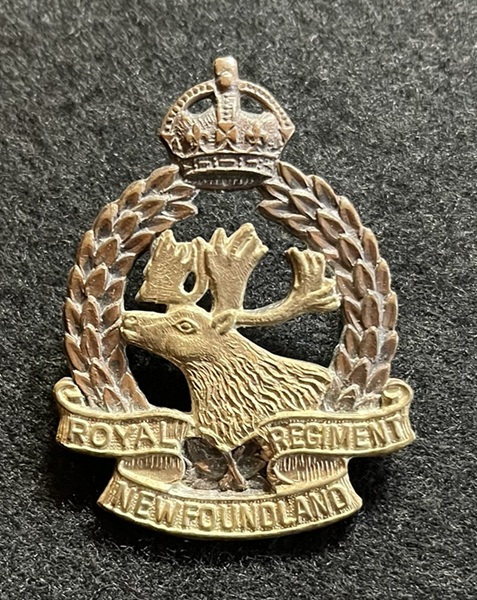  One. Royal Newfoundland Regiment bi-metal cap badge c.1949. Mazeas #179. No maker's mark. Darkened bronze finish with white metal overlay and original lugs. VF Condition $180 |
 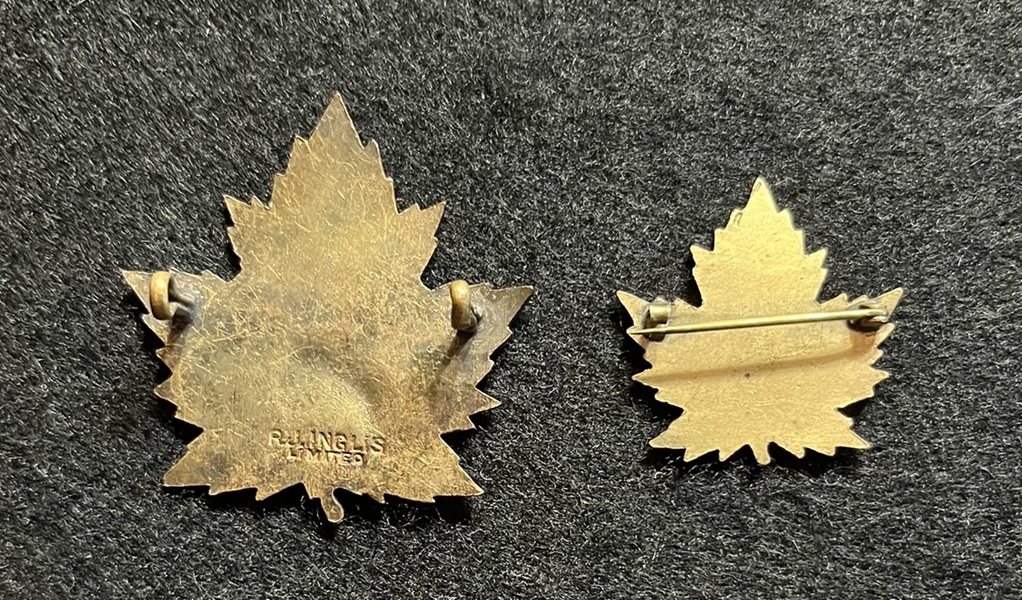 Two. A 6th Canadian Mounted Rifles cap badge and single collar badge. Babin B4-6. Both badges have a pickled finish and flat back. The cap badge is maker marked R J Inglis Limited, and has its original lugs. The collar has no maker nark and is fitted with a pin fastener. Good VF Condition $150 |
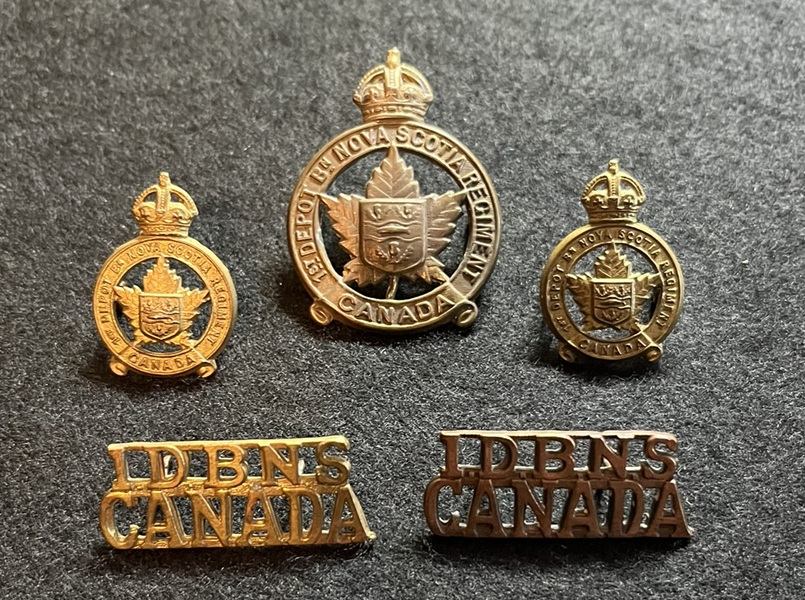  Five. 1st Nova Scotia Depot Regiment cap badge, pair of collar badges, and pair of shoulder titles. Babin 38-1. All with original lugs. No maker's mark. Good VF Condition $250 |
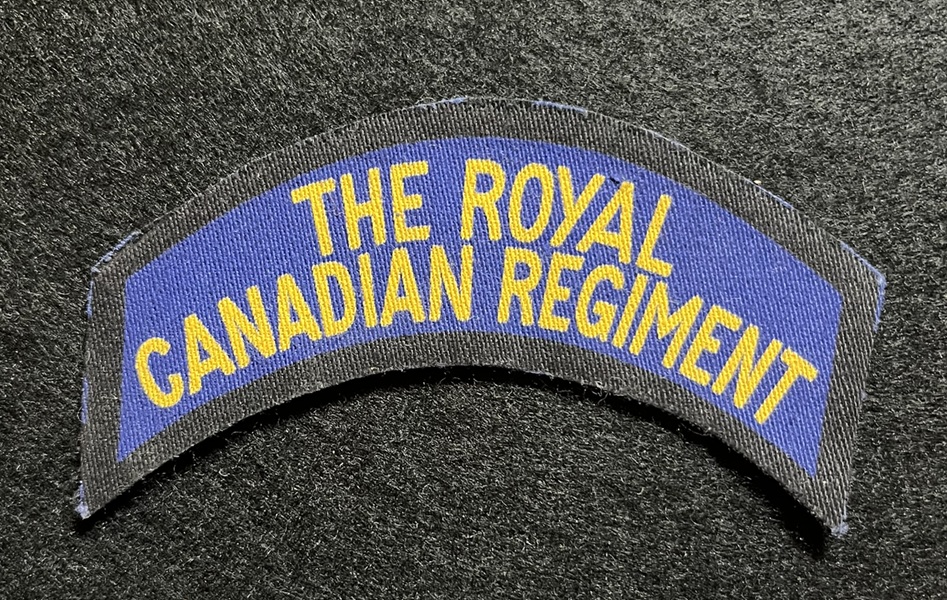  One. A Royal Canadian Regiment Second World War printed shoulder title. Unused with clean back. Good VF Condition $200 |
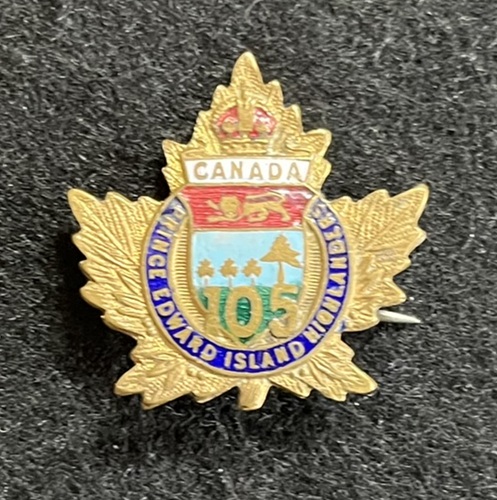  One. 105th (Prince Edward Island) Battalion sweetheart pin in brass with enamel detailing. No maker mark. Pin on reverse is intact but prong of 'c' catch is broken off. Good VF Condition $75 |
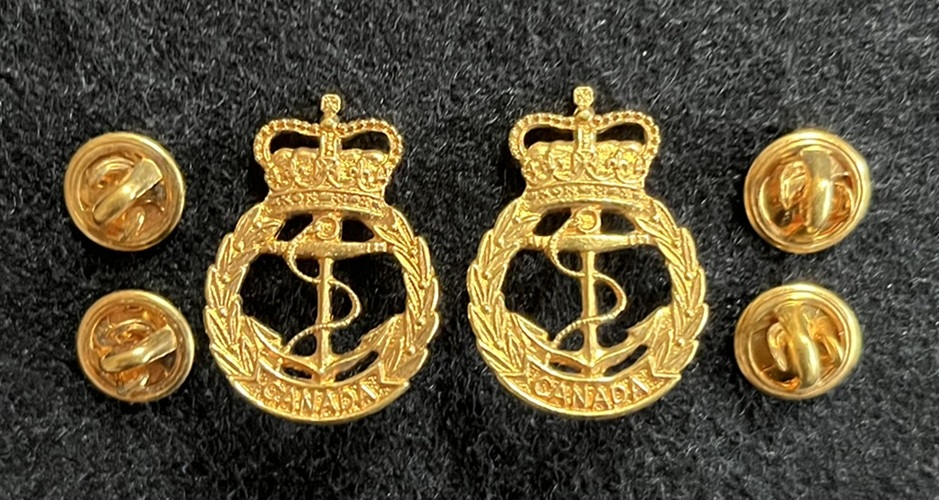 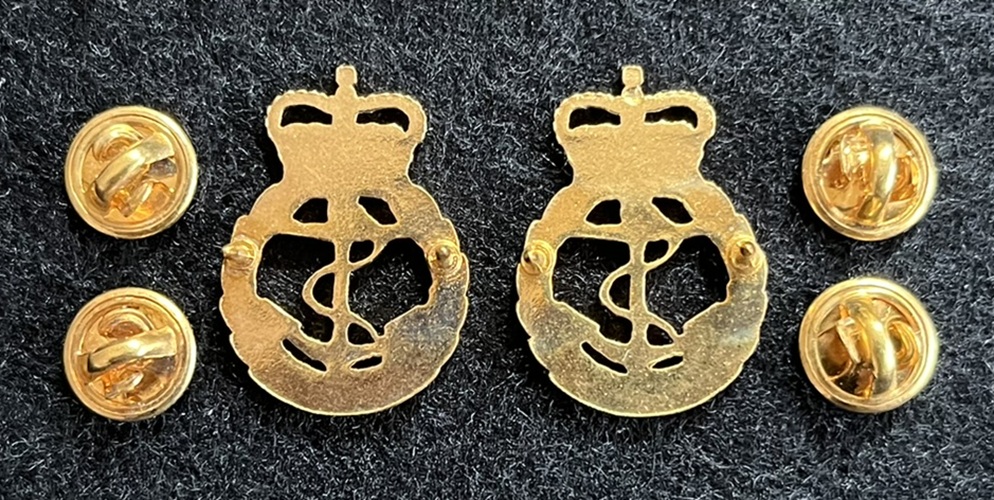 Two. A pair of early Canadian Armed Forces Naval collar badges in gilt with pin back fittings. These insignia were produced at the time of unification of the Royal Canadian Navy, Canadian Army and Royal Canadian Air Force into the newly created 'Canadian Armed Forces' in 1967-1968, and were only worn for a brief period. A very scarce set of early CAF insignia. Good VF Condition $80 |
 One. CEF Death Certificate. Named to 733669 Private Herman Wesley Roy, Royal Canadian Regiment, who was killed in action on 31 October 1917. Roy has no known grave, and is commemorated on the Commonwealth War Graves Commission's Menin Gate, Ypres, Belgium. Good VF Condition $100 |
  One. A 3rd Victoria Rifles of Canada cap badge c. 1862. Mazeas MM.31. Approximately 3" tall x 2 3/4" wide. Two original lugs to reverse, with some wear to black paint finish as can be seen in photos, but otherwise... VF Condition $95 |
     One. A Lord Strathcona's Horse (Royal Canadians) brass ceremonial dress helmet with King's Crown helmet plate. This style of helmet was adopted by Lord Strathcona's Horse (RC) in 1911. This helmet is an older example, but has had a new liner added, as is typical given that they have continued to worn by members of the unit on ceremonial occasions, and by the unit's Ceremonial Mounted Troop, to this day. One small dent to rear (see photos), and some curling/shrinkage of the green leather on the inside peak of the helmet. Good VF Condition $1500 |
  One. A 3rd Victoria Rifles of Canada Victorian helmet plate c. 1879-1904. Mazeas SBP-80. Good VF Condition $275 |

| What's New! | About Us | Terms of Sale | Commonwealth Medals | Militaria | Books | Research Corner | Medal Finder | Links | Home |